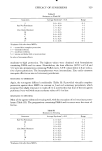
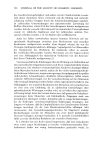
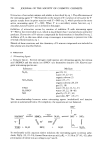
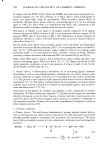
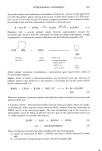
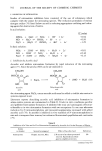
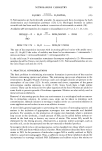
NITROSAMINE CHEMISTRY 591 amines is indicated by the following data gathered for reaction of a ratio of 5 mol NaNO2/mol amine at 78øC and pH 5.6 for 4 hr (73). Amine % Yield of (CHa)2NNO (CHa)2NH 9.6 (CHa)aN 0.9 (CHa)4N + 0.6 (CHa)2NCH=CH=OH 1.6 (CHa)aN + CH= CH=OH 0.0002 Several naturally occurring quaternary ammonium compounds were found to be much less reactive than the tetramethylammoniurn ion (73). The tribenzylmethylarnmoniurn ion is reported to be unreactive under similar conditions (68). No nitrosation of 10 -a M hexadecyltrimethylammonium bromide by a 20-fold excess of nitrite at 25øC and pH 3.5 was observed after 40 min (44). Tertiary amine oxides in the presence of excess nitrite at pH 1 to 3 and temperature 25 to 75øC are converted to secondary nitrosamines to a greater extent than are tertiary amines (74). However, at 90 to 100øC and pH 4 to 5 both classes show similar reactivity (68, 70, 74). Two mechanisms that account for the change in relative reactivity with conditions have been proposed (70, 74). e. Secondary and Tertiary Amides. For secondary amides, as with amines, the nitrosation condition most widely investigated has been nitrite in aqueous acid. N-Alkyl ureas and carbamates are rapidly nitrosated at pH 1 to 2. The nitrous acidium ion is the main nitrosating agent for these and other amides (eq 16) and the reaction rate follows eq 17 (23, 39, 40). ZNHR + H2ONO + -- ZN(NO)R + H=O + H + (16) rate = k[ZNHR] [HNO=] [H +] (17) The reaction rate increases about ten times for each 1-unit drop in pH from 3 to 1 and does not show a pH maximum. At pH 2.5 nitrosation by NzOa contributes (39). In acidic aqueous media nitrogen substrates decrease in propensity toward nitrosation in the order 2-imidazolidone acyclic N-alkylurea N-arylurea N-alkylcarba- mate less basic dialkyl and secondary aromatic amines (pK• 9) and tertiary eneamines more basic dialkyl amines N-alkylamides, N-acylureas, N-alkylgua- nidines and tertiary amines (23). High yields of nitrosamides are obtained from reactions of amides with N=Oa (2) or SgO4 (28) in organic solvents. However, N-methylacetamide in aqueous solution at pH 13 does not react with added SzO4, conditions under which secondary amines are rapidly nitrosated (27). Apparently the weakly basic amide is too unreactive to compete with hydrolysis of the nitrosating agent. Nitrosation of tertiary amides in acidic aqueous solutions of nitrite at high concentra- tions and temperatures produce either nitrosamides or nitrosamines (23, 70, 75). Ni- trosation of trialkylureas gives the corresponding nitrosoureas. Dialkylnitrosamines are the major product from dialkyl- or trialkylthioureas, 1,1-dialkylureas, 1,1-dialkyl- 3-phenylureas and tetraalkylureas.

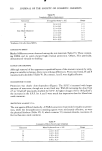
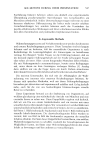
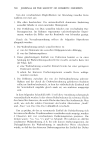
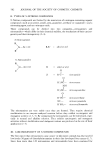
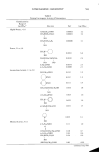
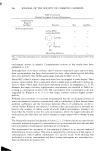
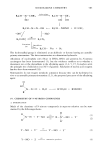
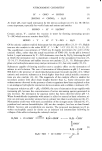
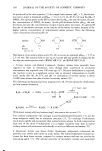
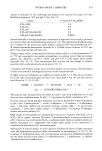
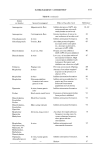
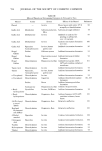
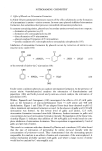
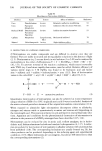
592 JOURNAL OF THE SOCIETY OF COSMETIC CHEMISTS C. INHIBITION OF NITROSATION Studies of nitrosamine inhibition have consisted of the use of substances which compete with the amine for nitrosating species. The reduction potentials of various nitrogen oxides (76) listed below can aid in selecting appropriate oxidizing and reduc- ing agents for destruction of nitrite. In acid solution: E ø (volts) HNO2 + H20 • NOa- + 3H + + 2e- -0.94 NO + H20 ,-• HNOz + H + + e- -0.99 NzO + 3HzO • 2HNOz + 4H + + 4e- -1.29 In basic solution: NO2- + 2OH- • NOa- + HzO + 2e- -0.01 NO + 2OH- • NOz- + HzO + e- +0.46 NzO + 6OH- • 2NO2- + 3HzO + 4e- -0.15 i. Inhibition by Ascorbic Acid Ascorbic acid inhibits nitrosamine formation by rapid reduction of the nitrosating agent (77). Since the product NO can be air-oxidized to CH2OH CH2OH I HO C•_O_x•O HOCH /O O __ + N2Oa •- -•O + 2NO + H•O (18) HO OH Ascorbic Dehydroascorbic acid acid the nitrosating agent $204, excess ascorbic acid must be added to inhibit nitrosation in systems exposed to air. Literature reports describing ascorbic acid inhibition of nitrosamine formation in amine-nitrite systems are summarized in Table II. Under in vitro conditions ascorbic acid inhibited nitrosamine formation. It inhibited the toxic and carcinogenic effects at- tributable to in vivo nitrosamine formation with two exceptions. In one case adenoma induction by N-nitrosomorpholine and mononitrosopiperazine increased with added ascorbic acid (78). In another it inhibited in vivo synthesis of N-nitrosomorpholine in rats and consequent liver tumors, but enhanced forestomach papillomas and carcinoma (79). Table II Inhibition of In Vitro and In Vivo Nitrosamine Formation by Ascorbic Acid in the Presence of Nitrite (or Amide) System Investigated Effect of Ascorbic Acid Reference Aminopyrine Hepatic necrosis, Mice 2 M excess of ascotbate prevented 80 necrosis. Equimolar ascotbate gave incomplete protection. continued on p 593
Purchased for the exclusive use of nofirst nolast (unknown)
From: SCC Media Library & Resource Center (library.scconline.org)