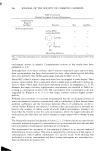
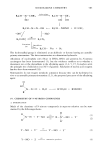
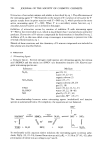
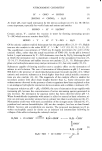
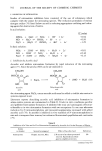
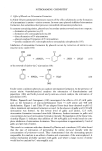
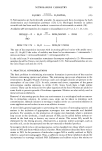
NITROSAMINE CHEMISTRY 599 reduction R2NNO R2NHNHz (26) N-Nitrosamides are hydrolytically unstable. In aqueous acid they decompose by both denitrosation and deamination pathways (120, 121). Hydrogen bromide in carbon tetrachloride has been used for synthetic conversion of nitrosamide to amide (28). At alkaline pH nitrosamides decompose to diazoalkanes (eq 27) (2, 4, 17, 23, 122). OH RCH2N--Z + H20 ) RCH2NHNO + ZOH (27) l RCH•N=N + H20 RCH2N=NOH The rate of decomposition increases with increasing pH and varies with amide struc- ture (2). At pH 9 the order of stability was found to be nitrosourea nitrosamide nitrosourethane nitrososulfonamide nitrosoguanidine (2). In the solid state N-nitrosamides sometimes decompose explosively (2). Nitrosourea samples should be frozen, not merely refrigerated (123). Nitrososulfonamides are sta- ble only if kept cool and dry (124). V. PRACTICAL CONSIDERATIONS The basic problem in minimizing nitrosamine formation is prevention of the reaction between nitrosating species and amines. The nitrosating species are ubiquitous in the environment. Roughly 50 ppb of nitrous oxide and nitrogen dioxide are present in the atmosphere of our cities (125). In soils, streams and rivers, organisms of the genus nitrosomonas oxidize ammonia to nitrite (126). Some foods have a high nitrate content. These can be reduced in vivo after ingestion of the food. Nitrites are added to some foods to prevent growth of botulinus organisms. Nitrites are also widely used as metal corrosion inhibitors. Removal of nitrosating species from our environment is a sociological task not amena- ble to immediate solution. In certain cases, steps can be taken to minimize such contamination. Already industry is moving to replace nitrite as a corrosion inhibitor in some applications and reduce its use as an additive in meat. A more likely general approach to preventing the reaction of nitrosating species and amines is the inclusion of appropriate scavengers into raw materials and finished products. For example, in the production of organic raw materials, where a nitration step occurs in the synthesis, a small amount of SO2 can be added before solvent re- moval in the final step to destroy any traces of nitrite. The excess SO2 would be eliminated by the drying process. Alternatively, a nontoxic nitrite scavenger, such as ascorbic acid, can be incorporated into the raw material or finished product. Scavengers which reduce nitrosating species can be classified into those which convert nitrite to NO and those which reduce it further. Most inhibitors described here reduce nitrite to NO. In the presence of molecular oxygen NO is readily oxidized to N204 which is a good nitrosating agent. Thus, a sufficient excess of these inhibitors should be incorporated to scavenge oxidized NO. Sulfamates and sulfites reduce the nitrites to

600 JOURNAL OF THE SOCIETY OF COSMETIC CHEMISTS N2 and N20, respectively, which are not reoxidized by molecular oxygen. These in- hibitors are not as innocuous as some of the weaker reducing agents, however. Cosmetics are frequently in the form of emulsions. Mirvish has shown that lipids readily extract nitrosating species from water. Under these conditions, nitrosation reactions are very fast. Since amines are also more soluble in the oil phase of emul- sions, it is appropriate to incorporate oil soluble inhibitors, such as ascorbyl palmitate and g-tocopherol, into such products for maximum inhibition of nitrosamine forma- tion. REFERENCES (1) T. Y. Fan, U. Goff, L Song, D. H. Fine, G. P. Arsenault and K. Biemann, N-Nitrosodiethanolamine in cosmetics, lotions and shampoos, Food Cosmet. Toxicol., 15,423 (1977). (2) H. Druckrey, R. Preussmann, S. Ivankovic, D. Schmlihl, J. Afkham, G. Blum, H. D. Mennel, H. Mfiller, P. Petropoulos and H. Schneider, Organotrope carcinogene Wirkungen bei 65 verschiedenen N-Nitroso-Verbindungen an BD-Ratten, Z. Krebsforsch., 69, 103 (1967). (3) H. Druckrey, Chemical carcinogenesis on N-nitroso derivatives, GANN Monogr. Cancer Res., n. 17, 107 (1975). (4) P. N. Magee, R. Montessano and R. Preussman, N-Nitroso Compounds and Related Carcinogens, in C. E. Searle, "Chemical Carcinogens" (ACS Monograph 173), The American Chemical Society, 1976, pp 491-625. (5) P. N. Magee andJ. M. Barnes, Carcinogenic N-nitroso compounds, Adv. Cancer Res., 10, 163 (1967). (6) P. N. Magee andJ. M. Barnes, The production of malignant primary hepatic tumors in the rat by feed- ing dimethylnitrosamine, Br. J. Cancer, 10, 114 (1956). (7) Later studies showed that as little as 2 to 5 ppm fed over a lifetime produced liver tumors (8). (8) B. Terracini, P. N. Magee and J. M. Barnes, Hepatic pathology in rats on low dietary levels of dimethylnitrosamine, Br. J. Cancer, 21,559 (1967). (9) C. L. Walters, Nitrosamines--environmental carcinogens?, Chem. Br., 13,140 (1977). (10) Another analysis of nitrosamine carcinogenicity is presented by Druckrey et al. (2). They show that the total dose required for carcinogenesis in rats becomes smaller with decreasing daily doses and longer induction times. The log of the induction time is directly proportional to the log of the daily dose, ruling out a recovery process. They conclude that ihe carcinogenic effect is due to a summation of irreversible primary effects. (11) J. S. Wishnok, M. C. Archer, A. S. Edelmann and W. M. Rand, Nitrosamine carcinogenicity: a quanti- tative Hansch-Taft structure-activity relationship, Chem. Biol. Interact., 20, 43 (1978). (12) M. Greenblatt and W. Lijinsky, Carcinogenesis and chronic toxicity of nitrilotriacetic acid in Swiss mice, J. Nat. CancerInst., 52, 1123 (1974). (13) J. S. Wishnok and M. C. Archer, Structure-activity relationships in nitrosamine carcinogenesis, Br. J. Cancer, 33,307 (1976). (14) W. Lijinsky, How nitrosamines cause cancer, New Sci., 27, 216 (1977). (15) D. Seebach and D. Enders, Umpolung of amine reactivity. Nucleophilic a-(secondary amino)-alkyla- tion via metalated nitrosamines, Angew. Chem. Int. Ed. EngL, 14, 15 (1975). (16) J. E. Baldwin, S. E. Branz, R. F. Gomez, P. L. Kraft, A. J. Sinskey and S. R. Tannenbaum, Chemical ac- tivation of nitrosamines into mutagenic agents, Tetrahedron Lett., 333 (1976). (17) J. Venulet and R. L. Van Etten, Biochemistry and Pharmacology of the Nitro and Nitroso Groups in H. Feuer, "The Chemistry of the Nitro and Nitroso Groups," Part 2, Wiley Interscience, New York, New York., 1970, Chapter 4, pp 201-287. (18) B. Singer, All oxygens in nucleic acids react with carcinogenic alkylating agents, Nature, 264, 333 (1976). (19) B.C. Challis and A. R. Butler, Substitution at an Amino Nitrogen in S. Patai, "The Chemistry of the Amino Group," Wiley Interscience, New York, New York, 1968, Chapter 6, pp 277-345. (20) G. B. Neurath, M. Dfinger and F. G. Pein, Nitrosation of Nornicotine and Nicotine in Gaseous Mix- tures and Aqueous Solutions, in E. A. Walker, P. Bogovski and L. Griciute, "Environmental N-Ni- troso Compounds: Analysis and Formation," IARC Scientific Publications no. 14, International Agency for Research on Cancer, Lyon, France, 1976, pp 227-236.
Purchased for the exclusive use of nofirst nolast (unknown)
From: SCC Media Library & Resource Center (library.scconline.org)