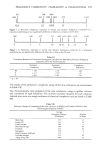
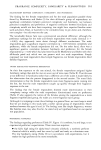
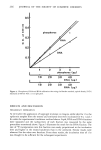
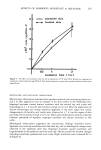
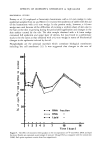
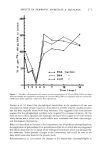
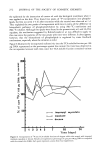
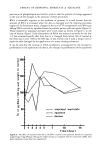
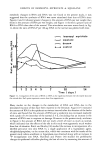
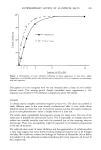
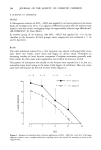
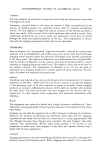
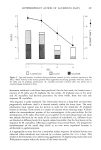
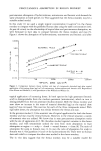
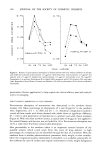
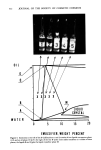
EFFECTS OF ISOPROPYL MYRISTATE & SQUALANE 273 precursors of phospholipids and nucleic acids so that the pattern of change appeared as the sum of the changes in the amounts of these precursors. RNA is essentially requisite to the synthesis of proteins. It is well known that the amount of RNA is increased when the skin is damaged and the repairing processes begin (14). In the present study, changes in the rate of 32p incorporation into RNA per 100 •g DNA induced by squalane showed a periodic pattern with two peaks (Figure 5). Those induced by isopropyl myristate were much larger as shown in Figure 6. In the case of decane (Figure 7), the biosynthesis of RNA was reduced markedly for the first 3 d, but increased rapidly after that that is, it changed from below 10% of normal at the third day to over 150% at the fifth day. It was evident that it took a longer time to repair the skin damaged by the application of a more irritating substance. It can be said that the increase in DNA synthesis is accompanied by the increase in proliferation in the epidermis (14) that is, the changes in proliferation of the epidermis 200 ß 150 g lOO isOpropyl myristate • = squalane - • decane 50 4 6 7 10 14ß • 0•0 ß ß ß . . ß : . Ti me (days) Figure 9. The effect of treatment with oils on the RNA content in the epidermis. Results are expressed as •rcentage of •g RNA per • mg wet weight of tissue as compared with the normal skin (•%). Each point represents a mean from four experiments.

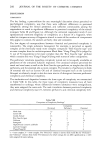
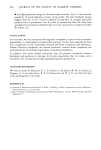
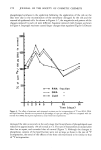
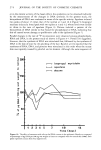
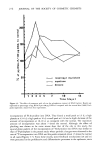
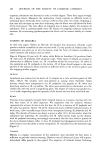
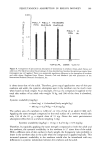
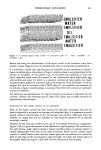
274 JOURNAL OF THE SOCIETY OF COSMETIC CHEMISTS or in the mitotic activity of the basal cells in the epidermis can be observed indirectly by the measurement of the changes in DNA synthesis. In the present study, the biosynthesis of DNA was evaluated in terms of the specific activity. Squalane induced two peaks of about 1.5 times that of the normal at 3 and 10 d (Figure 5). Isopropyl myristate induced a broad peak with two spikes at 3 and 5 d, whose levels were similar to those in the case of squalane (Figure 6). Decane induced a pattern of the biosynthesis of DNA similar to that found for phospholipid or RNA, indicating that this oil caused severe damage to proliferative cells in the epidermis (Figure 7). Parallel changes in the rate of •2p incorporation were observed among phospholipids, RNA and DNA, in the present study as shown in Figures 5-7. Potten (15) suggested, however, that the synthesis of RNA was stimulated first, followed by the synthesis of DNA in the skin of mice by the plucking of the hair. Baird et al. (16) reported that the syntheses of RNA, DNA, and proteins were stimulated in this order when the mouse skin was topically treated by phorbol and its diesters. Although the same sequence of = 200 E o o ß ? 150 E o 100 z 50 o o o isopropyl u [] squalane • • decane myristate 1 2 34 5 7 10 14 Time (days) Figure 10. The effect of treatment with oils on the DNA content in the epidermis. Results are expressed as percentage of •tg DNA per 100 mg wet weight of tissue as compared with the normal skin (100%). Each point represents a mean from four experiments.
Purchased for the exclusive use of nofirst nolast (unknown)
From: SCC Media Library & Resource Center (library.scconline.org)