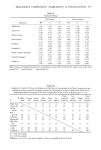
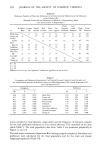
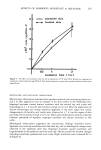
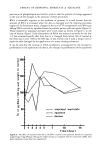
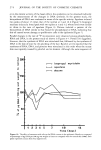
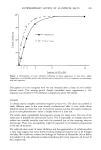
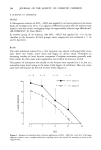
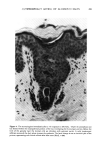
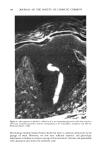
ANTIPERSPIRANT ACTION OF ALUMINUM SALTS 285 Comment The long duration of anhidrosis is in general accord with the observations of previous investigators (6, ! 7,19). Assuming a physical block in the ducts, its removal is likely accomplished by the process of epidermopoiesis the epidermis renews itself by constant proliferative activity. The time required to replace the stratum comeurn on the forearm and back is about two weeks, while renewal of the whole epidermis takes about a month. Since suppression persisted for up to four weeks, the obstruction would have to extend through the entire intra-epidermal portion of the duct. This interpretation is concor- dant with the stripping experiments which will now be described. STRIPPING Papa & Kligman (21) distinguished 'thigh-level blockade," induced by strong tissue reactants such as formaldehyde and trichloracetic acid, on the basis that Scotch-tape stripping would instantly relieve the anhidrosis. Histologic study showed a precipitate in the sweat pores. This high-level obstruction was demonstrated also for glutaralde- hyde by Gordon & Maibach (22). By contrast, both pairs of workers failed to restore sweating by stripping aluminum treated sites. This implied a block below the level of the stratum comeurn. The observations of Hunziker et al. (12) are not quite in agreement since stripping resulted in a variable pattern of sweat restoration. Accord- ingly, the matter was restudied with greater care. Method Anhidrosis was induced at four sites on the forearms of six volunteers by 3-hr chamber exposures to 20% AIC13 ß 6H20. One site was left as a control. A second was stripped to the glistening layer 24 hr after exposure as gently as possible (sharp stripping produces an exudative, inflammatory reaction which itself can interfere with sweating for some days). The third and fourth sites were stripped on the 7th and 14th day, respectively. In each instance sweat suppression was estimated immediately after stripping. Reslilts The unstripped sites behaved as before with a slight decrease in anhidrosis at 7 days. Thereafter, sweating gradually increased and was restored to the original level by about three weeks. Stripping one day after the exposure had no effect whatever in relieving the anhidrosis. However, the duration of anhidrosis was shortened. Seven days after the stripping, hypohidrosis was about !0% less than the control and by 14 days approximately 20% less. Though not great, these changes were consistent. The sites stripped 7 days after exposure were questionably affected, there being perhaps a 5% increase in the proportion of active units. Sites stripped !4 days after the exposure showed only a slight relief of sweat suppression. Comment Stripping performed a day after establishing anhidrosis did not result in sweating. No formerly closed ducts became patent. When stripping was delayed 7 to !4 days after

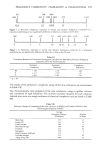
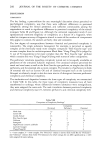
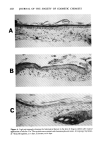
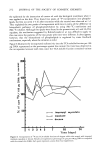
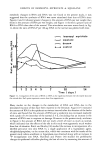
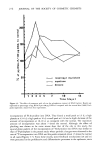
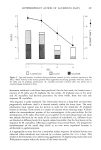
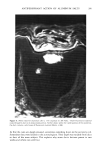
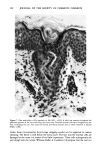
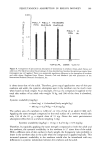
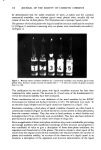
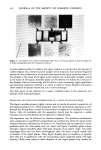
286 JOURNAL OF THE SOCIETY OF COSMETIC CHEMISTS exposure, anhidrosis was lessened to only a modest degree. These facts argue strongly for a deep block. Moreover the obstruction clearly extends to different levels in individual ducts. Normally there is about a 50% recovery after two weeks. Stripping at that time did not open up new ducts indicating that the block was still below the level of the horny layer. The only effect of stripping was to lessen slightly the duration of anhidrosis. This is understandable since the trauma of stripping enhances epidermal turnover. By accelerating epidermopoiesis the block will be moved distally at a faster rate. STUDIES OF MILIARIA In their first paper, Shelley & Horvath (6) showed that aluminum chloride could produce miliaria crystallina. In their second work (7), they produced miliaria rubra. No explanation was given as to why the lesions took the form of millaria crystallina in some instances and miliaria rubra in others. Papa & Kligman (9) saw only M. rubra, while Relier & Luedders (14) produced both M. rubra and M. profunda with aluminum salts. These types of miliaria are related to obstruction at different levels, viz., M. crystallina within the horny layer, M. rubra in the epidermis and M. profunda in the dermis. All of these should appear in the same persons if the aluminum block extends to different levels as the recovery pattern and the stripping studies suggest. METHOD Anhidrosis was induced on the backs of 12 subjects by a 24-hr occlusive patch of 20% AIC13 ß 6H20. The subjects were heat-stressed at varying times thereafter. Small discrete wheals were interpreted to be M. profunda, tiny papules as M. rubra and dew-drop vesicles as M. crysta//ina. The latter were sometimes so diminutive as to be visible only with the aid of a magnifying glass. The degree of miliaria was graded on a 1 to 4 scale, depending upon the quantity of the lesions and not their individual size. Results Thermal stress regularly brought forth miliarial lesions in everyone, starting with the first heat stress 24 hr after exposure. We emphasize that the subjects sweated vigorously for at least 30 min in the hot box. At 24 hr, a mixture of M. profunda and M. rubra was present. About 75% of the obstructed ducts exhibited miliarial lesions. A week later, a few crystallina-type lesions were interspersed among M. profunda and M. rubra. The density of lesions was about as great as after 24 hr. At two weeks, when the anhidrosis was subsiding, M. crystallina and M. rubra lesions made up the display, with M. profunda becoming increasingly uncommon. By this time, about a quarter of the ducts showed miliaria. After 21 days, M. profunda had disappeared entirely and M. rubra lesions were decidedly a minor component M. crystallina was the dominant type (Figure 3). Comment Miliaria is a regular concomitant of the anhidrotic state provided the heat stress is sufficient to provoke intense sweating. However not all obstructed ducts will rupture. Individuals differ greatly in this regard. The sequence of miliarial lesions following
Purchased for the exclusive use of nofirst nolast (unknown)
From: SCC Media Library & Resource Center (library.scconline.org)