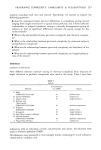
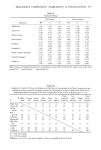
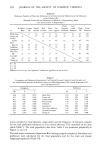
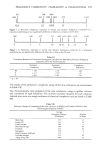
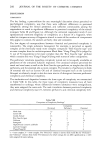
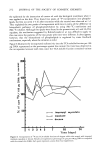
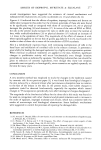
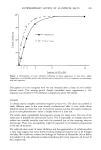
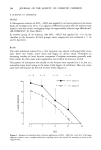
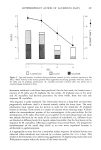
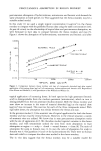
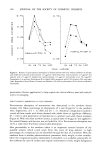
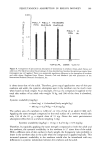
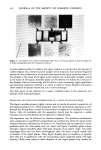
FRAGRANCE COMPLEXITY, FAMILIARITY & PLEASANTNESS 259 .012 .5oo .644 .000 I .499 [ .656 I ]682 .879 1.312 GA EC BDF H I __ _ Figure 1 a. Perceived complexity, expressed in normal unit deviates. Substances connected by a horizontal underlining are not significantly different all others are, at least at the 5% level. .000 .300 .479 .711 .868 .911 1.024 1.145 1,349 F I C H BG E A D Figure 1 b. Preference, expressed in normal unit deviates. Substances connected by a horizontal. underlining are not significantly different all others are, at least at the 5% level. Table VI Correlations Between the Dimensions Investigated, Calculated for Male (M) and Female (F) Subjects Separately and for the Total Group (T) Familiarity - Familiarity - Complexity - Complexity Preference Preference M +.383 + .276 --.667 • F +.117 +.7171 -.217 T +.021 +.583 --.563 .05. The results of the perfumers' complexity rating of the nine substances are summarized in Table VII. Gas chromatograms were prepared of the nine substances, using a capillary column and conditions of high resolution. The number of peaks obtained for each odorous material may serve as a rough indicator of chemical complexity and are listed in Table VII. Table VII Perfumers' Ratings of Complexity [Scale from 1 (Low) to 10 (High)], and Number of Peaks in Gas Chromatogram (Capillary Column) Average Complexity Rating-- Number 8 Perfumers of Peaks Musk base 5.75 12 Lemon Oil 2.63 20 Linalyl acetate 2.00 6 Rive Gauche type 7.88 49 Goldrose 5.75 20 isoeugenol 3.50 9 Hexyl Cinnamic Aldehyde 3,25 3 Lavender bouquet 5.13 26 Ylang-Ylang Oil 6.00 32

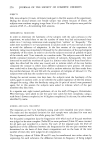
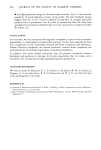
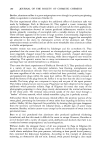
260 JOURNAL OF THE SOCIETY OF COSMETIC CHEMISTS DISCUSSION COMPLEXITY The key finding, a precondition for any meaningful discussion about perceived or psychological complexity, was that there were sufficient differences in perceived complexity among the stimuli presented, and sufficient communality among the respondents to result in significant differences in perceived complexity of the stimuli (compare Table III and Figure la). Although the untrained respondent rarely if ever spontaneously mentions simplicity or complexity as a feature of a fragrance, when asked to compare an array of fragrance stimuli in terms of the number of components they appear to contain, the answers are fairly clear and consistent. The low degree of correspondence between chemical and perceived complexity is noteworthy. The single substance Isoeugenol, for example, is perceived as equally complex as the chemically vastly more complex compound "Rive Gauche type" and as more complex than the multicomponent Musk Base. Ylang-Ylang Oil is judged by 51 out of 59 respondents to be more complex than the "Rive Gauche type" perfume which contains this very Ylang-Ylang Oil along with scores of other components. The perfumers' intuitions regarding complexity turned out to be equally unreliable as predictors of the untrained subjects' responses. The untrained subjects perceived the musk and rose bases, as well as the Rive Gauche type perfume, as simpler than did the perfumers, and the essential oils as more complex. The tendency of perfumers to think of essential oils such as Lemon Oil and of classical bouquets such as the Lavender Bouquet as relatively simple is also the main source of divergence between perfumers' complexity and chemical complexity. The similarities and disparities between the three types of complexity are summarized in Table VIII. In this table, the three types of complexity measures have all been transformed to rankings where differences between substances were nonsignificant, they were assigned the same rank. The rank correlation between perceived complexity and chemical complexity was 0.71, between perfumer's and chemical complexity 0.69. Table VIII Comparison of Complexity Rankings • Complexity Perceived Perfumer's Chemical Musk base 1,5 7 4 Lemon Oil 6 2 5,5 Linalyl Acetate 3,5 1 2 Rive Gauche types 6 9 9 Goldrose 3,5 7 5,5 Isoeugenol 6 3,5 3 Alpha-Hexyl cinnamic aidehyde 1,5 3,5 1 Lavender bouquet 8 5 7 Ylang-Ylang Oil 9 7 8 •1 = least complex, 9 = most complex. The "Perceived" column is derived from Table III, the "Perfumer's" and '*Chemical" columns from Table VII. Substances for which ratings did not differ significantly (p 0.05) were assigned the same ranking.
Purchased for the exclusive use of nofirst nolast (unknown)
From: SCC Media Library & Resource Center (library.scconline.org)