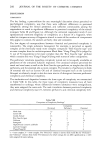
FRAGRANCE COMPLEXITY, FAMILIARITY & PLEASANTNESS 255 subjects including both men and women. Specifically, we wanted to explore the following questions: © does the untrained subject perceive differences in complexity among stimuli ranging from single chemicals to a typical luxury perfume, and is there sufficient communality in judged complexity among a culturally homogeneous group of subjects to lead to significant differences between the group ratings for the various stimuli ? © What is the relationship between perceived complexity and chemical complex- ity? © What is the relationship between perceived complexity by untrained subjects and perfumer's complexity? ß What are the relationships between perceived complexity and familiarity of the stimuli? ß What are the relationships between perceived complexity and judged pleasant- ness of the stimuli? METHOD ODOROUS SUBSTANCES Nine different odorous materials varying in chemical complexity from solutions of single chemicals to perfume compounds were used in this study. Table I lists these Table I Stimuli Concentration Material % in DMP Nature A. Musk (DRAGOCO 0/213650) 10 perfume base B. Lemon Oil Messina 10 essential oil C. Linalyl acetate 10 single substance D. Perfume, type "Rive Gauche" (DRAGOCO 0/513490) 10 perfume composition E. Goldrose (DRAGOCO 0/062680) 10 perfume base F. Isoeugenol 10 single substance G. alpha Hexyl cinnamic aidehyde 10 single substance H. Lavender bouquet (DRAGOCO 0/062440) 10 perfume composition I. Ylang-Ylang Oil extra 5 essential oil substances with an indication of their concentration and nature. All solutions were made in dimethyl phthalate (DMP). All substances were presented in 20-ml straight bottles containing 0.5 ml of substance, closed with an ordinary cork.

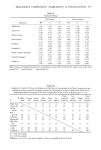
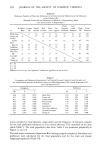
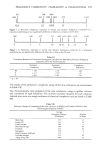
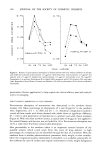
256 JOURNAL OF THE SOCIETY OF COSMETIC CHEMISTS SUBJECTS Fifty nine subjects (23 male, 36 female) took part in the first session of the experiment. During the second session one female subject was absent because of illness. All subjects were students ranging in age from 16 to 29 years. The subjects were paid the amount of hfl. 25,--for attending both sessions. EXPERIMENTAL PROCEDURE In order to determine the familiarity of the subjects with the odor previous to the experiment, we asked them to rate the number of times they had encountered these odors on a 7-cm-long continuous scale ranging from "seldom" to "frequently." The odors were numbered 1 to 9 and presented in random order at 75-sec intervals in order to avoid the influence of adaptation. In the first session of the experiment the familiarity rating was immediately followed by the determination of the psychological complexity of the odors. In order to do this the subjects received all possible 36 pairs of the stimuli, with 75-sec intervals, in a random order. The subjects were told that all bottles contained mixtures of varying numbers of odorants. Subsequently they were instructed to smell the members of a pair in a distinct order (half of them from left to right, the other half the other way round) and to indicate which of the two bottles contained the mixture in which most different substances were present. All stimuli were coded with a three-digit code for which a random selection had been made from the numbers between 101 and 999 with the exception of multiples of 100 and 111. The subjects were told that the numbers were chosen at random. During the second session, two days later, the subjects rated the familiarity of the odors, again in random order, to see whether the added experience of the first session changed the rating. After the familiarity rating the 36 pairs of stimuli were presented again, but in this session the subjects were asked to indicate which of the pair members they liked best. In a separate test, eight trained perfumers, all on the staff of Dragoco, Holzminden, West Germany, were asked to rate the same nine odors for their complexity, using a scale from 1 (lowest complexity) to 10 (highest complexity). In this test, the odors were identified by name. SCORING AND DATA TREATMENT The responses on the 7-cm familiarity rating scale were classified into seven classes. The mean and the standard deviation for each sample were calculated for men and women separately and for the whole group (see Table II). For the paired comparison data the frequencies with which each of the pair members was judged to be more complex (Table III) or more preferred (Table IV) were counted for all pairs and recorded in a matrix. For each of the separate pairs the level of significance of the difference between the frequencies for the two pair members was determined on the basis of their direct comparisons and on the basis of the total number of times they were judged in all comparisons. The frequency values of Tables III and IV may be transformed into scalar values by expressing, for each substance, the difference between its frequency of being judged
Purchased for the exclusive use of nofirst nolast (unknown)
From: SCC Media Library & Resource Center (library.scconline.org)