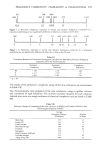
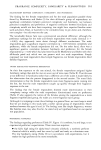
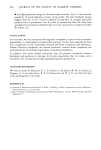
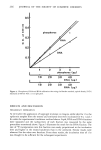
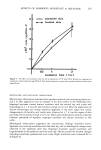
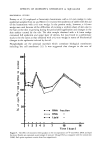
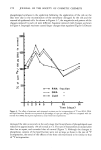
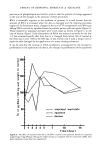
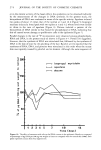
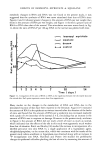
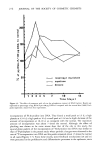
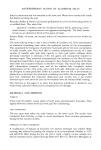
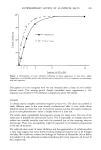
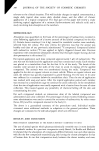
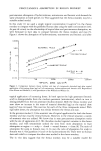
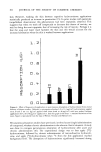
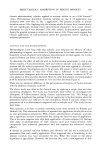
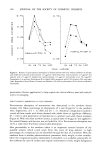
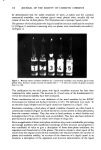
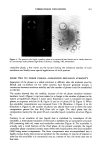
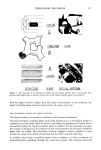
EFFECTS OF ISOPROPYL MYRISTATE 8: SQUALANE 275 metabolic changes in RNA and DNA was not found in the present study, it was suggested that the synthesis of RNA was more stimulated than that of DNA since Figures 9 and 10 showed greater changes in the amount of RNA per wet weight than those in the amount of DNA per wet weight, and Figure 11 showed a greater ratio of RNA to DNA than that of the normal. This stimulation was seen more clearly in Fig. 12, where the ratio of RNA-P per 100/ag DNA to the normal was plotted with time. '" 1.0 o o o isopropyl myristate m•m squalane •-----• decane ß = control 1 2 3 4 5 7 10 14 Time (days) Figure 11. Comparison of the ratio of RNA to DNA in the epidermis between the oil-treated skin and the normal skin. Each point represents a mean from four experiments. Many studies on the changes in the metabolism of RNA and DNA due to the stimulated reaction of skin have been reported in the literature. Argyris (17) measured the amount of RNA in the epidermis at various intervals after the abrasion of the backs of mice and found that the amount of RNA per g epidermis was increased markedly with a peak of 3.43 times that of the normal at 4 d, concluding that an increase in the amount of RNA was in response to damage. However in the present study, as shown in Figure 9, the amount of RNA did not reach a level of twice as much as normal, which indicated that the effects of the oils in this study were apparently much weaker than that of abrasion. Raick and Burdzy (18) studied the increase in incorporation of a labelled precursor into skin RNA by a single application of a hyperplastic agent, ethylphenylpropiolate, on the mouse skin, which was consistent with the results of the present study where acanthosis or hyperplasia was observed along with an increase in 32p incorporation into RNA. Hamilton and Potten (19) studied the proliferative changes in epidermal cells after plucking the hair of mice by measuring the amount of

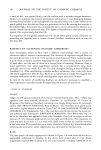
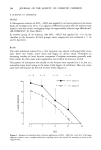
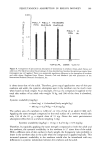
276 JOURNAL OF THE SOCIETY OF COSMETIC CHEMISTS 200 z o o isopropyl u u squalane • • decane myristate I I I I , I , I I ß - , I 2 3 4 5 7 10 14 Time (days) Figure 12. The effect of treatment with oils on the phosphorus content of RNA fraction. Results are expressed as percentage of/ag RNA-P per 100/zg DNA as compared with the normal skin (100%). Each point represents a mean from four experiments. incorporation of 3H-thymidine into DNA. They found a small peak at 1.5 d, a high plateau at 4.5-8 d, a high peak at 10 d, a small peak at 14 d and a slight decrease of the amount of incorporation at 18-20 d, as compared with the normal. The maximum amount of incorporation was about 7 times the normal. Although the effect of plucking was shown to be more severe than that of the oils in this study, the up-and-down pattern of the incorporation of 3H-thymidine into DNA was similar to that of •2P-phosphate in the present study where periodic changes were observed in the rate of •2p incorporation into DNA and the peaks remained about 1.5 times the normal in all cases (Figures 5-7). From these results, some feedback mechanisms (20 and 21) were presumed in the proliferative and differentiative processes in the epidermis, since
Purchased for the exclusive use of nofirst nolast (unknown)
From: SCC Media Library & Resource Center (library.scconline.org)