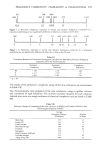
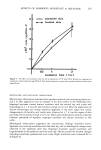
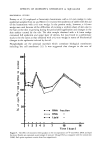
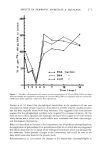
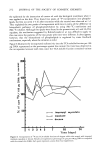
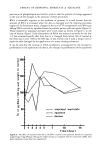
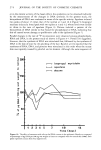
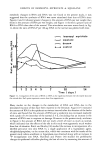
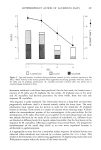
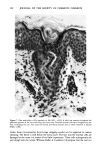
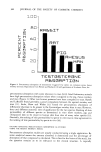
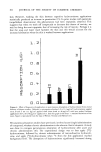
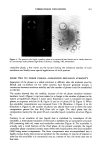
300 JOURNAL OF THE SOCIETY OF COSMETIC CHEMISTS z P H Z • W O_ U O• WU• RRI:!-,BT T RRT P'T_G RHE_qWEi MRN T ES T r'4':::iT ER B N E RB'qPIRPTIPIN Figure 2. Percutaneous absorption of testosterone (4 /,tg/cm 2) by rabbit, rat, miniature swine, rhesus monkey and man. Reproduced from Wester and Maibach (10) with permission of Academic Press, Inc. percutaneous absorption with some relevance to man (9,10). Small laboratory animals have high percutaneous absorption values when compared to the pig, rhesus monkey and man (Figure 2). Other non-human primates have been compared to man. Bartek and LaBudde found generally a good comparison between the squirrel monkey and man (11). Sinha, Shaw and Weber (12) found the percutaneous absorption of diflorasone diacetate to be greater in the Cynomolgus monkey than in man. However, they used different anatomic sites of application for the two species. Ranking of skin permeability of different species as determined in vitro show monkey, pig and chimpanzee skin to be closer to human skin than skin of many other species (13). Generally, the ranking of skin permeability by specie in vitro was in close agreement to the ranking of skin permeability by specie in vivo (10). FACTORS AFFECTING PERCUTANEOUS ABSORPTION AS STUDIED USING THE RHESUS MONKEY MODEL Percutaneous absorption studies are usually conducted using a single application. By some analytical means the amount absorbed is determined and the percentage of absorption of that compound is calculated. This is fine for the limits of the study, but the question remains as to its relevance to the clinical situation. A topically

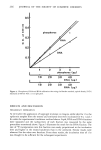
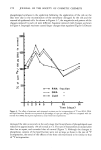
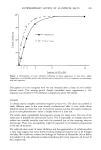
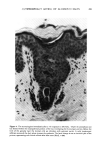
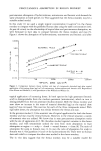
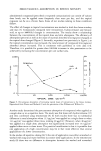
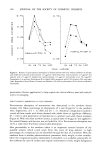
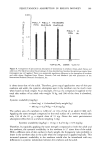
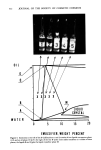
PERCUTANEOUS ABSORPTION IN RHESUS MONKEY 301 administered compound (prescribed or exposed contamination) can consist of various dose levels, can be applied more frequently than once per day, and the topical exposure can be on a chronic basis. Some of our studies relating to these conditions follow. The effect of changes in topical concentrations was studied in both the rhesus monkey and man (5). Compounds compared were testosterone, hydrocortisone and benzoic acid, at up to 1000-fold changes in concentration. The results show a relationship between the concentration of the topical dose and skin absorption. The efficiency of absorption (percent) as well as the mass of material absorbed (micrograms) changed as the topical dose changed (Figure 3). Secondly, as pointed out previously in Figure 2, as the topical concentration was increased, the total amount of compound (micrograms) absorbed always increased. This is consistent with published in vitro data (14). Therefore, it is possible for greater than 100-fold increases in skin penetration to be achieved by increasing the concentration per unit surface area. lOO0: • z PEBEENT ^ lOO % DG 1• H v 1• z B 9 Z O.1 • i l'O lO0 l•00 10000 TO•SL •0• UG/•Me Figure3. Percutaneousabsorptionofincreasingtopicaldosesoftestosteroneintherhesus monkey. Reproduced•om Westerand Maibach(5) withthepermissionoftheWilliamsand WilkinsCo. Another study determined the percutaneous absorption of compound when applied as a single dose or on a repetitive basis. The study was first done with hydrocortisone (15) and then confirmed using testosterone (8). In both studies there was no substantial difference in total absorption when 13.3 3tg/cm 2 was applied as a single dose or when 13.3 3tg/cm 2 was applied three times, totaling 40 3tg/cm 2. However, when 40 •tg/cm 2 was applied as a single dose, absorption was significantly increased over 13.3 3tg/cm 2 applied either once or three times. The practical ramification is that it is possible that one application of a high concentration may be in fact more effective than several applications of a lower concentration. In the studies of repetitive dosing ($,15) the site of application was either unwashed or washed with soap and water between successive dose applications. In the testosterone study (8) there was no difference in absorption between the washed and unwashed
Purchased for the exclusive use of nofirst nolast (unknown)
From: SCC Media Library & Resource Center (library.scconline.org)