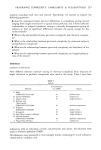
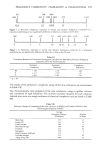
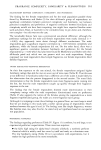
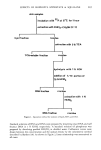
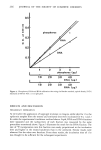
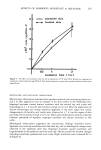
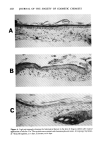
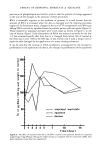
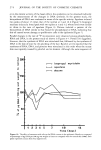
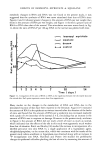
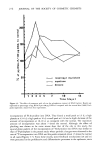
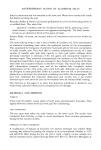
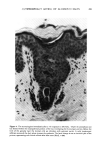
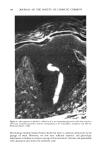
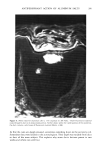
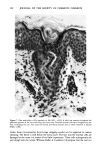
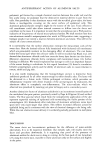
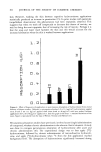
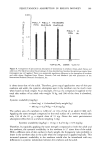
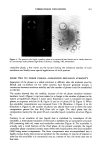
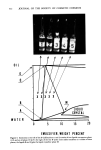
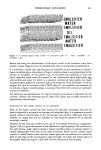
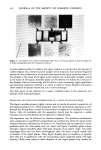
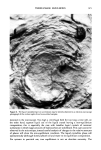
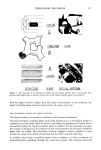
THREE-PHASE EMULSIONS 317 c A I: 1/2:V3:Jg NONE STEUCTURE X-RAY OPTICAL PATTERN Figure 7. The low-angle X-ray reflections (middle) and the optical patterns from a microscope with polarized light (right) serve to identify the structure of the liquid crystalline phase in an emulsion. with the liquid crystal is higher than the actual concentration in the emulsion, the liquid crystalline phase will never form and is, of course, of no use. THE STABILIZING ACTION OF LIQUID CRYSTALS The liquid crystals in an emulsion stabilizes it with several mechanisms. The layers of liquid crystalline phase around the droplets act as a rheological barrier to coalescence an extremely effective barrier considering the pronounced viscous forces encountered when the liquid crystalline phase is sheared. To this increased viscosity the change of driving force for coalescence due to the presence of the liquid crystalline phase must be added. The calculation of these changes is fairly complex (13) and outside the scope of an article of this kind, but the effect is worth observing. In addition some liquid crystalline phases have a tendency to form a network of semi-solid phase extending through the continuous phase. This network slows the

318 JOURNAL OF THE SOCIETY OF COSMETIC CHEMISTS movement of the droplets and adds to the stability in a fashion similar to the one by polymeric materials. SPECIFIC USES OF THREE-PHASE EMULSIONS These three-phase emulsions make it possible to obtain lotions and other cosmetic products of desired consistency with a free variation of the oil/water ratio. It is even possible to prepare creamy emulsions with no free oil present (8,9) the two-phase system water/liquid crystalline phase (B-M, Figure 3) does not contain free oil only water and liquid crystalline phase, the latter containing solubilized oil. The liquid crystal can also be used to dissolve higher amounts of some substances than normal liquids. Such substances, e.g., steroids which dissolve only in minute amounts in liquids, can be brought to solution in a suitable liquid crystalline phase. This means that substances with steroid structure otherwise only present as crystalline compounds can be brought into a smooth dissolved state. Finally the liquid crystals serve to prevent fast release of a substance dissolved in the dispersed liquid phase (16). In a normal two-phase emulsion of liquids the diffusion across the interface is little hindered and the release of substance from the droplets to the continuous phase is fast. A liquid crystalline layer has a diffusion coefficient that is at least one thousand times less than the one in a liquid (18) and a layer around the droplet will effectively reduce the transport of a dissolved substance from the droplets. SUMMARY The properties of three-phase emulsions containing a liquid crystalline phase have been discussed, methods for their identification and analysis have been given and utilization of their specific properties in the cosmetic industry indicated. ACKNOWLDGEMENTS This research was supported by the American Chemical Society, Petroleum Research Fund, Grant Number ACS PRF 9934 AC5, Code 2149-2232. REFERENCES (1) P. Becher, "Emulsions: Theory and Practice," Reinhold Pub. Corp.: New York, 1%5. (2) P. Sherman, Ed., "Emulsions Science," Academic Press: New York, 1%8. (3) B. W. Burt, An Approach to emulsion formulation, J. Soc. Cosmet. Chem., 16, 465-475 1%5. (4) R. Salisbury, E. E. Leuallen and L. T. Chawkin, The effect of phase volume ratio on emulsion type, I--Beeswax-borax ointments, J. Am. Pharm. Assoc.--Scientific Edition, 43, 117-119 1954. (5) F. Lachampt and R. M. Vila, A contribution to the study of emulsions, Amer. Perfumer Cosmet., 82, 29-36 1%7. (6) J. Swarbrick, Phase equilibrium diagrams: an approach to the formation of solubilized and emulsified systems, J. Soc. Cosmet. Chem., 19, 187-209 1%8. (7) L. Mandell, K. Fontell and P. Ekwall, The system water-sodium caprylate-decanol, I. Different phase regions, Acta Polyt. Scand., 1, 1 1968. (8) S. Friberg, L. Mandell and M. Larsson, Mesomorphous phases, a factor of importance for the properties of emulsions, J. CoIL Interf $ci., 29, 155-156 1%9.
Purchased for the exclusive use of nofirst nolast (unknown)
From: SCC Media Library & Resource Center (library.scconline.org)