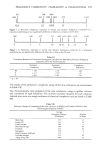
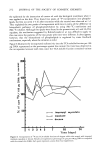
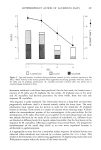
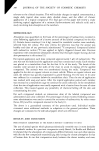
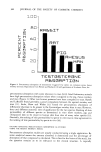
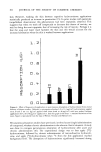
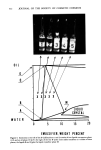
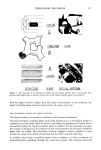
302 JOURNAL OF THE SOCIETY OF COSMETIC CHEMISTS skin. However, washing the skin between repetitive hydrocortisone applications statistically produced an increase in penetration (15). In prior studies with pesticides (unpublished observations) this phenomenon had been repeatedly observed. This suggests that when we wash off compounds to decrease the chance of toxicity, we may be doing the exact opposite, that of increasing the risk of toxicity. Perhaps it is that the soap and water wash hydrates the skin and this would account for the increased absorvtion when the skin is washed between applications. 2..2 2_ . 123 Z R [- Figure 4. Effect of frequency of application on percutaneous absorption of hydrocortisone from ventral forearm of rhesus monkey. Ordinate is micrograms absorbed. A is 13.3/2g/cm 2 hydrocortisone applied once B and C are 13.3 /2g/cm 2 applied three times (total to 40 /2g/cm 2) with area washed between applications for C D is 40/2g/cm 2 applied once. Each bar graph is the mean + standard deviations of the mean. Figure is reproduced from the data of Wester, Noonan and Maibach (15). Percutaneous absorption studies have previously involved acute (single) administration of compound whereas chronic administration is the relevant clinical situation. A study was done to compare percutaneous absorption of hydrocortisone after acute and chronic administration (16). The experimental design was to first apply [•4C]- hydrocortisone, followed by chronic administration of non-radioactive hydrocorti- sone, and apply ['4C]-hydrocortisone when •4C from the first application reached background level. The absorption of hydrocortisone significantly increased during

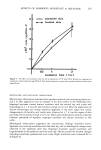
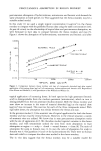
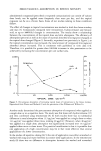
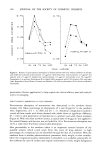
PERCUTANEOUS ABSORPTION IN RHESUS MONKEY 303 chronic administration, whether applied in acetone vehicle or as a 0.9% Eucerin © cream. Percutaneous absorption (acetone vehicle) on day 8 of application was increased 144% over that on day 1 application. The greatest increase in urinary excretion was at 24 hr. Applying only the acetone vehicle for seven days (control study) did not significantly increase (5%) hydrocortisone absorption. In a cream vehicle, absorption on day 8 was increased 275% with chronic hydrocortisone application. Again, the greatest increase in urinary excretion was at 24 hr. These results suggest that chronic application of hydrocortisone alters the penetration barrier resulting in enhanced penetration. SALYCYLIC ACID AND HYDROCORTISONE Dermatologists have long held that salicylic acid enhances the efficacy of other pharmacological agents, one of which is hydrocortisone. It has been assumed that the keratolytic action of salicylic acid enhances the penetration of other agents. An in vitro study by Polano and Ponec (17) did indeed show this. To determine the effect of salicylic acid on hydrocortisone penetration in vivo in the rhesus monkey, [•4C]-hydrocortisone, with and without salicylic acid, was applied in acetone and the solvent evaporated. The compounds also were applied in a formula- tion (60% ethanol, 5% propylene glycol, 5% glycerin, 30% water) in which salicylic acid enhanced penetration in vitro (18). There was a difference in the kinetics of hydrocortisone absorption with the two formulations. In acetone, excretion of •4C in urine peaked at 48 hr and then declined. With the other formulation, excretion peaked at 48 hr, remained relatively constant to 72 hr and then declined (Figure 5). There was no statistical difference in the percutaneous absorption of hydrocortisone with the addition of salicylic acid (18). The above study was done in the classical way by applying a single dose and then monitoring absorption. The study was historically done before we investigated the absorption of hydrocortisone during chronic administration (16). This brings up the intriging hypothesis that perhaps if chronic application of hydrocortisone alters the penetration barrier and enhances its own absorption, would it not also enhance the penetration of a co-administered compound such as salicylic acid ? This study has not been done. With salicyclic acid there is another interesting study done recently by Roberts and Horlock (19). They examined the effect of repeated skin application of salicylic acid on its own percutaneous absorption. With chronic administration of salicylic acid they saw a significant increase in penetration flux during the first five days of application. This is the same response seen with daily application of hydrocortisone (16). Perhaps with daily co-administration of both salicylic acid and hydrocortisone, both compounds have enhanced penetration and this explains the enhanced clinical efficacy. It should be pointed out that Roberts and Horlock (19) did see a reduction in penetration flux with weekly application. They suggested that a broadening in the stratum corneum may have accounted for this. What this means to the above hypothesis is speculation. However, the fact that they took a new approach to skin
Purchased for the exclusive use of nofirst nolast (unknown)
From: SCC Media Library & Resource Center (library.scconline.org)