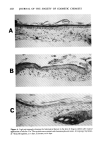
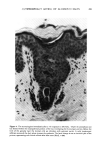
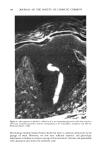
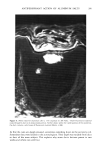
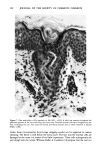
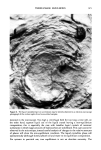
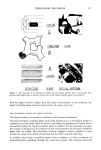
ANTIPERSPIRANT ACTION OF ALUMINUM SALTS 293 polymeric gel formed by a simple chemical reaction between the acidic salt and the less acidic sweat, we postulate that the obstructive material derives in part from the cells. One possibility is that aluminum reacts with the so-called glyco-calyx the latter forms a mucilage-like covering on the outer surface of epidermal cells. This aluminum-polysaccharide complex might be the source of the cast. Toxic effects to cell membranes could also allow internal contents to diffuse into the ducts and contribute to the mass. It is important to note that the amorphous cast is PAS-positive, indicative of the presence of neutral muco-polysaccharides. We shall mention here that non-aluminum metallic antiperspirants also result in PAS-positive casts, suggesting a biologic product not merely a reaction between aluminum and sweat. This will be the subject of a later communication. It is noteworthy that the earliest obstruction exempts the intracorneal coils of the sweat duct. Here the luminal cells are fully keratinized with thickened cell membranes which are presumably resistant to the damaging effect of aluminum. The cast forms below the horny layer where the cells are viable. It will be recalled that Blank et al. (23) showed that aluminum chloride could not cross the horny layer barrier into the dermis. Moreover, aluminum chloride forms complexes with keratinized tissue (24), further limiting its diffusion. We would emphasize that damage to cells is an important feature of the events leading to anhidrosis. In this regard Lansdown (25) found a correlation between antiperspirant activity and the ability of aluminum salts to cause irritation in mouse, rabbit and pig skin. It is also worth emphasizing that the histopathologic picture is distinctive from anhidrosis produced by all other means except by other metallic salts. The latter will be discussed in a future work. Unlike prolonged occlusion, which provokes an inflammatory response with dense invasion of the acrosyringium by leukocytes, the aluminum effect is completely non-inflammatory. The micro-miliaria which we observed was provoked by sweating just prior to biopsy and is a secondary event. Another distincitive factor of aluminum anhidrosis is an inconsistent intensification of the methylene blue pore pattern, previously noted by Papa & Kligman (9) and verified herein. The blue punctae which result from the iontophoretic application of the dye represent supravital staining of epidermal cells surrounding the viable portion of the acrosyringium (26). Immediately after induction of aluminum anhidrosis, some dyed spots were very much larger than others. This reflects increased diffusion across the epithelial lining and is consistent with the view of chemical damage to the lining cells. While the cast obstructs sweat delivery it is evidently partially permeable to methylene blue. DISCUSSION The sweat ducts are low-resistance pathways for the diffusion of water-soluble electrolytes. It is to be expected, therefore, that metallic salts will readily enter the ducts and percolate downwards. It is surprising that proof of the presence of aluminum within the ducts was so long in coming. In the foot-pads of rats Lansdown (27), using the morin stain, was able to show aluminum only on the surface and slightly in the pores.

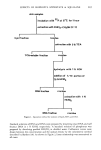
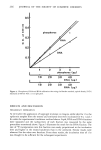
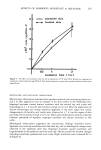
294 JOURNAL OF THE SOCIETY OF COSMETIC CHEMISTS Our work supports Reller 8: Luedder's claim that a physically demonstrable obstruc- tion accounts for the anhidrosis induced by aluminum chloride. However, their interpretation of the nature of the obstruction and certain of their observations differ from ours. Hence, a detailed analysis seems justified. They found reddish-staining aluminum masses, "predominantly in the distal segment of the epidermal sweat duct." In our specimens, aluminum chloride practically always reached the upper- and mid-dermis. Our method of application was doubtless more intense. At one week, they observed a separation of the entire duct from the surrounding epidermal tissue and regarded this as a "delayed" effect of aluminum. This total sloughing of the acrosyringium cannot be reconciled with our findings. In contrast, we saw damage in the luminal cells at the very outset these soon died and sloughed into the lumen but the acrosyringium itself was never cast off. Perhaps Relier 8: Luedders were looking at an artifact of histologic processing. We believe we have examined many more biopsies. At three weeks, Relier 8: Luedders found that ducts were dilated and separating as hypertrophied, distorted acrosyringical units. These late alterations were never observed in our material. Indeed, most of the changes had regressed. We hold a different view concerning the nature of the aluminum-containing material within the ducts. Our notions too are purely speculative. Relier 8: Luedders studied a number of antiperspirant metallic salts and created the "emphraxis" theory. According to this view, the salts form polymeric gelatinous hydroxide precipitates at or below physiologic pH. It is the gel itself which constitutes the obstruction. We neutralized aluminum chloride with sodium hydroxide and stained the resultant fiocculant with PAS. In contrast to the in vivo situation, the fiocculant was PAS-negative. The model used by Relier 8: Luedders to demonstrate hydroxide gels is a far cry from physiologic conditions. They first measured the flow of water through a millipore filter in a Swinny holder under a fixed pressure of 32 cm Hg. Then they immersed the filter in the metallic solution and suspended it over ammonium hydroxide, thereby assuring complete neutralization by ammonia vapor. The percentage reduction in flow was taken as a measure of gel formation. However, in real life complete neutralization is impossible. The pH of sweat is 5.5 to 6.0. With sodium hydroxide we found incipient precipitation of aluminum chloride at this pH and none when aluminum chloride was added to sweat itself. We see the obstruction as more than a reaction product of sweat and the antiperspirant. Tissue components contribute. It is noteworthy that the anhidrosis gradually deepens over a 24-hr period, suggesting a biologic reaction. Finally, the perspicacious observer will note that our report makes no mention of the keratotic and parakeratotic plugs which earlier workers had imagined to be the cause of the block. Why did we fail to see them? It will be recalled that plugs result from repair of ducts damaged by bouts of miliaria. Our focus was on the early events associated with anhidrosis and not the late stages of repair after rupture of the ducts. ACKNOWLEDGMENT We wish to thank Miss Rosalynn Bloomberg, Mrs. Helga Hi51zle and Mrs. Janice C. Stebbins for their excellent technical assistance.
Purchased for the exclusive use of nofirst nolast (unknown)
From: SCC Media Library & Resource Center (library.scconline.org)