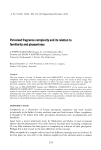
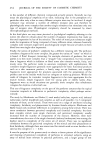
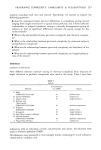
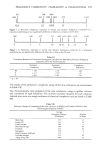
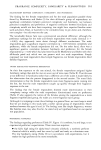
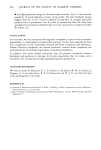
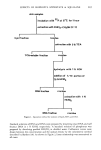
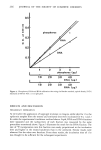
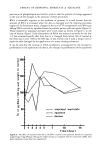
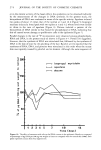
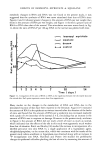
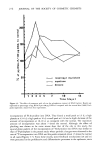
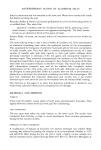
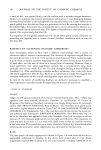
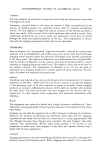
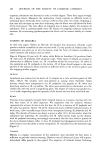
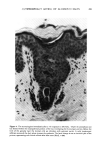
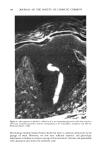
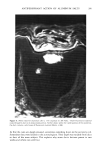
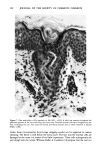
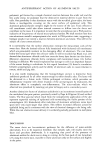
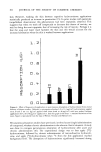
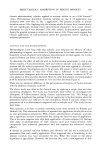
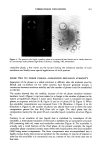
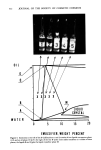
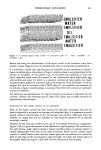
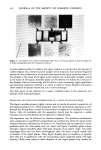
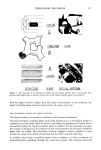
THREE-PHASE EMULSIONS 313 EMULSIWATER EMULSIFIER OIL EMULSIFIER ::- W A T E R ..... EMULSIFIER Figure 4. A lameliar liquid crystal consists of consecutive layers of .... water - emulsifier - oil - emulsifier - water .... Before discussing the identification of the liquid crystal in the emulsion a few facts related to phase diagrams must be clarified since they are sometimes misunderstood. It is essential to realize that high amounts of emulsifier are not necessary to obtain a liquid crystalline phase the amount of liquid crystalline phase is not proportional to the amount of emulsifier. In the present case, 3% emulsifier was sufficient to form the liquid crystalline phase within the system. In the combination liquid triglyceride, egg yolk lecithin and water (9), which is a common commercial base system, the liquid crystalline phase appears at extremely small concentrations of the emulsifier (•0.1% by weight). For such an emulsions with a W/O ratio 1/2, an emulsifier concentration of 2% will give a liquid crystalline phase occupying 15% of the total volume an impressive amount of stabilizer. The detection and identification of a liquid crystal in an emulsion is important for the cosmetic chemist the following section deals with useful and available methods of detection and identification. DETECTION OF THE LIQUID CRYSTAL IN AN EMULSION Most of the liquid crystals (see next section) are optically anisotropic (10) and are directly observed in an optical microscope with polarized light. It is important to avoid optical artifacts bad focusing of the microscope may produce reflections from the droplets, an image that may be mistaken as indicating the presence of an optically anisotropic material. Mistakes of this kind are avoided by the use of a two-phase emulsion as comparison. Figure 5 (10) is a good illustration of the difference in optical pattern. The emulsion to the right (photo, upper right) contains a liquid crystalline phase its optical pattern is clearly distinguished from that of the other emulsions, which do not contain liquid crystals. A useful further check that the radiant parts are not artifacts is to rotate the slide on the stage of the microscope in polarized light. The dark and radiant parts of the droplet layers (see Figure 2) will shift with the direction of the turntable.

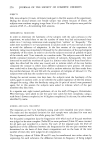
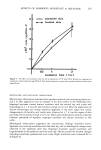
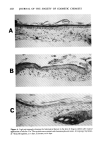
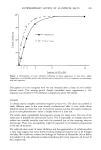
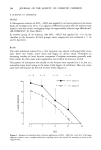
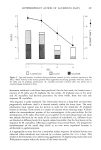
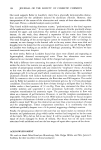
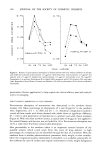
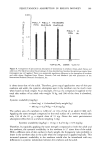
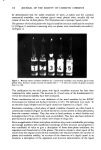
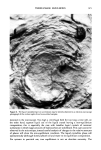
314 JOURNAL OF THE SOCIETY OF COSMETIC CHEMISTS ' . . : . : Figure 5. An emulsion with a liquid crystal (upper right) has a microscope pattern in polarized light that is clearly distinguished from the two-phase emulsions. A more refined method to observe the liquid crystal is to use electron microscopy of carbon replicas from freeze fractured samples of the emulsion. Such photos (Figure 6) enable the direct observation of the individual layers in the liquid crystalline phase (12). The droplet in the center of the figure is flocculated with several other droplets around it the layers of the liquid crystalline phase can be observed to follow the contours of the droplets. Electron microscopy of this kind is a time consuming, highly specialized and extremely expensive method it is useful in order to obtain detailed information about systems of special interest but is no routine technique. The final proof of the presence of a liquid crystalline phase is the separation and analysis of the individual phases. SEPARATION AND STRUCTURE DETERMINATION OF A LIQUID CRYSTALLINE PHASE The liquid crystalline phase is highly viscous and its interfacial tension towards the oil and aqueous phase is low. These properties mean that spontaneous separation is slow because the driving force is small and the kinetics of separation is hindered by viscous forces. After all, problems with the separation should also be expected a stable emulsion may not and should not be expected to separate easily. The separation may be achieved by ultracentrifugation. The problems encountered with a separation to equilibrium compositions are cumbersome when the liquid crystal contains maximal solubilization of water or oil. Emulsions may be expected to cause problems since the three-phase area oil, water and liquid crystalline phase always includes a liquid crystalline phase with high amounts of oil and/or water. Too small centrifugal force and too short centrifugation time will leave a liquid crystal with occlusions of the liquid phases. These liquid droplets have no tendency to separate since they are in equilibrium with the surrounding liquid crystalline phase with high viscosity. With some practice these droplets of the liquid phases may usually be
Purchased for the exclusive use of nofirst nolast (unknown)
From: SCC Media Library & Resource Center (library.scconline.org)