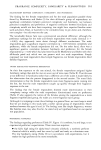
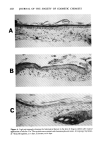
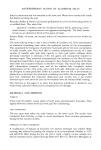
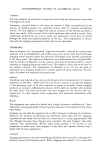
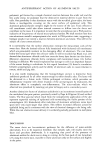
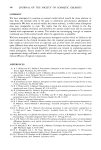
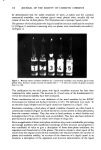
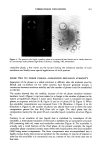
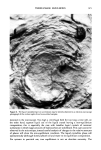
THREE-PHASE EMULSIONS 315 Figure 6. The liquid crystalline layers in an emulsion may be directly observed in an electron microscope photograph of the carbon replica from freeze-etched samples. detected in the microscope. Too high a centrifugal field for too long a time will, on the other hand, squeeze liquid out of the liquid crystal leaving a non-equilibrium composition this is especially the case with lameliar liquid crystals of nonionic surfactants in which large amounts of hydrocarbon are solubilized. This case cannot be observed in the microscope instead careful analysis of changes in the relative amounts of phases will show the non-equilibrium condition. The liquid crystalline phase will spontaneously (although slowly) absorb oil and water to its equilibrium composition. For systems in practical use, true equilibrium is not an absolute necessity. The

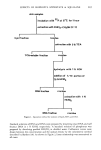
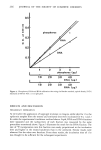
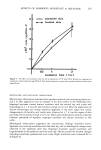
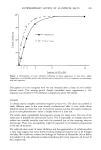
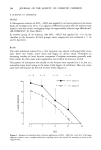
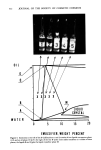
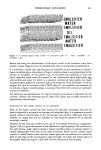
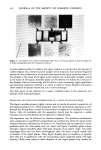
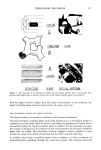
316 JOURNAL OF THE SOCIETY OF COSMETIC CHEMISTS existence and structure of a liquid crystal may be sufficient information. Even under these conditions the results have to be handled with care because a liquid crystalline phase may be formed by sedimentation of large micelies during centrifugation. In this respect systems of water, hydrocarbon and nonionic emulsifiers are especially dangerous since they may form microemulsions which are isotropic liquids with large amounts of both oil and water dissolved. These microemulsions readily separate at centrifugation giving two liquid phases and one liquid crystalline phase, which are not an equilibrium with each other. The following example is illustrative: 60% water, 12% pentaoxyethylene dodecyl ether and 28% hexadecane form an isotropic liquid phase at 20øC. After centrifuging for 2 hr at 150,000 g the solution separated into one liquid crystalline phase and two liquid phases. However, these three phases are not the equilibrium state of the system. When left at 20øC the liquid crystalline phase gradually disappeared in one week. The phase boundary between the two remaining liquids disappeared after about three weeks' time and the microemulsion was reformed. The guidelines for ultracentrifugation are to use as high centrifugal forces as possible, observe the movement of the phase boundaries as function of time and stop the centrifugation if a sudden change to slower separation rate is observed. At that point the two liquid phases are removed and the less dense one is carefully poured on top of the other. The liquid crystalline part is microscopically checked for occlusions of liquid. If such are found the centrifugation is continued of the liquid crystalline phase only to prevent the sedimentation of micelies to form an artifact liquid crystalline phase. The two liquids in contact with each other are checked that no liquid crystal will appear at the interface. After the separation, the structure of the liquid crystalline phase may be determined using optical microscopy and low-angle X-ray diffractometry (17). The two common liquid crystals are the one with a lameliar structure (Figure 7, A) and the one with cylinders packed in a hexagonal array (Figure 7, C). The two structures give different patterns in the microscope in polarized light these patterns are useful as a primary identification. The final identification is made using the low-angle X-ray diffraction patterns the lameliar structure gives the ratio 1:1/2:1/4 between the characteristic distances from the film the hexagonal one l:l/xf•:l/x/• and the cubic structure 1:1/x/•:l/xf•-/8. The latter cannot be identified by its optical pattern and only with difficulty observed in the microscope. These structure determinations are useful for identification purposes, but have little practical utility. From the cosmetic chemist's point of view a chemical analysis of the composition of the liquid crystalline phase is more important since this information determines the usefulness of the surfactant. A low surfactant concentration in the liquid crystalline phase is beneficial. There is a wide difference between a surfactant that forms the liquid crystalline phase at 50% surfactant, such as the combination of sodium dodecyl sulfate and dodecyl alcohol, and at 5% surfactant, such as lecithin. Assuming no micellization it is easy to realize that 2% of the latter means that the emulsion will contain 20% liquid crystalline phase, a sufficient amount to ensure stability. In the first case the hquid crystal will occupy only 4% of the mixture a considerably less amount. Another equally important factor is the concentration of the aqueous and oil phases with which the liquid crystalline phase is in equilibrium. If the concentration of surfactant both in the oil and the water at the points connecting the three-phase area
Purchased for the exclusive use of nofirst nolast (unknown)
From: SCC Media Library & Resource Center (library.scconline.org)