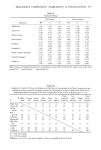
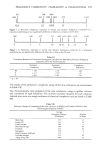
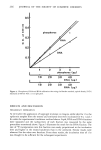
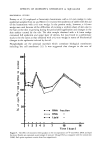
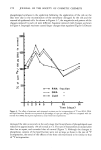
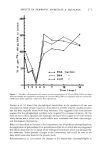
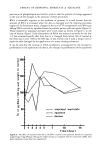
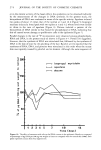
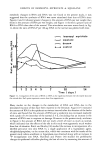
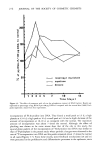
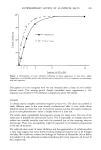
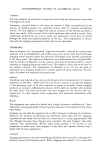
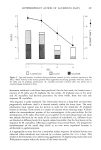
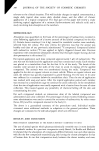
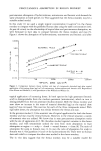
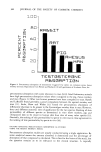
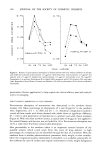
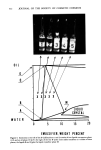
ANTIPERSPIRANT ACTION OF ALUMINUM SALTS 283 ß • i di ly w mme ate -- 'O" --24 hr later 0 I I I 1 2 3 6 12 2-4 Exposure to AlCl 3 (hr) Figure 1. Development of sweat inhibition following occlusive application of 20% AICI 3 ß 6H20. Suppression is considerably greater when thermal stress is delayed for 24 hr in comparison to immediately after each exposure. This pattern is to be compared with the one obtained after a delay of 24 hr before thermal stress. This waiting period sharply intensified sweat suppression a 3-hr exposure now resulted in 75% inhibition compared to about 50% before. Comment To obtain nearly complete anhidrosis required at least 6 hr. The ducts succumbed at vastly different rates. A few were already nonfunctional after 15 rain, while others delivered sweat for more than 6 hr. It should be pointed out that the imprint method is an all or none phenomenon--either a droplet forms or it does not. The results imply considerable heterogeneity among the sweat units. The size of the sweat pore is possibly the determinant factor. This is impossible to evaluate since the orifices are virtually invisible even with the powerful eye of the scanning electron microscope. Then, too, susceptibility might be expected to be inversely proportional to the rate of secretion. The relatively slow onset of sweat inhibition and the augmentation of anhidrosis after a 24-hr wait suggest that some slowly evolving biological response has to be brought into play. We could not confirm the findings of Tronnier & Rentschler (16) or Relier & Luedders (14), who obtained a marked anhidrosis after short exposures of 10 and 30 min, respectively.

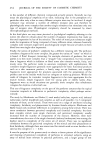
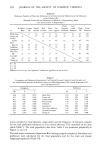
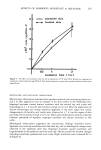
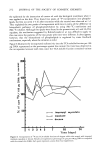
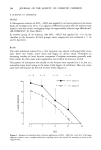
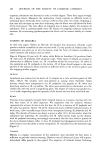
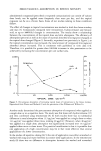
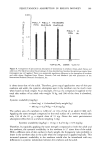
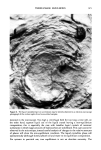
284 JOURNAL OF THE SOCIETY OF COSMETIC CHEMISTS II. DURATION OF ANHIDROSIS Method A 20% aqueous solution of A1CI 3 ß 6H20 was applied by occlusive patches to the lower backs of 14 subjects for 24 hr. 5 cm squares of Webril saturated with the solution were sealed to the skin under overlapping strips of impermeable adhesive tape (Blenderin ©, 3M COMPANY, St. Paul, Minn.). In another group of 18 subjects, 20% A1C13 ß 6H20 was applied for 3 hr via the chamber on the forearms. In both groups, sweat suppression was estimated 1, 7, 14, and 21 days later. t•e$gllt$ The solid anhidrosis induced by a 24-hr exposure was almost unchanged after seven days. After two weeks, some ducts had begun to deliver sweat. Thereafter an increasing number of units became competent. Complete restoration generally took three weeks. In a few cases some suppression was evident for almost a month. This pattern of restoration was similar on the forearm sites exposed for 3 hr, but at a somewhat lower level owing to the lesser initial degree of anhidrosis. Here too, some units were still inactive by the end of three weeks (Figure 2). N II 18 •l = 14 N = 12 N = 12 100- 75- 50- 25_ • • 24 hr exposure -- '-• -- 3 hr exposure I I 1 0 I 7 14 28 DAYS Figure 2. Duration of anhidrosis after occlusive application of A1C13 ß 6H20 for 3 and 24 hr. The longer exposure results in near complete anhidrosis, requiring about one month for sweating to return to the original level.
Purchased for the exclusive use of nofirst nolast (unknown)
From: SCC Media Library & Resource Center (library.scconline.org)