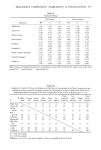
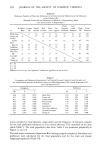
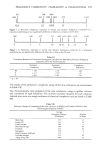
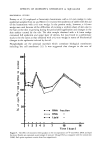
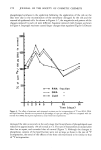
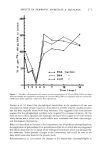
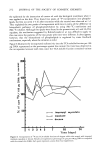
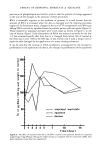
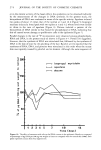
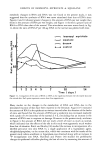
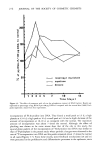
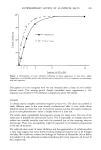
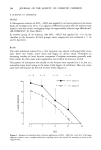
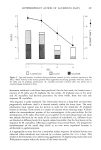
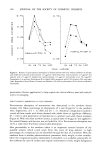
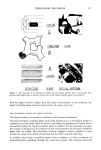
FRAGRANCE COMPLEXITY, FAMILIARITY & PLEASANTNESS 261 RELATIONSHIP BETWEEN COMPLEXITY, FAMILIARITY AND PREFERENCE The finding for the female respondents and for the total population parallel those found by Moskowitz and Barbe (1) for their all-female group of respondents: no significant correlations between perceived complexity and familiarity, nor between perceived complexity and preference. A negative correlation between familiarity and complexity would not have been surprising one might have expected familiar notes such as Lemon, Rose, or Lavender to be considered easy to pin down and, therefore, non-complex--but this was not the case. The remarkable feature here was a pronounced sex-related difference: although the preference rankings for the male and female respondents were nearly identical (r = +0.983), they apparently came about through different mechanisms. The male respondents gave a significant negative correlation (p = 0.05) between complexity and preference, while the female respondents did not. On the other hand, there was a significant positive correlation between familiarity and preference for the female respondents (p = 0.05) which had also been found be Moskowitz and Barbe with their all-female panel and which was not present with our male respondents. Simply expressed: our male respondents liked simple fragrances, our female respondents liked familiar fragrances. OTHER SEX-RELATED RESPONSE DIFFERENCES At their first exposure to the test stimuli, the female respondents assigned higher familiarity ratings than did the men in seven out of nine cases (Table II). That this was a true difference in familiarity rather than a different use of the scales is made likely by the observation that the pattern disappeared in the second session. The most likely interpretation is that the female respondents were more fragrance-aware coming into the test, but that the male respondents caught up quickly through their fragrance- exposure in the test. The finding that the female respondents showed more discrimination in their complexity ratings while the male respondents discriminated more on preference (Table V) also supports the notion of the females among the respondents as a more fragrance-sophisticated group, the males as a more fragrance-naive group. Although it is tempting to state these findings in a general form, we must keep in mind that we are dealing in this study with a rather special group of respondents: Dutch students between the ages 16 and 29. The finding: men like simple fragrances, women like familiar ones, may also, thus far, be stated only as hypothesis based on our special test population. PREFERENCE RANKINGS The findings regarding preference (Table IV, Figure 1 b) conform, by and large, to an experienced perfumer's expectations. There were two surprises: ß the fairly high rating for alpha-hexyl cinnamic aidehyde, a synthetic perfume chemical which is widely used but never by itself and rarely as a dominant note. The low familiarity rating (Table II) is in accordance with expectations, but it makes the high preference the more remarkable.

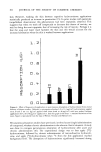
262 JOURNAL OF THE SOCIETY OF COSMETIC CHEMISTS ß the high preference rating for the musk base. Actually, this is in line with the popularity of musk fragrances among young adults. The low familiarity ratings suggest that this is not a learned response (recognition of strongly promoted products) but a spontaneous one. It is also of interest that both the musk base and alpha-hexyl cinnamic aidehyde rank very low on perceived complexity (Table III, Figure 1 a). CONCLUSION In conclusion, we may summarize that fragrance complexity, as perceived by untrained respondents, is a meaningful and measurable concept. For the male respondents there was a significant inverse relationship between perceived complexity and preference. Neither chemical complexity nor trained perfumers' notions about complexity are good predictors of untrained respondents' complexity perceptions. In addition, this study yielded indications that the positive correlation between familiarity and preference is stronger for female respondents than for males, and it furnished a few unexpected findings regarding fragrance preferences. ACKNOWLEDGEMENT We want to thank R. Bloemink, D.C. de Goiijer, C. M. Jansen, W. M. van Keulen, J. Kragten, A. A. van den Oever, R. P.M. Sonneveld and W.J.D. van Vliet for their active participation in this study. REFERENCES (1) Howard R. Moskowitz and Charles D. Barbe, "Profiling of Odor Components and their Mixtures," Sensory Processes 1,212-226 (1977) (2) Egon P. KiSster "Psychological Dimensions of Odour Perception," Lecture, IFSCC Seminar, Brussels, September '77.
Purchased for the exclusive use of nofirst nolast (unknown)
From: SCC Media Library & Resource Center (library.scconline.org)