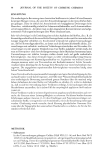
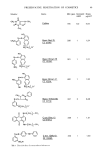
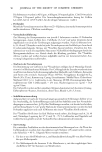
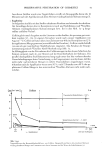
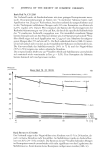
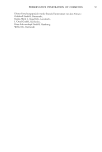
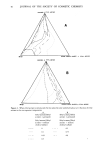
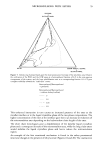
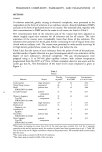
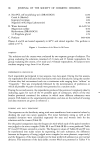
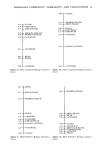
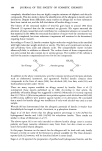
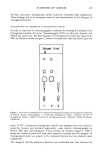
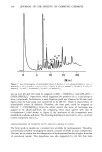
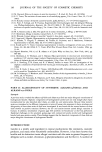
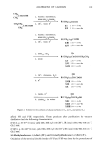
74 JOURNAL OF THE SOCIETY OF COSMETIC CHEMISTS The esters were selected with a chain length varying from the short one in ethyl acetate to the long one in methyl stearate. In addition, octyl aidehyde and 2-butoxyethanol were used for a preliminary evaluation of differences from the behavior of esters. EXPERIMENTAL MATERIALS The following materials were used with no further purifications: pentanol (Fisher, certified), ethyl acetate (Fisher, certified), n-butyl acetate (Aldrich, spectorphotometric grade), methyl stearate (Eastman, distillation products industrial), octyl aldehyde (Aldrich, 99%), 2-butoxyethanol (Aldrich, 99%). The surfactant, sodium dodecyl sulphate (BDH, specially pure), was repeatedly recrystallized from ethanol until no minimum was found in the surface tension/surfactant concentration plot. The water was doubly distilled. DETERMINATION OF MICROEMULSION AREAS The microemulsion areas were determined by titration with water of mixtures of the surfactant, the ester and the pentanol, and the solubility limits were confirmed by long time storage of samples at 21.5 + 0.5øC. PENTANOL L 2 L 1 WATER SODIUM DODECYL SULFATE Figure 1. The system water, sodium dodecyl sulfate and pentanol shows two isotropic liquid phases containing normal (L1) and inverse micelies (L2).

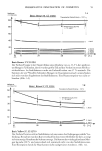
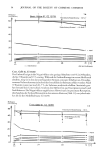
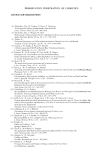
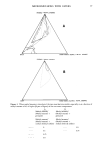
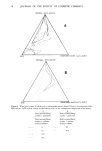
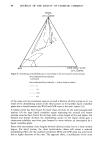
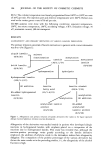
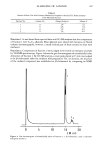
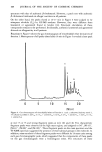
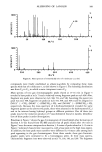
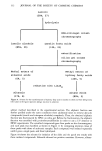
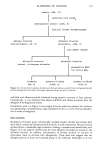
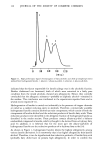
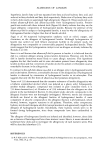
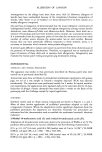
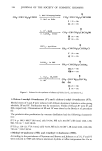
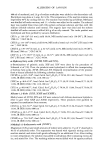
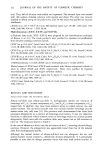
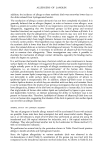
MICROEMULSIONS WITH ESTERS 75 RESULTS The basis for all the results is the phase regions in the system water, sodium dodecyl sulphate, and pentanol (Figure 1). Two areas with isotropic liquids are found. L• is the aqueous solution containing normal micelles and L= is the pentanol solution containing inverse micelies, the latter being the basis for W/O microemulsion systems (11,12). The microemulsion regions with the esters will be described as the variation in these two solubility areas when the pentanol, the cosurfactant, and sodium dodecyl sulfate, the surfactant, are gradually replaced by the organic compound. Replacing 10 per cent by weight of the two compounds with ethyl acetate (Figure 2A) led to a coalescence of the L• and L• areas to form a continuous solubility region from the pentanol/ethyl acetate corner to the water corner. In addition, the minimum water content to bring the surfactant into solution was increased the right hand solubility limit was moved to the left. Further increase of the ethyl acetate content led to an expansion toward higher surfactant/water ratios of this limit, followed by a pronounced increase of the minimum surfactant/water ratio for ethyl acetate content in excess of 50% (Figure 2B). As a contrast to this trend, the replacement with methyl stearate (Figures 3A and 3B) led to a gradual reduction of the W/O microemulsion area. With 50% methyl stearate, the L• region had disappeared (Figure 3A) and the L2 area was strongly reduced. With 75% methyl stearate (Figure 3B), the L2 area was extremely small and could not be detected at all for the sample with 90% methyl stearate. The phase regions with butyl acetate (Figures 4A and 4B) displayed an intermediate trend. The joining of the L• and L• areas that took place with only 10% of the ethyl acetate now was found first at 50% of the ester, when the left limit already had begun its transfer to higher surfactant/water ratios (compare Figures 4 and 2). 75% butyl acetate gave a solubility region similar to the one for methyl stearate. The modification of the polar group to butoxyethanol (Figure 5) gave rise to a drastic increase of the solubility area. With 50% butoxyethanol, most of the right hand part of the diagram was covered by the microemulsion region at the 75% level the coverage was complete. The octyl aldehyde (Figure 6) gave a trend of the solubility regions similar to the one found for methyl stearate (compare Figure 6 and Figures 3A and 3B). The O/W area disappeared at 25% octyl aldehyde and the W/O area showed a retrenchment from 25% octyl aidehyde. DISCUSSION The results showed the microemulsions with polar substances displayed significantly different solubility regions from those with hydrocarbons. These differences may be related to the influence the association structures had from the polar group of the ester. The presence of this group means an enhanced interaction with the polar part of the microemulsion droplets and with the liquid crystalline phase that is in equilibrium with the microemulsions (11).
Purchased for the exclusive use of nofirst nolast (unknown)
From: SCC Media Library & Resource Center (library.scconline.org)