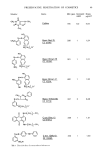
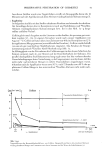
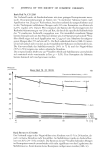
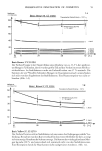
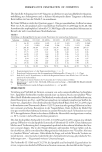
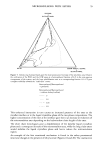
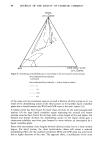
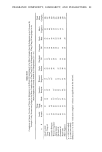
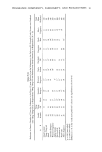
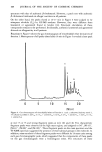
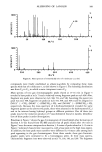
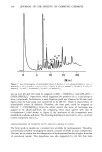
FRAGRANCE COMPLEXITY, FAMILIARITY, AND PLEASANTNESS 95 Table IX Rank Order Correlation Between Exp. 1 and Exp. 2 for the 5 Substances Used in Both Experiments M F Familiarity + 0.4 + 0.7 Complexity + 0.7 + 1.0'* Preference + 1.0'* + 0.9* * = P 0.05 ** = p 0.01 respondents (Table IX). This indicates that the respondents' perception of complexity of a stimulus is not greatly affected by the other stimuli which are being rated at the same time. It means that it is meaningful to speak in a general sense about the complexity of a fragrance stimulus. COMPLEXITY--CREAMS There are a number of striking differences between the complexity z-scores of given stimuli in DMP solution and cream. Linalyl acetate and the Lavender Bouquet were rated more complex in solution than in cream for Alpha Ionone and the Peach Base the reverse was true. As a result, the rank order correlation between the complexity ratings in solutions and in cream, although positive, is not significant (Table X). Table X Rank Order Correlation Between Solutions and Creams Familiarity Complexity Preference M -I- 0.830'* -I- 0.418 + 0.503 F +0.770** + 0.315 + 0.445 ** = p 0.01 In our judgment two factors may well be responsible, at least in part, for these differences: --It has been shown that the vapor composition over perfumed products or solutions, that is, that which is actually being smelled, varies with the product in which the perfume is incorporated or the solvent in which it is dissolved (2). Since the perception of the stimuli in cream and in DMP is therefore likely to be qualitatively different, it is not surprising that their judged complexity is different as well. --The odor intensity of all of the creams was much lower than that of the solutions. This was done on purpose since in actual practice cosmetic creams are usually rather delicately perfumed. It is conceivable that the perceived complexity of a stimulus varies with the intensity in a different way for different stimuli. The correlation between perceived and actual (chemical) complexity was low in creams (Table VIII).

96 JOURNAL OF THE SOCIETY OF COSMETIC CHEMISTS PREFERENCE--SOLUTIONS As in the case of complexity, the z-score range for preference was considerably lower in the present experiment than in our first one (Table VIII). However, the rank correlation of preference scores for the 5 stimuli common to both studies was very high, both with male and female respondents (Table IX). PREFERENCE--CREAMS As in the case of complexity, there were some striking differences between preference ratings for the same materials in solutions and creams. Ylang Oil received a considerably better rating in cream than in solution, whereas the reverse was true for Alpha Ionone and for Peach Base. The rank correlation of preferences between the two media was again, although positive, not significant (Table X). In addition to the two considerations given above for complexity, the difference between creams and solutions may well be related to the fact that people consider different types of odors appropriate for a cream than for a perfume. CONCLUSION The main finding from our previous study, that is, that fragrance complexity as perceived by untrained respondents is a meaningful, measurable concept, was confirmed in the present study. It was given additional support by the finding that the perceived complexity rankings of a subset (5 substances included both in the first and in the present test) were independent of the nature of the total set. Also confirmed were our findings that women discriminated better between fragrances in terms of complexity and that their complexity ratings correspond more closely to the actual (chemical) complexity of the substances than did the male respondents. The finding that the male respondents (but not the females) gave a significant negative correlation between perceived complexity and preference, that they, in other words, preferred the substances which they regarded as simple, was confirmed in this study. Likewise the finding that the female respondents (but not the male ones) gave a significant positive correlation between familiarity and preference was confirmed. When the same substances which had been studied in solutions were incorporated in creams, the responses to them were different both in terms of preference and in terms of perceived complexity only the familiarity rankings were significantly correlated in both media. There were no significant correlations, either for male or for female respondents, between perceived complexity, familiarity, and preference in creams. Notwithstanding the fact that the present study yielded gratifying confirmations of our earlier findings, there were clear indications that by giving ten stimuli to the respondents requiring 45 paired comparisons in each session, and by placing the complexity question in the second session, we had overtaxed our respondents. These findings will be taken into account in future work.
Purchased for the exclusive use of nofirst nolast (unknown)
From: SCC Media Library & Resource Center (library.scconline.org)