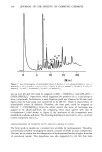
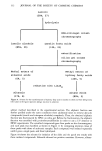
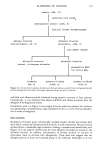
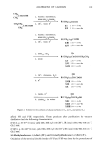
102 JOURNAL OF THE SOCIETY OF COSMETIC CHEMISTS FRACTIONATION OF HYDROGENATED LANOLIN Florisil (30 g) dispersed in benzene was packed into a glass column with 2.5 cm i.d., and the packing washed with benzene. Hydrogenated lanolin (1.5 g) dissolved in benzene was placed on the column, and eluted with 300 ml of benzene and then with 300 ml of methanol. Each eluate was collected and concentrated under reduced pressure. Benzene and methanol eluates were 77 and 23%, respectively. HYDROLYSIS OF LANOLIN Commercial lanolin (30 g) dissolved in 350 ml of ethanol was added to a solution consisting of 300 ml of water, 200 g of potassium hydroxide, and 350 ml of ethyleneglycol monomethyl ether. The mixture was refluxed for 8 hr. The mixture was extracted with three 500 ml portions of ether. The ethereal layers were combined, washed with water, dried, and the ether was evaporated to give 11.8 g of unsaponifiable matter. The residual aqueous mixture was made acidic with hydrochloric acid, and extracted with three 500 ml portions of ether. Combined ethereal layers were washed with water, dried, and the ether distilled off to afford 15.7 g of acidic residue. PURIFICATION OF ACIDIC RESIDUE Silica gel (30 g) was added to a solution of 5% potassium hydroxide in 80 ml of isopropanol-ether (1/1). The resulting suspension was stirred for 10 min, packed into a glass column with 2.5 cm i.d., and washed with 300 ml of ether. The acidic residue (1.5 g) obtained from lanolin was placed on the column, and 300 ml of 2% methanol in ether was passed through the column to elute trace amounts of unsaponifiable matter. Then, acidic matter was eluted with 600 ml of 2% formic acid in ether. The eluate was concentrated to 200 ml, washed with water, and dried. After evaporation of ether under reduced pressure, 1.32 g of purified acidic residue was obtained. SEPARATION OF FATTY ACID AND HYDROXY FATTY ACID FROM ACIDIC RESIDUE The acidic residue (6.56 g) was esterified with sulfuric acid-methanol to afford 7.10 g of methyl esters. Silica gel (30 g) dispersed in benzene was packed into a glass column with 2.5 cm i.d., and 2.0 g of methyl esters were placed on the column. With 300 ml of benzene, fatty acid methyl esters were eluted. Then 0.04 g of a mixture of fatty acids and hydroxy fatty acid methyl esters was eluted with 300 ml of chloroform. Finally, 0.61 g of hydroxy fatty acid methyl esters was eluted with 300 ml of ether. GENERAL PROCEDURES FOR LITHIUM ALUMINUM HYDRIDE REDUCTIONS A little excess of lithium aluminum hydride was added to a sample dissolved in anhydrous ether (12), and the solution was refluxed for an hour. Ether saturated with water was cautiously added to the solution, and then 2N sulfuric acid was added in order to dissolve aluminum oxide. The resulting solution was extracted twice with ether. Ethereal layers were combined, washed with water, dried and evaporated under reduced pressure.

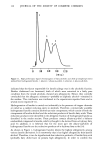
ALLERGENS OF LANOLIN 103 SEPARATION OF ALIPHATIC COMPOUNDS FROM HYDROGENATED LANOLIN BY THE UREA ADDUCT METHOD Commercial lanolin (20 g) was reduced with lithium aluminum hydride as described above. The resulting hydrogenated lanolin was separated into two fractions (benzene and methanol) by column chromatography on Florisil, and 4.32 g of a methanol eluted fraction obtained. The methanol fraction (0.5 g) and 4 g of urea were dissolved in 70 ml of benzene-methanol (1/2), and 15 g of Celite 545 added to the solution. Solvent was gradually evaporated at 30øC under reduced pressure. The residue was dried under reduced pressure, and ground to a powder with a spatula. The powder was packed into a 2.5 cm i.d. glass chromatographic column and washed with 200 ml of isooctane to elute alicyclic compounds, which did not form adducts with urea. Then, 300 ml of benzene-methanol (1/2) was passed through the column. The eluate was collected and concentrated under reduced pressure. Water was added to dissolve urea, and the resulting solution transferred to a separatory funnel. The solution was extracted with two 100 ml portions of ether. The combined ethereal layers were washed with water, dried, and evaporated to give 0.23 g of aliphatic compounds. The obtained aliphatic compounds were treated three additional times by the urea adduct method described above to remove alicyclic compounds completely. A combined yield of 1.47 g of aliphatic compounds resulted when the 4.32 g of material from the methanol fraction was processed as described above. ISOLATION OF ALIPHATIC DIOLS BY HPLC Because of the absence of UV absorption, the aliphatic compounds obtained above were esterified with p-nitrobenzoylchloride as follows. An excess of p-nitrobenzoyl- chloride (2 g) was added to the aliphatic compounds (1.47 g) dissolved in 5 ml of pyridine. The solution was stirred at 50øC for an hour. After cooling to room temperature, the solution was transferred into a separatory funnel with ether, and water was added. The ethreal layer was washed with 0.5N hydrochloric acid, 5% sodium carbonate solution and water, dried, and then evaporated. The obtained product was subjected to HPLC as described below. In HPLC experiments, a chromatographic column packed with LiChroprep SI 60 (Merck, Lobar column Size C) and a Milton Roy Model 396-57 pump were used. The eluent consisted of dichloromethane (21%), dichloromethane saturated with ammonia (9%), and n-hexane (70%). The flow rate was 7 ml per min. Elution was detected at 254 nm. After the chromatography, esters were hydrolyzed with 0.5N alcoholic potassium hydroxide, and 1.16 g of alkanols, 167 mg of alkane-o•,odiols, and 58 mg of alkane-c•,/5-diols obtained. CONDITIONS OF GAS CHROMATOGRAPHY AND GC-MS Trimethylsilylation was carried out at 50øC for 20 min with TMS-HT (Tokyo Kasei, Tokyo, Japan). A Shimadzu 4BM-PF gas chromatograph equipped with a dual flame ionization detector was used for all experiments. The column was Pyrex glass, 1 m long, 3 mm i.d., packed with Chromosorb W (AW. DMCS. 60-80 mesh) coated with 3% w/w
Purchased for the exclusive use of nofirst nolast (unknown)
From: SCC Media Library & Resource Center (library.scconline.org)