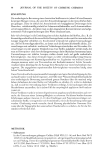
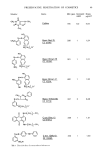
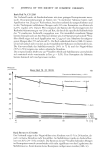
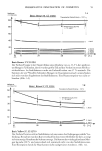
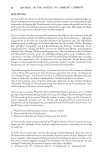
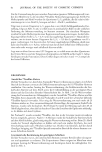
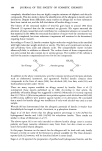
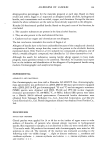
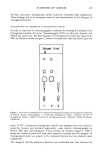
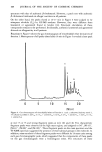
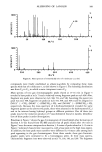
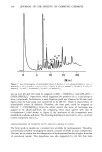
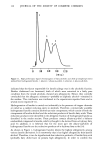
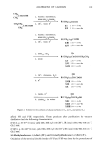
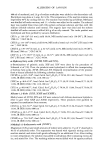
110 JOURNAL OF THE SOCIETY OF COSMETIC CHEMISTS 1 13 15 14 10 121 i . 89 1• i i i 0 õ 10 15 20 (Min) Figure 7. Gas chromatogram of trimethylsilyl ethers of fraction 4. 1-16. alkane-oz,/•-diols (1. n-C•4 , 2. anteiso-C•, 3. n-C•, 4. iso-C•6 , 5. n-C•6, 6. n-C•7 , 7. iso-C•8, 8. n-C•8, 9. anteiso-C•,•, 10. iso-Q,0, 11. n-C•0, 12. anteiso-%•, 13. iso-C==, 14. anteiso-C•, 15. iso-C•4, 16. anteiso-C•5) ions at m/e 103 and 205 could be assigned to (CH2 = OSi(CH,),) + and ((CH0,SiO = CHCH2OSi(CH3)3) + respectively, which suggested the presence of a 1,2-diol group in these compounds. Furthermore, a weak fragment peak was observed at 88 mass units higher than the base peak, and considered to be (M-15) +, which is characteristic of trimethylsilyl ethers of alkanols. Therefore, the base peak could be assigned to (M-103) + (--CH2OSi(CH03). From the above results, the series of homologs was judged to be alkane-oz,fi-diols. By comparing these mass spectra with that of n-hexadecane-l,2-diol shown in Figure 8, the structures of the compounds were established as alkane-oz,fi-diols. The homolog distribution was from C•4 to C25, in which a main component was n-C•6. TRANSFORMATION OF HYDROXY FATTY ACIDS IN LANOLIN TO DIOLS The fatty acids in lanolin are converted into alcohols by hydrogenation. Therefore, commercially available hydrogenated lanolin contains alcohols as main components. This may be the reason that the allergenicity of hydrogenated lanolin is higher than that of unreduced lanolin. This hypothesis was also supported by the fact that main

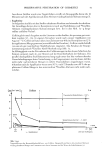
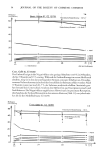
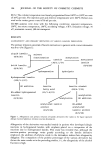
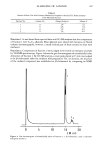
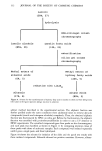
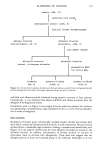
ALLERGENS OF LANOLIN 111 lOOO z z 1000 - 50 100 % 15 " ' • 0 .... I .... ! .... I .... I1''''1 .... I .... I''''11'' 150 200 M/E •20 / 250 300 350 400 M/E Figure 8. Mass spectrum of trimethylsilyl ether of n-hexadecane-l,2-diol. -15 - 0 450 aliphatic components of the allergenic fraction of hydrogenated lanolin were diols such as alkane-cejg-diol and alkane-ce,c0-diol as described above. To confirm this hypothesis, lanolin was hydrolyzed to give its fatty acid portion. Then, this portion was purified as shown in Figure 9, and separated into alkanoic acids and hydroxy fatty acids, which were then converted into diols. The diols obtained were examined for allergenicity. As shown in Figure 9, only one patient exhibited a positive reaction to hydroxy fatty acid methyl esters. However, diols obtained from them by reduction showed strong allergic reactions in four patients. The results of this study demonstrated that the alkane diols are a cause of hydrogenated lanolin allergy. They also suggest that the alcohol groups of the alkane diols are the active sites responsible for their allergenicity. Hence, we tried to isolate alkane-cejg-diol and alkane-ce,c0-diol from hydrogenated lanolin. ISOLATION OF DIOLS FROM HYDROGENATED LANOLIN Commercial anhydrous lanolin was reduced with lithium aluminum hydride. The resulting hydrogenated lanolin was separated into two fractions by column chromatog- raphy on Florisil. The methanol fraction (allergenic fraction) was further treated as shown in Figure 10. The allergenic fraction was separated into aliphatic and alicyclic fractions by the urea
Purchased for the exclusive use of nofirst nolast (unknown)
From: SCC Media Library & Resource Center (library.scconline.org)