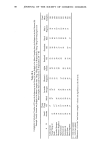
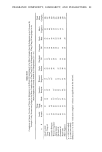
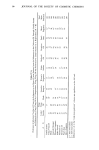
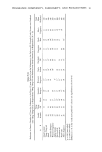
J. Soc. Cosmet. Chem., 34, 83-97 (March/April 1983) Perceived fragrance complexity and its relationship to familiarity and pleasantness II DR. J. STEPHAN JELLINEK, DRAGOCO, 3450 Itolzminden, oo German Federal Republic, and EGON P. KOSTER, P•ychological Laboratory, Utrecht University, Varkenmarkt 2, Utrecht, The Netherlands Received August 31, 1981. Presented at the 1 lth IFSCC Congress, Venice, Italy, September 1980. Synopsis 48 subjects (23 male, 25 female) rated the familiarity of 10 odors varying in chemical complexity from single odorous materials to complex perfumes. The results of these ratings were compared with the results of two experiments in which the same subject judged the perceived complexity of the odors and their pleasantnes• using a paired comparison method. Five of the odors used had also been used in a previous study of similar design. The ranking of perceived complexity of these 5 was highly correlated to the ranking obtained in the previous study, confirming that perceived complexity is a meaningful and measurable concept with untrained respondents. In men but not in women, there was a significant negative correlation between perceived complexity and preference. In women but not in men, preference was positively correlated with familiarity. Familiarity and perceived complexity were unrelated both in men and in women. Women discriminated more strongly between the stimuli in terms of complexity, and their perceived complexity rankings were more highly correlated to chemical complexity than the men's. All of these findings confirmed the findings of the earlier study. A different group of 47 respondents (23 male, 24 female) participated in a parallel experiment of identical design in which the 10 odors were incorporated in a cosmetic cream. Rank order correlations between perceived complexity of the same stimuli in creams and in odorless solvent solutions were positive but not significant the same was true for the preference ratings. Only between the familiarity ratings of the same stimuli in creams and in solutions were the rank order correlations positive and significant. No significant correlations were found between familiarity, pleasantness, and complexity in creams. INTRODUCTION In an earlier publication (1) we have described the findings from a study of 9 olfactory stimuli ranking in chemical complexity from single substances to perfume composi- tions containing well over one hundred different synthetic and natural ingredients. In that study, we established that fragrance complexity is a concept which is meaningful and measurable even to untrained respondents, and that complexity as perceived by such respondents is significantly correlated to complexity in the chemical sense (the 83

84 JOURNAL OF THE SOCIETY OF COSMETIC CHEMISTS number of different components contained in the stimulus) but rather different from perfumers' notions about complexity.* Exploring the relationship between perceived complexity, familiarity, and pleasantness, we found that the female respondents significantly preferred familiar over unfamiliar fragrances while for th6 male respondents the correlation between preference and familiarity, although also positive, was not significant. On the other hand, the male respondents showed a significant preference for simple over complex stimuli this relationship was non-significant with the female respon- dents. In this paper we report on the continuation of the earlier study. Four questions were of special interest to us: --Can we confirm the indications that men like simple fragrances and women like familiar ones, using a different set of fragrance stimuli? --Are the relative perceived complexi(y, pleasantness, and familiarity of a set of fragrance stimuli invariant if the context, i.e., the total range of fragrances examined, is changed? Only if it turns out that complexity is context invariant is it meaningful to talk about the perceived complexity of a stimulus in a general sense. --To what extent are perceived complexity, pleasantness, and familiarity and the relationships between them dependent upon the medium in which the fragrance is presented? In the first study, we had presented the fragrances "as such," i.e., in the form of solutions in an odorless solvent. It is quite conceivable that the responses would be different if the same fragrance stimuli are presented in a product such as a cream or a soap. --The final question was a methodological one. In the first study we elicited the complexity and the pleasantness data through a paired comparison design. If one wants a fully balanced design in which each stimulus is compared to all others, this places strict limitations on the range of fragrances that can be examined in one study, because with an increasing range the task demanded from each respondent soon becomes excessive. Nine fragrances, as used in our first study, required 36 paired comparisons, 10 fragrances, as used in this one, 45. We have examined the possibility of a monadic design in which each stimulus is rated individually. In the present paper, the findings with respect to the first 3 questions shall be discussed the methodological final question will be the subject of a future publication. *We must correct a statement made in the discussion of our previous paper (Ref. 1, p. 260). Contrary to our statement, the positive correlation between chemical and perceived complexity (rho = 0.71) was significant at the level p 0.05 the correlation between perfumers' complexity rankings and chemical complexity was about equally high (rho = 0.69, also significant at p 0.05). It is interesting to note that while both complexity as perceived by the layman and as perceived by the perfumer are thus positively correlated. with chemical complexity, the correlation between the perfumers' view and the laymen's view is very 'much lower (rho = 0.19). Our statement about "the perfumers'" intuitions regarding complexity (being) unreliable as predictors of the untrained subject's "responses" remains valid.
Purchased for the exclusive use of nofirst nolast (unknown)
From: SCC Media Library & Resource Center (library.scconline.org)