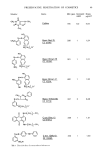
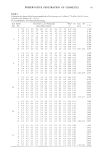
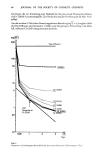
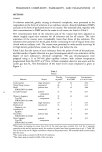
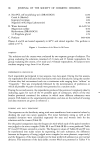
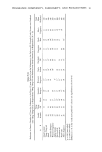
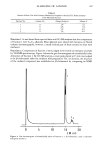
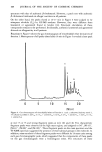
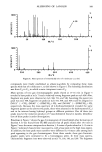
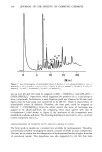
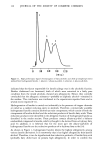
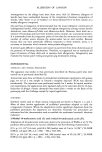
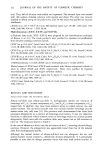
FRAGRANCE COMPLEXITY, FAMILIARITY, AND PLEASANTNESS 85 METHOD STIMULI 10 odorous materials, greatly varying in chemical complexity, were presented to the respondents in the form of solutions in an odorless solvent, dimethyl phthalate (DMP), and also in the form of perfumed water-in-oil creams. The materials used, together with their concentrations in DMP and in the water-in-oil cream, are listed in Table I. The concentrations both of the solutions and of the creams had been adjusted to obtain roughly equal odor intensity for all solutions and for all creams. The odor intensities of the creams were considerably lower than those of the solutions. The solutions were presented in 20 ml glass bottles containing 0.5 ml of liquid these were closed with an ordinary cork. The creams were presented in wide-mouth screw-top 50 ml high density polyethylene cream jars, filled to just below the rim. Table I also lists the nature of each substance from the point of view of the perfumer, and the number of peaks obtained in a gas chromatogram which is an indication of the degree of each substance's chemical complexity. The gas chromatograms were prepared using a 21 m OV-IO! glass capillary column, with column temperature programmed from 60-2!0øC at 4ø/min. A flame ionization detector was used, and the carrier gas was N2. The formulation of the water-in-oil cream employed is given in Figure 1. Table I Stimuli Number Concentration Concentration Material Nature of peaks (a) % in DMP % in w/o Cream single substance 6 © 10 0.50 essential oil 40 5 0.15 perfume base 21 10 0.80 Linalyl acetate Ylang Ylang oil extra Musk (DRAGOCO 0/213650) Lavender bouquet perfume 52 10 0.35 composition Women's fragrance perfume 79 10 0.30 Type RG composition 79 (DRAGOCO 0/513490) Alpha Ionone single substance 13 ¸ 5 0.35 Patchouli oil essential oil 34 5 0.15 Singapore, rect. Geranium oil essential oil 56 5 0.15 Egyptian' Peach Base perfume base 49 5 0.05 (DRAGOCO 0/139459) Men's fragrance perfume 88 10 0.25 Type PR composition (DRAGOCO 0/216587) (a)Only peaks accounting for more than 0.1% of the total area were counted. For 4 of the 5 materials common to this and the previous study, the number of peaks listed here is greater than in ref. 1, Table VII. This is due to the use of a higher resolution column in the present study. The materials used in both studies were the same. (b)One major peak accounts for %.5% of the total area. (C)One major peak accounts for 88% of the total area.

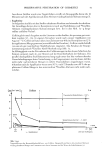
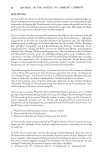
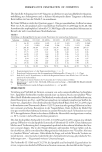
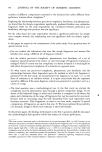
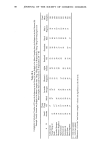
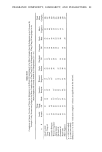
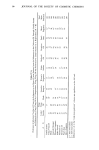
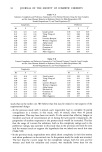
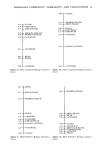
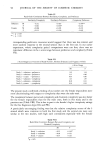
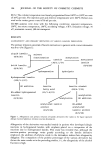
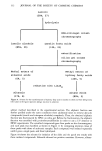
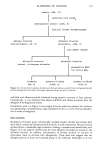
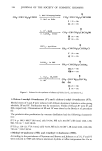
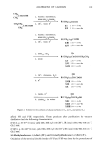
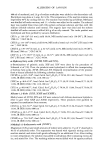
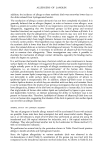
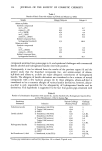
86 .JOURNAL OF THE SOCIETY OF COSMETIC CHEMISTS A. Neo-PCL self emulsifying w/o (DRAGOCO) Cetiol A (Henkel) Isopropyl myristate Nipasteril 30 K (Nipa Laboratories) B. Water deionized Magnesium sulfate Hydrovitone (DRAGOCO) 1,2-Propylene glycol C. Perfume 22.0% 3.0% 3.0% 0.3% 64.4-65.15% 0.5% 3.0% 3.7% 0.05-0.8% Phases A and B are heated separately to 80 ø C and stirred together. The perfume is added at 35 ø C. Figure 1. Formulation of the Water-In-Oil Cream SUBJECTS The solutions and the creams were evaluated by two separate groups of subjects. The group evaluating the solutions consisted of 23 male and 25 female respondents the group evaluating the creams, of 23 male and 24 female respondents. All subjects were students ranging in age from 18 to 30 years. EXPERIMENTAL PROCEDURE Each respondent participated in two sessions, two days apart. During the first session, the respondents first indicated their familiarity with each stimulus by rating the number of times they had encountered each on a continuous scale ranging from "seldom" to "frequently." This was immediately followed by the determination of preference, in which all possible 45 pairs of stimuli were presented in a random order. During the second session, the respondents produced the perceived complexity data by indicating, again for each of the 45 possible pairs of substances, which of the two bottles presented contained the mixture in which most different substances were present. Full details on the experimental procedure, and also on the method of scoring and data treatment are given in reference 1. SCORING AND DATA TREATMENT The responses on the familiarity rating scale were transformed into numerical values by dividing the scale into seven segments. The mean familiarity rating as well as the standard deviation were calculated separately for men and women both for the solutions and the creams (Table II). For the paired comparison data the frequencies with which each of the paired members was judged to be more complex (Table IIIA and Table III B) or more preferred (Table IV A and IV B) were entered in a matrix. The frequency values of Tables III and IV may be transformed into scalar values by expressing, for each substance, the difference between its frequency of being judged more complex (or more pleasant, respectively) and the frequency of the least complex (or the least preferred) substance as unit normal deviates. This treatment of the data yields z-scores which are presented in Tables V A
Purchased for the exclusive use of nofirst nolast (unknown)
From: SCC Media Library & Resource Center (library.scconline.org)