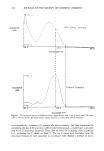
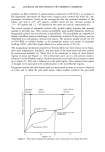
266 JOURNAL OF THE SOCIETY OF COSMETIC CHEMISTS testing of untreated and modified hair in the wet state. It is defined as the ratio of work regained in unloading from 20% extension to the work required to extend by 20% (W20 see loading and unloading stress-strain curves in Figure 1). The authors studied the effect of various degradative and nondegradative treatments such as bleaching, reduc- tion and blocking, reactions with ninhydrin, formaldehyde, phenylisocyanate, mercuric acetate, etc. on the hysteresis ratio and its dependence on temperature. For untreated hair, the loading and unloading curves yield an increasing hysteresis ratio with in- creasing temperature. This study showed that the work of unloading and especially the shape of the unloading curve vary appreciably with temperature and chemical modifi- cation. It was also suggested from a spring-dashpot model of a keratin fiber that the apparent second-order phase transition, observed by plotting the hysteresis ratio versus temperature, is related to a change in the viscosity of the matrix. DYNAMIC MECHANICAL MEASUREMENTS A rocking beam oscillator, an apparatus originally developed by Tokita (12), was ap- plied to the study of untreated and modified hair fibers (13). The measurements per- formed at low strain and 75% RH yield values of longitudinal elastic modulus (E') and of loss modulus (E"), a measure of the irreversible loss in energy when the fiber is extended. For virgin hair at 25øC, E' and E" were found to be (4.1 ___ 0.66) ß 10 • pascals and (0. 177 --- 0.027)' 10 • pascals, respectively. Considerable scatter in the values of E' and E" was ascribed to difficulty in accurately determining the cross-sec- tional area of the keratin fiber. The technique was sensitive to hair modifications in- volving binding of organic molecules, reduction, and impregnation of hair with polymer. The values of the real (G) and imaginary (G') parts of the torsional modulus determined under dry and wet conditions provide useful information about the matrix, the water- accessible phase of the fiber (6,14). The measurements were performed by the use of a free-swinging torsional pendulum. For virgin hair at 25øC and 65% RH, the torsional modulus G and logarithmic decrement 8 (related to the loss modulus G' by the equa- tion G' = GS/w) were found to be (1.02 --- 0.09)' 10 • pascals and 0.4 ___ 0.05 respectively. The data reported for heat-set, bleached, dyed, waved, and relaxed hair demonstrated that the changes in both G and G' can be related to the configurational stability in water and can be of some utility in predicting the setting behavior of hair. SWELLING MEASUREMENTS The swelling of hair in water, determined by the liquid retention technique, was found to be in the range 31-33 percent (15). The experimental procedure involves measuring the amount of liquid retained by hair after a 30-min equilibration in water or other specified solvent. The pH does not have a detectable influence on swelling in the range 2-9. Further increase in pH, especially above 10, causes considerable expansion. Re- duction of pH below 2 results in a slight increase in swelling. Swellability of 40-50% above pH 10 probably signifies hydrolytic decomposition of the keratin structure and consequently loss of cohesion of fibrous material. This method had been applied to

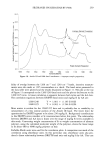
HAIR DAMAGE 267 determine the extent of loss in crosslinking density in wool keratin from reduction, bleaching, dyeing etc. FRICTION AND COMBABILITY MEASUREMENTS Inter-hair friction measurements, performed by the twist method of Lindberg and Gralen (16), provided useful information about the degree of cuticle damage and the response of hair fibers to physical handling (17). Static and kinetic coefficients of fric- tion for root-to-tip and tip-to-root directions were calculated and used to interpret chlorine-hair interactions. Combing work or force determination can also be a good indication of the degree of surface modification or damage. The details of experimental techniques, which consist of suspending a hair swatch from a force-measuring device, inserting a comb close to the root end of the swatch, setting the comb in a straight-combing motion through the swatch at a constant speed, and continuously recording the forces that resist its motion during transit from the point of insertion till it clears the tip end of the swatch, were described in a few papers (18, 19). The experiments can be performed on dry hair at constant relative humidity or on wet samples, and should be referenced to a control swatch of untreated hair. This method is sensitive to the presence of surface deposits which can either decrease (lubricants such as cationic surfactants or silicon oils) or in- crease (dye or polymer deposits) the frictional coefficients and, consequently, combing forces (20). THERMOMECHANICAL ANALYSIS (TMA), DIFFERENTIAL THERMAL ANALYSIS (DTA), AND THERMOGRAVIMETRIC ANALYSIS (TGA) TMA, DTA, and TGA were utilized to assess thermally-induced viscoelastic and di- mensional transitions in untreated and modified keratin fibers in the temperature range -50 to 325øC (21). In the TMA experiment, penetration and extension thermograms showed two transitions, at 59-72øC, corresponding to side-chain motions of the pro- teins, and at 242øC, resulting from melting of the or-helix. The low-temperature TMA transitions were covered under the broad DTA endotherm and are not distinguishable in the TGA analysis except for about 10% weight loss, presumably related to water evaporation. The high-temperature TMA transitions are also evident as an inflection in the TGA and two sharp endotherms in DTA traces. ELECTRON SPECTROSCOPY FOR CHEMICAL ANALYSIS (ESCA) This ø technique provides valuable information about the hair surface to a depth of 20 to 30 A (22). It involves irradiation of a fiber with X-rays of known energy, which causes core electrons to be ejected from the sample. Their binding energy is related to specific atoms and functional groups, thus unraveling the chemical composition of the fiber surface. In the case of human hair, this technique was found useful to study the oxida- tion of disulfide sulfur during bleaching, removal of lipid from hair, and weathering by UV radiation (22).
Purchased for the exclusive use of nofirst nolast (unknown)
From: SCC Media Library & Resource Center (library.scconline.org)