j. Soc. Cosmet. Chem., 39, 159-167 (May/June 1988) Two new and rapid approaches for studying the phase properties of cosmetic lipids and oils MARTIN CAFFREY and MARIA T. BYWATER, Department of Chemist•, The Ohio State University, 120 W. 18th Avenue, Columbus, OH 43210. Received.July 13, 1988. Synopsis Lipids and oils, integral components of cosmetic products, exist in a number of intermediate physical states, or mesomorphic phases, between the crystalline solid and isotropic liquid. The stability of these phases depends on temperature and composition, and each lipid's pattern of dependency is conveniently described in the form of an isobaric (constant pressure) temperature-composition phase diagram. Such diagrams are of great utility in guiding the choice of formulation ingredients for inclusion in cosmetic products and for obviating such manufacturing problems as caking and immiscibility. This paper describes two new and related methods of collecting mesomorphic phase information which are less time-consuming and more efficient than conventional techniques. By incorporating a range of conditions into each sample preparation--a temperature gradient in the first method and a lyotrope gradient in the second--and utilizing a new method of phase identification called time-resolved x-ray diffraction, the time required to collect phase information for a complete diagram is reduced to minutes. Temperature-composition phase diagrams constructed using these methods compare well with those constructed by conventional means. INTRODUCTION Lipids and oils are integral components of many cosmetic products, and an under- standing of a particular lipid's properties is essential in designing products and efficient processing procedures. However, lipids and oils exhibit some unconventional properties which can make their behavior unpredictable. Lipids can exist in a number of intermediate phase states, or mesomorphs, between the crystalline solid and the isotropic liquid that result from differences in the way the lipid and solvent (usually water) molecules arrange themselves in three-dimensional space. These molecular arrangements combine elements of order as found in crystals and dis- order as found in liquids. As such, the phases constitute what might be considered a fourth state of matter: the so-called liquid crystalline state. Although most lipids dis- play the same basic mesomorphic phases, each individual species exhibits its own pat- tern of dependency on temperature and composition. The same holds true for mixtures 159

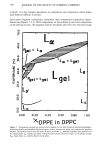
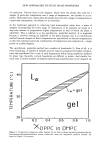
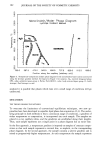
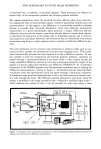
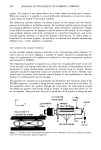
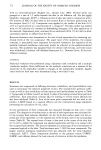
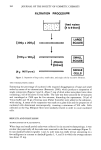
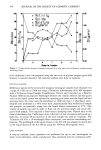
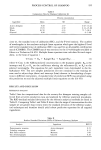
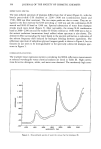
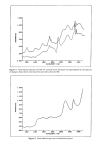
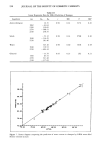
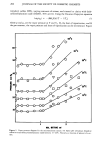
160 JOURNAL OF THE SOCIETY OF COSMETIC CHEMISTS of lipids. It is this complex dependence on temperature and composition which makes lipid behavior difficult to predict. Lipid phase diagrams conveniently summarize these temperature-composition depen- dencies (see Figures 1,2,3). With temperature on the ordinate (y-axis) and composition on the abscissa (x-axis), the diagrams indicate the phases that exist over the entire range I I I ß L Pgel* Ltl Pgel + Lgol 0.00 0.20 L L(= ß Lgel gel I I I 0.40 0.60 0.80 Lo Lc I .00 DPPE in DPPC Figure 1. Temperature-composition isobaric phase diagram for the fully hydrated dipalmitoylphosphati- dylcholine/dipalmitoylphosphatidylethanolamine system constructed using the temperature gradient method. The notation used is that of Luzzati (8) and is as follows: Lo lameliar crystalline (also referred to as the subgel phase) L•,, lameliar gel phase with hydrocarbon chains tilted with respect to the bilayer normal Pgeh ripple phase L=, lameliar liquid crystal phase.
Purchased for the exclusive use of nofirst nolast (unknown)
From: SCC Media Library & Resource Center (library.scconline.org)