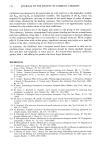
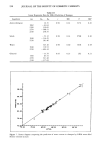
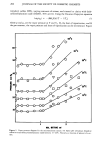
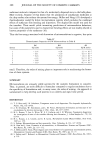
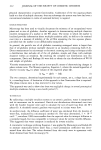
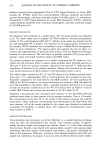
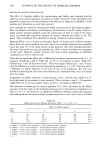
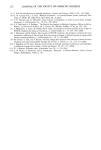
174 JOURNAL OF THE SOCIETY OF COSMETIC CHEMISTS Table II Distribution of the Test Compounds Following Topical Administration Data Expressed as a Percentage of the Applied Dose Compound Amount Skin absorbed wash Epidermis Dermis Surrounding tissue Recovery AETT (7) 32.5 -+ 2.03 Testosterone (14) 35.4 -+ 1.29 Triamcinolone acetonide (14) 14.5 + 1.19 Salicylic acid (6) 11.4 + 1.09 5-MOP (5) 69.9 --- 1.61 8-MOP (7) 66.4 + 1.42 Benzoic acid (6) 30.5 --- 2.69 Dihydrotestos- terone(11) 29.6 --- 1.54 Aspirin (6) 16.7 + 2.00 Hydrocortisone (7) 9.80 --- 0.37 Fumaric acid (6) 0.62 + 0.09 Caffeine (6) 71.8 -+ 1.80 Propylene glycol (7) 20.3 + 2.91 Nicotinic acid (7) 9.00 + 1.73 Nicotinamide (7) 15.3 --- 0.73 Urea (6) 9.68 --- 0.66 Glycerol (7) 7.34 + 0.88 19.1 --- 0.89 13.6 + 1.81 55.4 --- 1.80 2.63 --- 0.17 80.9 + 1.37 4.19 + 0.44 83.4 --- 0.82 10.1 _+ 1.94 15.3 + 1.29 1.05 4- 0.16 20.1 + 1.63 0.93 + 0.13 53.0 + 3.99 3.23 --- 0.39 46.5 + 1.38 8.81 + 0.57 78.7 + 0.46 6.69 --- 0.41 71.0 -+ 0.79 6.92 -+ 0.74 98.0 + 0.00 4.81 _____ 0.87 32.4 + 2.08 0.95 - 0.21 46.1 ___+ 1.87 1.84 _____ 0.14 75.5 --- 2.67 11.2 + 1.13 78.2 + 2.87 3.15 --- 0.30 85.5 + 3.25 3.03 + 0.36 90.3 + 2.51 5.56 + 1.50 4.89 + 0.72 15.4 + 2.10 87.7% 1.49 + 0.11 4.59 + 0.49 99.8% 0.62 + 0.10 2.92 4- 0.65 103.5% 1.26 + 0.34 1.70 + 0.34 108.0% 0.65 --- 0.13 12.7 + 2.37 99.8% 0.36 + 0.07 7.36 + 1.79 95.3% 0.78 --- 0.15 1.94 + 0.49 89.6% 2.50 + 0.16 7.09 + 0.78 95.0% 0.88 -+ 0.17 4.38 4- 1.22 107.6% 0.90 + 0.11 3.09 + 0.43 91.9% 0.40 _____ 0.10 0.00 + 0.00 103.8% 0.16 + 0.03 1.86 + 0.39 107.3% 0.27 -+ 0.06 0.36 -+ 0.06 68.9% 1.90 + 0.31 3.27 + 0.85 101.4% 0.65 _+ 0.09 0.88 4- 0.15 98.6% 0.24 ___ 0.06 0.19 + 0.04 98.7% 1.07 + 0.17 2.03 + 0.45 106.8% Values are the mean of the total Compounds were applied to the washed at 24 h. amount applied ___ SEM of the number of determinations in parentheses. skin in an acetone vehicle (• 4 •tg/cm2), and the surface of the skin was Rapidly penetrating compounds seem unlikely to form a reservoir in skin. A negative correlation was observed between reservoir formation and percutaneous absorption (Table III). No correlation was seen when either protein binding (K a values) or O/W partition coefficients were compared with reservoir formation of compounds in the complete data set. If an homologous series of compounds had been chosen for study, correlations between protein binding, lipophilicity, and reservoir formation may have been more easily observed. Five rapidly absorbed compounds were retained only slightly in the skin they were therefore excluded in the partial data set formed to examine correlations with solubility and binding among reservoir-forming compounds. Significant rank correlations were obtained between reservoir formation and two solubility parameters using the partial data set: (i) the octanol/water partition coefficient and (ii) a lack of water solubility. The negative correlation between reservoir and octanol solubility was not significant. This would indicate that reservoir formation occurs with compounds that have a high ratio of lipid-to-water solubility, possibly because of a requirement for dissolution in the stratum corneum. However, the solubility in water and lipids should remain low so that permeation into lower layers of the skin does not readily occur.

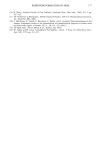
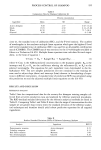
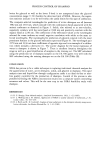
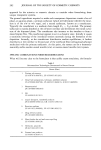
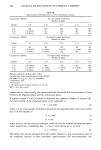
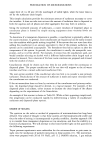
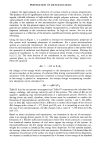
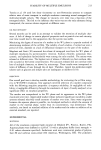
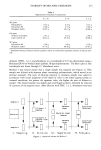
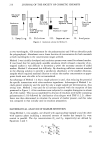
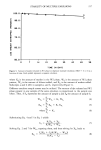
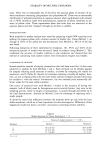
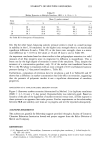
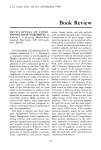
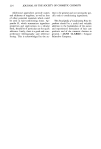
RESERVOIR FORMATION IN SKIN 175 Table III Spearman Rank Correlation Coefficients Complete Partial Correlation pair data set data set • Reservoir and K a 0.31 0.67 b Reservoir and Ko/w 0.12 0.58 b Reservoir and octanol solution - 0.062 - 0.48 Reservoir and water solution - 0.15 - 0.62 b Reservoir and absorption - 0.52 b 0.13 Absorption and Ko/w 0.51 b 0.53 K• and Ko/,, 0.69 b 0.83 b Excludes five fast-penetrating compounds (testosterone, 5- and 8-MOP, benzoic acid, and caffeine). Significant correlation (p .05). Equilibrium binding constants were determined for the test compounds to bovine serum albumin. A previously reported association constant for aspirin of 4 X 10 3 M- • (14) agrees closely with our findings. The differential binding of 5- and 8-MOP to human epidermal slices (6) was also observed in the affinity of these compounds to bovine serum albumin. The binding of 5-MOP to protein was independent of ligand concentration. A correlation was observed between reservoir formation and the K a values of compounds in the partial data set (Table III). It is clear that protein binding alone could not predict depot formation in skin since the fast-penetrating compounds excluded from the partial data set had, with one exception, good affinity for albumin. It was previously shown for a wide range of compounds that protein binding correlated in a linear, logarithmic manner with the octanol/water partition coefficient of the com- pounds (15). Lipophilicity was therefore thought to promote protein interaction in biological tissue. We have found a significant linear correlation between log Ka and log Ko/w in both the complete and partial data sets (data not shown). Also a high rank correlation was observed between K• and Ko/w in both sets (Table III). Considering all test compounds in this study, the partition coefficient was most predictive of protein binding, marginally predictive of percutaneous absorption, and unable to predict reser- voir formation. The relative contributions of protein binding and lipid/water solubility to reservoir formation were examined using multiple correlation analysis (Table IV). A significant Table IV Multiple Correlation Coefficients (R) and Corresponding Beta Coefficients of Reservoir With Ko/w and log K• Data set R Beta 1 Beta 2 Complete 0.29 0.40 0.23 PartiaP 0.55 b 0.41 0.46 Beta 1 and Beta 2 values indicate the relative contribution to the correlation of the octanol/water partition coefficient and log association constant, respectively. • Excludes five fast-penetrating compounds (testosterone, 5- and 8-MOP, benzoic acid, and caffeine). b Significant correlation (p 0.05).
Purchased for the exclusive use of nofirst nolast (unknown)
From: SCC Media Library & Resource Center (library.scconline.org)