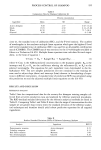
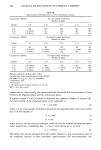
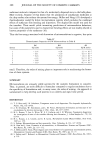
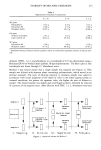
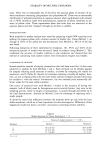
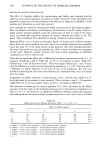
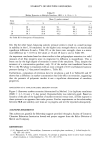
208 JOURNAL OF THE SOCIETY OF COSMETIC CHEMISTS surfactant molecule compared to that of a molecularly dispersed state in the bulk phase. More recently, Rosano (12) has shown that the adsorption of cosurfactant molecules at the drop surface also reduces the system free energy. Miller and Neogi (15) developed a thermodynamic model for dilute microemulsion systems which includes the combined effects of surfactant film bending and dispersion. The duplex film model was used for the interface. Their model yields interesting predictions of microemulsion behaviors, but some of the parameters used to characterize bending effects are not readily related to known properties of the surfactant (16). Thus the free energy associated with formation of microemulsions is negative, but quite Table IV Thermodynamic Properties of O/W Microemulsions in Table II AG AH AS System (kJ/mole) (kJ/mole) (kJ/K mole) 1 -17.4 -6.8 3.5 X 10 -2 2 -18.1 -6.0 4.0 X 10 -2 3 -19.6 -25.0 -1.8 X 10 -2 4 -6.4 18.7 8.2 X 10 -2 5 -14.8 8.7 7.8 X 10 -2 6 - 13.9 11.3 8.3 X 10 -2 small. Therefore, the order of mixing plays an important role in accelerating the forma- tion of these systems. SUMMARY Microemulsions are uniquely stable systems for the cosmetic formulator to consider. They, in general, are more difficult to formulate compared to regular emulsions due to the specificity of formulation and, in many cases, the order of mixing. An approach is summarized to help develop such systems in an orderly and rapid time period. REFERENCES (1) T. P. Hoar and J. H. Schulman, Transparent water-in-oil dispersions: The oleopathic hydromicelle, Nature, 152, 102 (1943). (2) J. H. Schulman, W. Stoeckenius, and L. M. Prince, Mechanism of formation and structure of mi- croemulsions by electron microscopy, J. Phys. Chem., 63, 1677 (1959). (3) H. L. Rosano, T. Lan, A. Weiss, W. E. F. Gerbacia, and J. H. Whittam, Transparent dispersions: An investigation of some of the variables affecting their formation, J. Colloid Interface Sci., 72, 233 (1979). (4) H. L. Rosano, J. L. Cavallo, and G. B. Lyons, Microemulsion Systems (Marcel Dekker, New York, 1987), p. 259. (5) S. Friberg, Microemulsions and their potentials, Chem. Technology, 6, 124-127 (1976). (6) R. Zana and J. Lans, Dynamics of microemulsion, in Microemulsions.' Structure and Dynamics (CRC, Boca Raton, FL, 1987), pp. 153-172. (7) A. Belloca and D. Roux, Phase diagram and critical behavior of a quanternary microemulsion system, Microemulsions: Structure and Dynamics (CRC, Boca Raton, FL, 1987), pp. 33-77. (8) S. Friberg and P. Bothorel, in Microemulsions.' Structure and Dynamics, (CRC, Boca Raton, FL, 1987), p. 219.

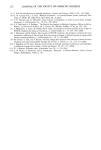
PREPARATION OF MICROEMULSIONS 209 (9) H. L. Rosano, Microemulsions, J Colloid Interface Sci., 44, 242 (1973), and Method for Preparing Microemulsions U.S. Patent 4, 146, 499 March 27, 1979. (10) W. Gerbacia and H. L. Rosano, Microemulsions: Formation and stabilization, J. Colloid Interface Sci., 44, 242 (1973). (11) J. L. Cavallo, and H. L. Rosano, Vapor pressure measurements of an o/w microemulsion system, J. Phys. Chem., 90, 6817 (1986). (12) H. L. Rosano, and G. B. Lyons, Free energy, enthalpy and entropy changes during the formation of a n-hexadecane/potassium stearate/water/1-pentanol microemulsion system, J. Phys. Chem., 89, 363 (1985). (13) K. S. Birdi, Microemulsions: Effect of alkyl chain length of alcohol and alkane, Colloid Polymer Sci., 260, 628 (1982). (14) E. Ruckenstein, The origin of thermodynamic stability of microemulsions, Chemo Phys. Lett., 57, 517 (1978) (15) C. A. Miller and P. Neogi, Thermodynamics of microemulsions: Combined effects of dispersion entropy of drops and bending energy of surfactant films, Aiche, J., 26, 212 (1980). (16) S. Mukherjee, C. A. Miller, and T. Fort, Theory of drop size and phase continuity of microemul- sions, J. Colloid lnterfaceSci., 91, 223 (1983).
Purchased for the exclusive use of nofirst nolast (unknown)
From: SCC Media Library & Resource Center (library.scconline.org)