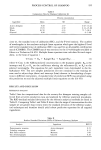
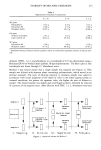
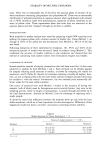
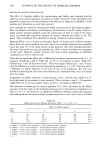
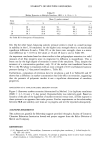
j. Soc. Cosmet. Chem., 39, 191-199 (May/June 1988) Process control of shampoo with near-infrared reflectance spectroscopy PRISCILLA L. WALLING and JACQUELYN M. DABNEY, Advanced Spectroscopy, Helene Curtis Inc., Chicago, IL 60639. Received July 30, I987. Synopsis Near-infrared reflectance analysis (NIRA) was investigated as an "on-line" or "near-line" monitor and possible controller in the manufacturing process for clear shampoos. A sample collection protocol was established in conjunction with a simulated pilot plant shampoo process which would cover the ingredient range encountered at every stage of a batch process of shampoo. The ingredients--total solids, active detergent, water, and glycerol -- were sampled and anlayzed by reference analytical methods. Near-infrared (NIR) optical spectra of the samples were obtained by pumping the shampoo directly into the sampling drawer of a grating instrument. The reference analytical results were correlated with NIR optical spectra in order to obtain prediction equations. The resulting prediction equations accounted for greater than 93% variability between the reference chemical analyses and NIRA. The prediction equations were programmed into a filter NIR instrument suitable for the rugged plant environment. The method was validated using the filter instrument. Quantitative results for all four ingredients were obtained simultaneously using NIRA in less than one minute. Sampling intervals of less than five minutes, including three minutes of sample introduction, were achievable. INTRODUCTION Near-infrared reflectance analysis (NIRA) is a chemometric quantitative analytical tech- nique that is simple, fast, and non-destructive. It uses multiple linear regression sta- tistics to develop a prediction equation relating a reference analytical method to absor- bances in the near-infrared region. In so doing, it automatically compensates for sample matrix effects and background interferences. Because NIRA is a secondary technique, the selection of a training sample set is the most critical step in developing an NIRA calibration. The nature of the training set is dependent upon the analysis required. For example, in the quality assurance of a finished product shampoo, the training set should consist of a representative set of finished product shampoos which are the result of the manufacturing process. In the process control of shampoo, the training set should con- sist of samples at every stage in the process. The training set for the latter cannot be used to predict the former. This is because NIR spectroscopy is dependent on the chemical and physical interactions of the ingredients in the sample matrix. The near infrared region consists of overtones and combination bands which are pri- marily due to hydrogen-stretching vibrations. The shampoo matrix is rich in com- 191

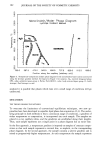
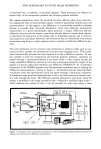
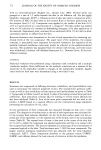
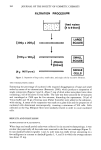
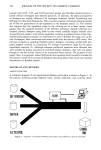
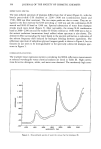
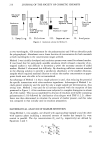
192 JOURNAL OF THE SOCIETY OF COSMETIC CHEMISTS pounds with O-H, C-H, and N-H functional groups and therefore should produce a poorly defined overlapped near-infrared spectrum. In addition, the physical properties of shampoo are highly influenced by hydrogen bonding, further broadening and shifting the vibrational frequencies. This situation requires a minimum training sample set of fifty for quantitation of one ingredient in the shampoo matrix (1). The method also requires that the ingredient range in the training set be at least twenty times greater than the standard deviation in the reference technique. Sample collection of a finished product shampoo using these criteria would normally require months since in-specification product with narrow ingredient variation is produced most of the time. Synthetically prepared samples can sometimes be used to broaden the range, but in the case of shampoo, false correlations with water result since the matrix is 80% water. Our previous attempts at sampling finished product shampoo, including synthetically pre- pared samples, resulted in a maximum 5% average concentration range for the major ingredients analyzed (2). Although adequate prediction equations were obtained that were suitable for quality assurance of a finished product shampoo, they were not robust enough to use for on-line control of an automated batch process. The purpose of this paper, then, is to generate robust NIR prediction equations which would be suitable for the process control of an automated shampoo processing plant from initial raw material introduction to finished product. MATERIALS AND METHODS SAMPLE COLLECTION A schematic diagram of our experimental shampoo pilot plant is shown in Figure 1. In the process, metering pumps dispense water, anionic surfactant, and a premix which DETERGENT NlRA ¾ATER STO GLYCEROL TANK Figure 1. Schematic of simulated shampoo pilot plant using NlRA as a process controller.
Purchased for the exclusive use of nofirst nolast (unknown)
From: SCC Media Library & Resource Center (library.scconline.org)