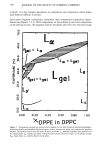
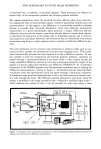
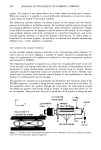
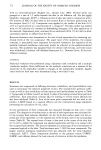
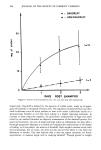
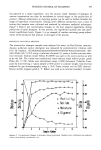
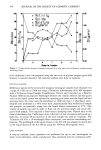
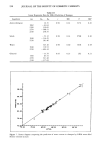
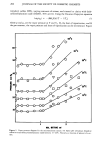
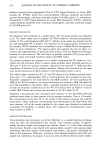
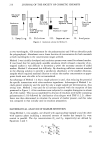
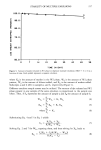
206 JOURNAL OF THE SOCIETY OF COSMETIC CHEMISTS tetradecyl sulfate (STS), varying amounts of octane, and titrated to clarity with dode- cyldimethylamine oxide (DDAO, 30% active). Using the Clausius-Clapeyron equation ln(p/po) = -(AHvR)(1/T - 1/To) (7) where p and Po are the vapor pressure at T and To, H v the heat of vaporization, and R the gas constant, the vapor pressure and heats of vaporization can be determined. Figure ] 2 VOL. OCTAN[ ml Figure 1. Vapor pressure diagram for the microemulsions system: 5% NaCI (pH 12)/sodium hexadecyl sulfate/n-octane/dodecyldimethylamine oxide between 15-40øC. Plotted as a function of amount of n-oc- tane.

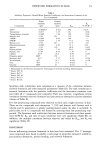
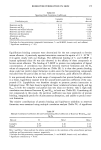
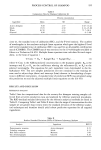
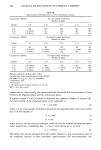
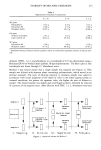
PREPARATION OF MICROEMULSIONS 207 1 depicts the vapor pressure as a function of n-octane volume at various temperatures. The presence of an oil significantly reduces the vapor pressure of the solution, similar to regular colloidal solutions or high-molecular-weight polymer solutions, whereby the vapor pressure of the system is less than that of the continuous phase. Also revealed in the plots is the existence of two microemulsion regions distinguished by the sharp transition. In the low-pressure region and hence lower oil content, the microemulsion particles are isolated non-interacting droplets encapsulated by a surfactant film and are dispersed uniformly in the continuous medium. At high oil contenr, the rise in the vapor pressure is a reflection of the dynamic equilibrium between particle merging and reforming. Using the data in Figure 1, it is possible to estimate the thermodynamic properties of this system with increasing adsorption of cosurfactant. For a given microemulsion system at a particular temperature, the minimum amount of cosurfactant required to form the microemulsion varies with the amount of continuous phase in the system while the quantities of surfactant and dispersed phase are being held constant. Plotting the amount of cosurfactant vs. the volume of continuous phase reveals a linear relationship (4,9,12,13). The mole fraction of the cosurfactant at the interface, x•, and in the aqueous phase, x b, can be determined from the intercept and the slope, respectively. From the equation AG - -RT In Xi/Xb (5) the change in free energy which corresponds to the adsorption of cosurfactant at the oil-water interface in the presence of surfactant film during microemulsification can be calculated. If the the same procedure is repeated at various temperatures and the change in free energy is plotted vs. temperature, the entropy change accompanying cosurfac- tant adsorption can be calculated via -- AS = (•/AG/•/T)p Table II lists the six systems investigated and Table IV summarizes the calculated free energy, enthalpy, and entropy values for each of the systems. The values of AG are all negative, signifying that microemulsification is a spontaneous process. However, the driving forces are small therefore, other factors must be considered to explain the formation of microemulsions satisfactorily. Also consider systems 1 and 3: the differ- ence in their AG values resulted from a difference in carbon chain length of the oils and AG changes with a value of - 275 J/mol per CH 2 unit. It is interesting to note that in the case of w/o microemulsions, the AG changes with a value of + 230 J/mol per CH 2 unit (13). Based on these calculations and experiments, the formation of this set of microemul- sions is an entropy-driven process (4,12). The large increase in interfacial area and the formation of a flexible surfactant/cosurfactant mixed film which produces a transitory low interfacial tension between oil and water oppose the entropy of the system. In microemulsification the free energy decrease caused by the entropy of dispersion out- weighs the increase in interfacial free energy from dispersion. For the systems studied, the entropy values are all positive with one exception. Ruckenstein (14) showed that the adsorption of surfactant at the surface of a drop is another factor which favors dispersion an increase in interfacial area is accompanied by a decrease in free energy of an adsorbed
Purchased for the exclusive use of nofirst nolast (unknown)
From: SCC Media Library & Resource Center (library.scconline.org)