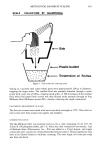
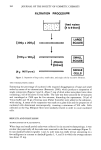
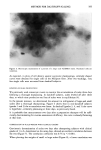
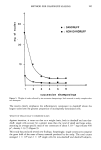
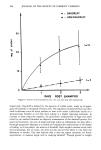
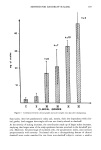
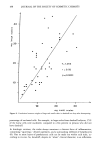
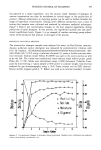
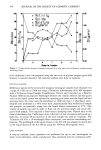
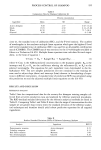
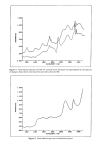
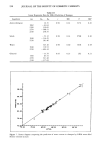
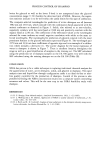
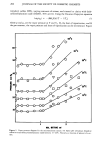
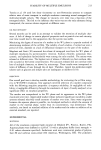
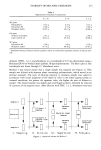
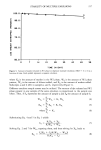
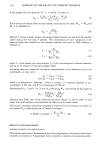
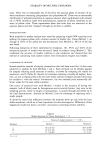
METHOD FOR DANDRUFF SCALING 183 Figure 3. Microscopic examination of a portion of a large scale (GIEMSA stain). Nucleated cells are numerous. As expected, in plots of cell density against successive shampooings, similarly shaped curves were obtained for single cells on the Millipore filter. After two washings, very few single cells were recovered from dandruff subjects. KINETICS OF SCALE PRODUCTION We previously used corneocyte counts to monitor the accumulation of scales three days following a thorough shampooing. In dandruff subjects, scales leveled off after three days, at which time production and loss of scales were in equilibrium (4). In the present instance, we determined the amount (in milligrams) of large and small scales after a thorough shampooing. Figure 6 shows that in non-dandruff subjects (grades 1 and 2) the accumulation was linear. In dandruff (grades 3, 4, and 5) the curve is hyperbolic, evidently plateauing at three days, as previously found. It is probable that measurements two days after a preparation shampoo will be suffi- ciently discriminating for routine assessments of efficacy the curve is already flattening at that time. CORRELATION OF SCALE WEIGHT WITH CLINICAL GRADES Gravimetric determination of scales two days after shampooing subjects with clinical grades of 1 to 6, determined on the same days, showed an excellent correlation between the two (Figure 7). The correlation coefficient was 0.76 (p 0.001). When plotting the weights of small vs large scales (Figure 8), a linear correlation was

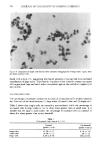
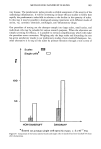
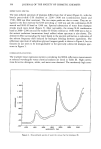
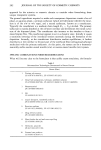
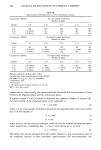
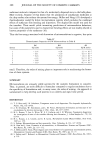
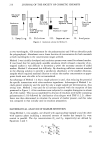
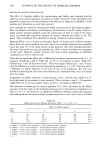
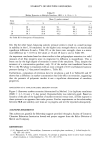
184 JOURNAL OF THE SOCIETY OF COSMETIC CHEMISTS Figure 4. Suspension of single cells obtained after ultrasonic disaggregation of large scales. Again, there are many nucleated cells. found with a slope 1, suggesting that higher amounts of scaling lead to an increased contribution of large scales. This linearity was also evident when the corneocyte counts of disaggregated large and small scales were plotted against the combined weights (plot not shown). PARAKERATOTIC INDEX The percentage of nucleated corneocytes in dandruff vs non-dandruff was determined on day 2 for each of the three fractions: (1) large scales, (2) small scales, and (3) single cells. Table I shows that single cells are essentially non-nucleated while the percentage of nucleated cells in large scales is two to three times greater than in small ones. It is notable that for equally sized scales, the percentage of nucleated cells in dandruff is about five times greater than in non-dandruff. Table I Parakeratotic Index (means & S.D.) Dandruff Non-dandruff (grades 3 to 6) (grades 1 and 2) Large scales 25.2% -+ 8.7 6.4% _+ 5.6 Small scales 10.5% -+ 6.7 2% -+ 1.5 Single cells 0.2% to 0.7% 0% to 0.5%
Purchased for the exclusive use of nofirst nolast (unknown)
From: SCC Media Library & Resource Center (library.scconline.org)