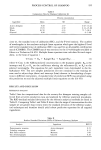
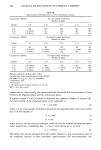
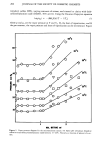
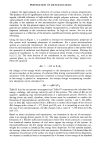
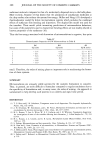
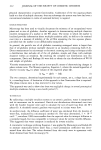
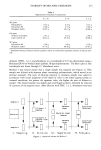
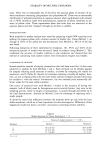
204 JOURNAL OF THE SOCIETY OF COSMETIC CHEMISTS Table III Microemulsion Formation From a Given Oil/Aqueous System Cosurfactant (ADAO) Na cetyl sulfate (surfactant) Paraffin oil phase LDAO C8 C 10 C 12 C 14 C 16 C16 C14 C12 NC NC NC NC NC 5.5 (90%)* NC NC NC NC 3.0 (88%) NC NC NC NC Cosurfactant (ADAO) Na myristyl sulfate (surfactant) Paraffin oil phase LDAO C8 ClO C12 C14 C16 C16 C14 C12 NC 6.6 (100%) 3.6 (96%) NC 6.9 (95%) 5.4 (97%) NC 7.8 (92%) NC NC 7.3 (96%) NC NC NC NC Cosurfactant (ADAO) Na lauryl sulfate (surfactant) Paraffin oil phase LDAO C8 C 10 C 12 C 14 C 16 C16 9.0 (100%) NC C14 3.3 (90%)* 2.1 (98%) C12 1.8 (99%) 3.3 (100%) NC 3.O (9O%) NC NC 4.O (88%) NC NC NC NC Primary surfactants: Sodium alkyl sulfates. Cosurfactants: Alkyl dimethylamine oxide (ADAO). Oil phase: C8, C•o, C•2, C•4, C•6 n-paraffins. Temperature: 30øC. *Viscous gel. ( )% transmittance (clarity) of system at 520 nm. NC = non-clear system. surface area or, more readily, the mono-molecular interfacial film area necessary to form between the dispersed phase and the continuous phase. If a given volume V (ml) of a phase is dispersed into spherical droplets of radius r (•), the total volume of the dispersed phase can be expressed as V = a(4/3)'rrr 3 (1) where a is the total number of droplets formed by the dispersed phase. The total surface area A of the droplets is A = a4'rrr 2 (2) A = c•n (3) where c• and n are the area per surfactant molecule and the number of surfactant mole- cules, respectively. Combining Eqs. 1, 2 and 3 and solving for n, we find n = (3V)/c•r (4) The value of c• can be obtained from the surface tension vs. log concentration plot of the surfactant solution or from monolayer measurements. For microemulsions, the

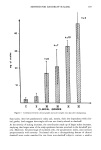
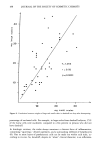
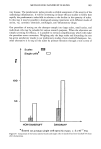
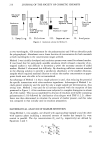
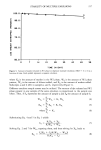
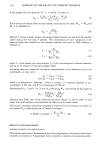
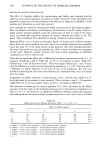
PREPARATION OF MICROEMULSIONS 205 upper limit of r is 40 'nm (1/4 the wavelength of visible light), while the lower limit is set by the surfactant chain length. This simple calculation provides the minimum amount of surfactant necessary to cover the interface. It does not take into account the amount of surfactant that is dispersed in both the aqueous and oil phases and other aggregates that may form in solution. Using the estimated amounts of surfactants, a coarse emulsion of dispersed phase in ß •-• ' formed by simple mixing o,-,,,•rnonr since viscosity level.• are continuous always low. To determine if a transparent dispersion is possible, a cosurfactant is gradually added to the coarse emulsion. In general, most cosurfactants are liquids and can be easily titrated into the emulsion while gentle mixing is appliedß If the system does not turn clear after adding the cosurfactant in an amount equivalent to that of the primary surfactant, the system can be considered unacceptable. The formulator then has an option to alter the components of the system. In general, the cosurfactant is usually the nonspecific com- ponent, and so it is first altered. For example, if octanol was the cosurfactant used, one would consider selecting an alcohol with a different hydrocarbon chain length such as decanol or hexanol. New solutions of the base coarse emulsion are prepared and titrated with the alcohol of choice. Cosurfactants should be chosen such that they do not prefer either the continuous or dispersed phase. The proper cosurfactant will be one that will migrate to the oil-water interface and form a mixed surfactant/cosurfactant film. The next option available if the cosurfactant selection fails is to consider a new primary surfactant. Recalculation of the amount of surfactant is made and repeat titrations with the cosurfactant are conducted. If the microemulsion does not form by variation of the cosurfactant and primary surfac- tant, the dispersed phase should be altered, in a logical manner. For example, if the dispersed phase is an alkane, either increase or decrease the chain length of the alkane depending on the requirements of the formulation. An example of this routine is shown in Table III. While at first appearing complicated, this progression can be conducted rapidly by redetermining a variety of cosurfactant/ surfactant and dispersed-phase optionsß ORDER OF MIXING The question on the order or method of preparation of microemulsions has long been debated. One school of thought is that these systems are thermodynamically stable and thus the order of mixing is inconsequential to product stability. Another approach (10) is to consider these transparent dispersions as true emulsions, and thus the stability is a function of preparation. We will attempt to shed some further light on this question by the following experiments. Vapor pressure experiments were undertaken for o/w microemulsions to gain some in- sight into the mechanism of particle interaction in these systems (11). The microemul- sions were prepared with 20 ml 5% NaC1, pH 11.2 (NaOH) solution, I gm sodium
Purchased for the exclusive use of nofirst nolast (unknown)
From: SCC Media Library & Resource Center (library.scconline.org)