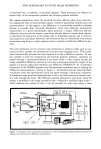
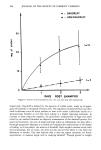
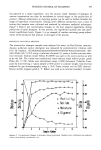
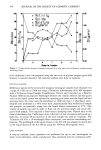
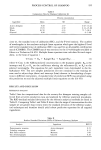
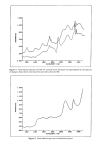
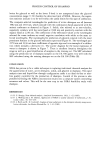
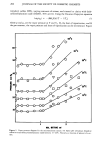
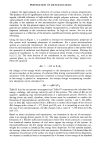
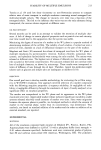
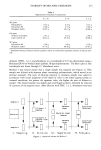
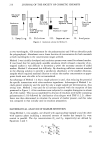
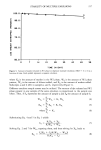
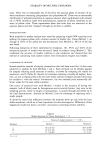
STABILITY OF MULTIPLE EMULSIONS 217 100. 0 z 90. 0 ,-, 80.0 a: 70.0 z z '" 60.0 50.0 I I I I I 0 7 14 •l •8 35 i i i 4: • 49 56 TIME IN DAYS Figure 3. Amount of marker retained in W 1 phase in duplicate multiple emulsions (HLB = 4.3, 6) as a function of time. Each symbol represents a separate emulsion. where X E is the amount of marker in the W2 phase, W E is the amount of W2 phase present, W^ is the amount of diluent added, and X K is the amount of marker added. Subscripts a and b refer to samples a and b, respectively (Figure 1). Different emulsion sample masses may be utilized. The amount of dye released and W2 phase present in any sample of the same emulsion is proportional to the sample size taken. Thus, if S^ represents the amount of sample a and SB the amount of sample b, Sb WEb -- saWEa = K•WEa (4) Sb XEb = • XE• = K• XE• (5) Sb = where • K•. (6) Substituting Eq. 4 and 5 in Eq. 3 yields K•XE• + X K Cb = K•WE• + W^ b Solving Eq. 2 and 7 for WE•, equating them, and then solving for XE• leads to Ca[XK + Cb(K•W & -- XE• • Ki(C b -- Ca) (7) (8)

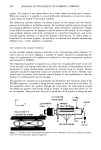
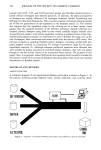
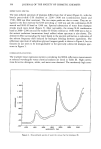
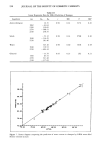
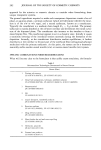
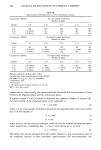
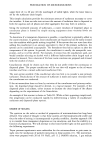
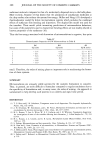
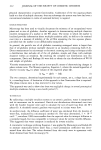
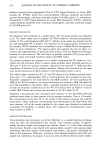
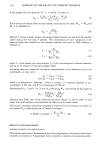
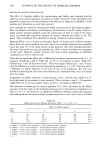
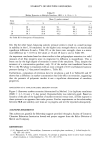
218 JOURNAL OF THE SOCIETY OF COSMETIC CHEMISTS If the sample sizes are identical, K• = 1 and Eq. 8 reduces to XE• -- Ca[XK + Cb(W& - WAb)] -- (C b _ Ca ) (9) If the amount of diluent added to each sample is also exactly the same, •0(/& = •0(/& and Eq. 9 is simplified to Xr.a -- Cb _ Ca (10) Method 2 utilizes a single sample containing released marker dye and external standard added during the first step of analysis. The concentration of each compound in the aqueous phase after addition of the external standard and prior to THF addition is defined by XE C• = (11) W E •- W A Xs C 2 = (12) W E •- W A where C• is the marker dye concentration, C 2 is the concentration of external standard, and X s is the amount of external standard added. Assuming that each compound contributes independently to the absorbance (A) at any wavelength, we may write Ao, = C•½•o, + C2oe2o • (13) and A• = C•½• + C2oe2[ 3 (14) where ß is absorptivity. Subscript 1 refers to marker, 2 to external standard, ot to a wavelength of 426 nm, and [3 to a wavelength of 548 nm. Substituting Eq. 11 and 12 in 13 and 14, eliminating WE, and solving for X E results in XE -- Xs(Aaß2[3 - A13ß2a) (15) (A•s½•= - A=ß•s) Dilution with THF, part of the analytical procedure (Figure 2), has no effect on this result since both polymer concentrations are affected to the same extent. The amount of marker remaining entrapped divided by the initial amount of marker in the system (Xo) yields the percent of marker entrapped: % Marker entrapped - Xø - XE x 100. (16) Xo RESULTS AND DISCUSSION MARKER SOLUBILITY AND PARTITIONING Preliminary experiments demonstrated that both polyporphyre and polytartrazine were insoluble in mineral oil. Polyporphyre did not dissolve in mineral oil containing surfac-
Purchased for the exclusive use of nofirst nolast (unknown)
From: SCC Media Library & Resource Center (library.scconline.org)