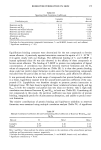
172 JOURNAL OF THE SOCIETY OF COSMETIC CHEMISTS with an electrodermatome (Padgett Inc., Kansas City, MO). Normal saline was pumped at a rate of 1.5 ml/hr beneath the skin in the diffusion cell. For the highly lipophilic compound, AETT, a 300-•m section of skin was used in conjunction with a 6% solution of PEG-20 oleyl ether as the receptor fluid to facilitate partitioning into the receptor fluid (12,13). Compounds were applied to the surface of the skin (0.32 cm 2) in 5 •1 of acetone at a concentration of 1-6 •g/cm 2. The skin surface was washed with a 0.5% solution of a commercial dishwashing detergent 24 hr after application of the material. Experiments were continued for an additional 48 hr (72-hr total) to allow unretained material to diffuse from the skin. Reservoir formation was determined at the end of each experiment by measuring epi- dermal levels of the test compound. The upper layer of the epidermis, the stratum corneum, is presumably most important for reservoir formation, but separation of the partially hydrated membrane could most readily be achieved at the epidermal-dermal junction. The epidermis was separated from the dermis with forceps, and both tissues were solubilized in Soluene 100 (Packard Instrument Co., Downers Grove, IL) for scin- tillation counting. STATISTICS Statistical evaluation was performed using a Spearman rank correlation and a multiple correlation analysis. Beta coefficients for the multiple correlation are a measure of the sensitivity of the dependent variable to changes in the independent variables. Signifi- cance levels for both tests were determined using a two-tailed t-test. RESULTS Seventeen test compounds of differing structures, solubilities, and penetrabilities were used to investigate the reservoir properties of skin. The octanol/water partition coeffi- cients as well as their solubilities in both aqueous and lipoidal phases are given in Table I. Compounds in Tables I and II are listed in order of decreasing octanol/water partition coefficients. Each association constant (Ka) for binding to bovine serum albumin has also been tabulated (Table I). Four of the more polar compounds did not bind to the protein. 5-MOP bound at a constant affinity over the concentration range employed, preventing the calculation of a K a value. In vitro penetration of these compounds was measured through rat skin over a 72-hr period. The disposition of radioactivity at the end of each experiment was calculated for: (i) the receptor fluid (amount absorbed) (ii) the 24-hr skin surface wash (iii) the ex- posed area of the epidermis (iv) the exposed area of the dermis and (v) the surrounding tissue (Table II). The exposed area of tissue is that area in the center of the skin disc (0.32 cm •) to which the compound was applied (epidermis) and that is in contact with the receptor fluid (dermis). The data are expressed as a percentage of the total amount of compound applied to the skin. Total recoveries were 90% for most compounds. The largest reservoir formation (epidermal level) was obtained with the most lipophilic compound, AETT. Those compounds absorbed to the greatest extent (5-MOP, 8-MOP, and caffeine) showed the least amount of retention within the epidermis.

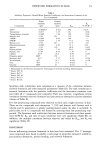
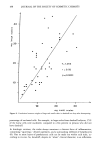
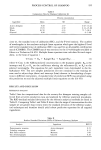
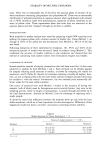
RESERVOIR FORMATION IN SKIN 173 Table I Solubility Properties, Octanol/Water Partition Coefficients, and Association Constants of the Test Compounds Water Octanol solubility solubility K• Compounds (g/L) (g/L) Ko/•, ( X 104 M- •) AETT 0.000012 a 0.012 992 912.9 Testosterone 0.011 a 3.53 321 8.68 Triamcinolone acetonide 0.040 b 7.96 199 8.29 Salicylic acid 2.18 ' 253 116 4.05 5-MOP 0.005 a 0.50 100 -- 8-MOP 0.023 a 1.79 77.6 4.63 Benzoic acid 3.34 e 247 73.9 2.21 Dihydrotestosterone 0.009 • 0.50 55.3 21.4 Aspirin 3.34 c 130 38.8 0.453 Hydrocortisone 0.28 e 7.45 26.6 0.200 Fumaric acid 6.30 e 8.76 1.39 0 Caffeine 20.0 e 16.6 0.83 0. 395 Propylene glycol 1000 f 150 0.15 0 Nicotinic acid 16.7 c 2.5 ! 0.15 0. 163 Nicotinamide 667 • 19.3 0.029 0.158 Urea 667 c 15.3 0.023 0 Glycerol 1000 f 21 0.02 ! 0 Determined by the Division of Cosmetics Technology of the Food and Drug Administration. Source: Ref 16. Source: Ref 17. Source: Ref 18. Source: Ref 19. Source: Ref 20. Spearman rank correlations were calculated as a measure of the correlation between reservoir formation and other measured parameters (Table III). The rank correlations to reservoir formation with the partition coefficients and the association constants were poor when all 17 compounds were compared. There was, however, a significant inverse correlation between reservoir formation and percutaneous absorption (amount absorbed column of Table II). Five fast-penetrating compounds were observed to form only a slight reservoir in skin. These are the compounds with absorption 35% and benzoic acid (benzoic acid is volatile and its penetration is greatly underestimated unless the skin is occluded). A partial data set of 12 compounds was formed by omitting these fast-penetrating com- pounds. The Spearman rank correlations between reservoir formation and three param- eters (O/W K, Ka, and lack of water solubility) were now significant (Table III). In addition, the multiple correlation between reservoir and values for Ko/•, and Ka was significant (Table IV). DISCUSSION Factors influencing reservoir formation in skin have been examined. The 17 heteroge- nous compounds were found to exhibit a wide range in properties measured: solubility, percutaneous absorption, protein binding, and reservoir formation.
Purchased for the exclusive use of nofirst nolast (unknown)
From: SCC Media Library & Resource Center (library.scconline.org)