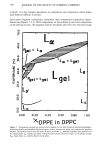
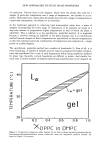
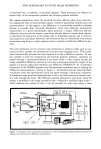
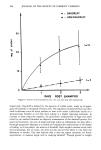
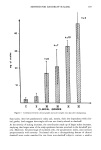
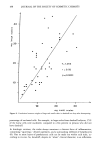
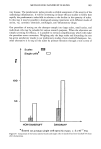
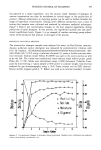
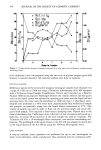
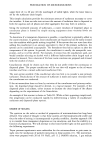
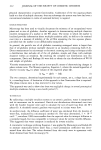
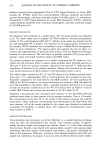
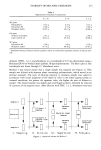
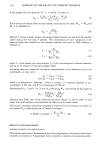
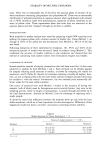
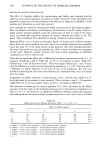
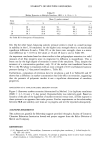
NEW APPROACHES TO STUDY PHASE PROPERTIES 161 of conditions. Vertical lines in the diagram, which show the phases that exist for a sample of particular composition over a range of temperature, are referred to as iso- pleths. Horizontal lines, which show the phases that exist for a range of compositions at a particular temperature, are referred to as isotherms. In the traditional approach to collecting lipid mesomorphic phase data, a series of samples encompassing the entire range of composition to be analyzed are raised in a step-wise manner to progressively higher temperatures at each of which the phase is identified. This is referred to as the equilibrium, isoplethal method. It is isoplethal because it involves moving up isopleths in the phase diagram and is an equilibrium method because samples of fixed composition are equilibrated at discrete temperatures so that they represent particular combinations of temperature and composition--single points in a phase diagram. The equilibrium, isoplethal method has a number of drawbacks (1). First of all, it is time-consuming. A number of samples must be raised to progressively higher tempera- tures and equilibrated for a time at each temperature before being separately analyzed for phase type. Secondly, vertical boundaries are difficult to isolate. And thirdly, be- cause only a limited number of samples representing isolated points in the diagram are 40 30 + gel gel 0 0.2 0.4 0.0 0.õ I .0 'XDPPC in DI'dPC Figure 2. Temperature-composition phase diagram for the fully hydrated dipalmitoylphosphatidylcho- line/dimyristoylphosphatidylcholine system constructed using the temperature gradient method. See legend to Figure 1 for notation.

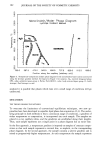
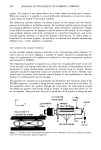
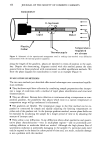
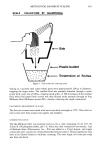
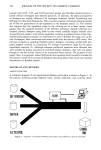
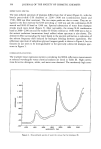
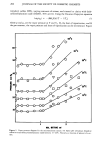
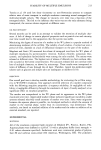
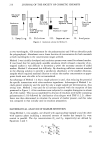
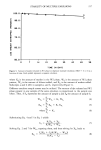
162 JOURNAL OF THE SOCIETY OF COSMETIC CHEMISTS .p,n o o c5 Monolinolein/Water Phase Diagram Lyotrope Gradient Method ISOTROPIC BCC12 Air o d I I I I I I I 500.0 587.5 475.0 562.5 650.0 737.5 825.0 912.5 Position along the capillary (arbitrary unit) 1000.0 Figure 3. Temperature-composition isobaric phase diagram for the monolinolein/water system constructed using the lyotrope gradient method. See legend to Figure 1 for notation, Hn, inverted hexagonal phase CP4, cubic, primitive (space group 4, Pn3m, Pn3) BCC12, cubic, body-centered (space group 12, Ia3d) isotropic, fluid isotropic or mel. analyzed it is possible that phases which exist over a small range of conditions will go undetected. DISCUSSION THE THEORY BEHIND THE METHODS To overcome the limitations of conventional equilibrium techniques, two new ap- proaches have been developed to expedite lipid phase data acquisition (2,3). The under- lying principle in both methods is that a continuous range of conditions, a gradient of either temperature or composition, is incorporated into each sample. The samples are placed in x-ray capillary tubes, and the gradients are established along their lengths. Thus, each sample represents not a single point in a phase diagram but an entire line. In the first approach, a temperature gradient is imposed on samples of constant compo- sition so that each sample represents a vertical line, or isopleth, in the corresponding phase diagram. In the second approach, the sample contains a solvent gradient and is raised to progressively higher temperatures. At each temperature the sample represents
Purchased for the exclusive use of nofirst nolast (unknown)
From: SCC Media Library & Resource Center (library.scconline.org)