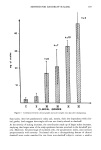
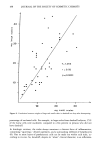
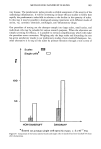
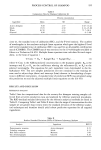
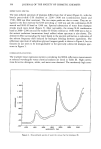
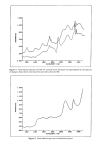
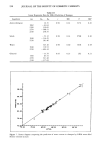
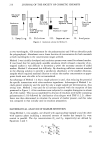
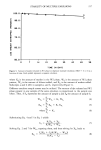
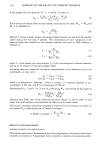
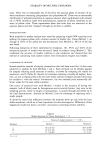
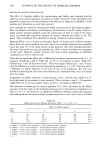
176 JOURNAL OF THE SOCIETY OF COSMETIC CHEMISTS correlation was obtained in the partial data set with reservoir as the dependent variable and Ko/w and log K• as independent variables. The logarithm of the K• values was required for significance this may be because of the much larger (4 orders of magni- tude) values obtained for the binding constants. The contributions of protein binding and octanol/water solubility to the correlation were found to be approximately equal as evidenced by the similar values of the beti coefficients. Nicotinic acid formed one of the largest skin depots in the group of test compounds. This substance, however, demonstrated little protein binding and had an octanol/water partition coefficient of less than 1. A factor that may be important in the slow diffusion of this compound through skin is its ionization to a charged molecule. With a higher pKa (4.9) than other acids in this group, significant amounts may ionize on or near the surface of the skin, contributing to the observed reservoir effect. In summary, the likelihood that a chemical would form a reservoir in skin can be predicted from certain properties. The substance should be slowly absorbed through skin and have low solubility in water and oil. An octanol/water partition coefficient greater than 1 and affinity for protein also favor depot formation. REFERENCES (1) F. Malkinson and E. Ferguson, Percutaneous absorption of hydrocortisone-4-•4C in two human sub- jects, J. Invest. Dermatol., 25, 281-283 (1955). (2) C. Vickers., Existence of a reservoir in the stratum corneum, Arch. Dermatol., 88, 72-75 (1963). (3) C. Vickers, "Stratum Corneum Reservoir for Drugs," in Pharmacology and the Skin, W. Montagna, R. B. Stoughton, and E. J. van Scott, Eds. (Appleton, Century, Crofts, New York, 1972), pp. 177-189. (4) C. Vickers, "Reservoir Effect of Human Skin: Pharmacological Speculation," in Percutaneous Absorpiton of Steroids, P. Mauvais-Jarvis, C. Vickers, and J. Wepierre, Eds. (Academic Press, New York, 1980), pp. 19-29. (5) B. Barry. Dermatological Formulations.' Percutaneous Absorption (Marcel Dekker, New York, 1983), pp. 127-233. (6) M. Artuc, C. Reinhold, G. Stuttgen, and J. Gazith, A rapid measurement for measuring drug enrichment in epidermis, Arch. Dermatol. Res., 268, 129-140 (1980). (7) A. Kligman, A biological brief on percutaneous absorption, Drug Der. Ind. Pharm., 9, 521-560 (1983). (8) M. Artuc, G. Stuettgen, W. Schalla, H. Schaefer, and J. Gazith, Reversible binding of 5 and 8-MOP to human serum proteins (albumin) and to epidermis in vitro, Brit. J. Dermatol., 101, 669-677 (1979). (9) G. Scatchard, The attraction of proteins for small molecules and ions, Ann. New York Acad. Sci., 51, 660-672 (1949). (10) H. Rosenthal, A graphic method for the determination and presentation of binding parameters in a complex system, Anal. Biochem., 20, 525-532 (1967). (11) R. Bronaugh and R. Stewart, Methods for in vitro percutaneous absorption studies. IV: The flow- through diffusion cell, J. Pharm Sci., 74, 64-67 (1985). (12) R. Bronaugh and R. Stewart, Methods for in vitro percutaneous absorption studies. III. Hydrophobic compounds, J. Pharm. Sci., 73, 1255-1258 (1984). (13) R. Bronaugh and R. Stewart, Methods for in vitro percutaneous absorption studies. VI: Preparation of the barrier layer, J. Pharm. Sci., 75, 487-491 (1986). (14) L. Arons, P. Clifton, and M. Rowland, Aspirin binding and the effect of albumin on spontaneous and enzyme-catalysed hydrolysis, J. Pharm. Pharmacol., 32, 537-543 (1980). (15) F. Helmet, K. Kiehs, and C. Hansch, The linear free energy relationship between partition coeffi- cients and the binding and conformational perturbation of macromolecules by small organic com- pounds, Biochem., 7, 2858-2863 (1968).

RESERVOIR FORMATION IN SKIN 177 (16) K. Florey, Analytical Profiles of Drug Substances, (Academic Press, New York, 1969), Vol 1, pp. 397-421. (17) The United States of Pharmacopeia, XII/The National Formulary, XVI (U.S. Pharmacopeial Convention, Inc., Rockville, MD, 1984). (18) F. Dall'Acqua, D. Veraldi, F. Baccichetti, F. Bordin, and D. Averbeck, Photochemotherapy of skin diseases: Comparative studies on the photochemical and photobiological properties of various mono and bifunctional agents, I1 Farmaco, Ed. Sc., 36, 519-535 (1981). (19) The Merck Index, loth ed. (Merck & Co., Rahway, NJ, 1983). (20) W. Griffin and M. Lynch. In Handbook of Food Additives, 2nd ed., T. Furia, Ed. (CRC Press, Cleve- land, OH, 1972), pp. 431-455.
Purchased for the exclusive use of nofirst nolast (unknown)
From: SCC Media Library & Resource Center (library.scconline.org)