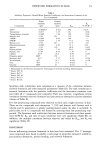
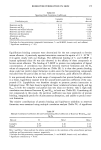
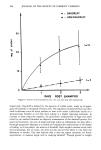
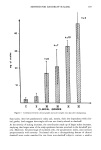
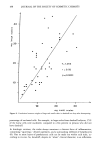
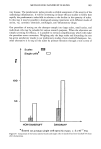
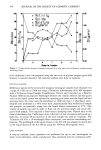
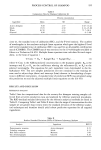
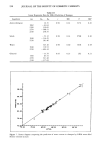
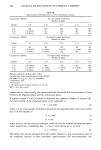
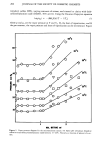
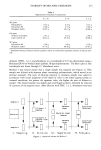
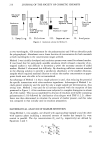
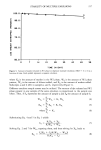
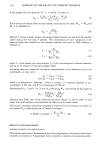
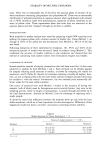
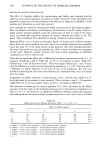
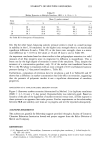
STABILITY OF MULTIPLE EMULSIONS 221 Table IV Marker Retention in Multiple Emulsion, HLB = 6, 10 (n = 3) Mean % marker retained Time (days) a b c d e 1 98 96.8 99 100 96.6 7 78.6 68.6 94.4 94.3 62.7 14 56.7 49.6 87.9 84.2 42.9 28 38.1 35.8 78.2 71.3 31.4 See Table III for description of formulations. III). On the other hand, balancing osmotic pressure seems to result in a small increase in stability in the 6, 10 emulsions. At the higher ionic strength there is no statistically significant difference (b and e, Table IV) at the lower ionic strength, there is a statis- tical difference (p 0.05) in the values at i4 and 28 days (c and d, Table IV). An important conclusion based on these studies is that polyporphyre retention is a valid measure of oil film integrity since its migration by diffusion is insignificant. This is borne out by the high degree of retention in some of the emulsions. Thus, despite the existence of a concentration gradient, only 1% of the marker was transferred from the W 1 to the W2 phase is emulsions with an ionic strength of 0.01 and balanced osmotic pressure during a 27-day period (emulsion c, Table III). Furthermore, comparison of retention data for emulsions a and b in Tables III and IV shows that a difference in marker concentration has little effect on retention, suggesting that the presence of polymeric marker is not a significant determinant of emulsion properties. APPLICATION TO A TYPICAL MULTIPLE EMULSION SYSTEM Figure 3 illustrates marker retention (determined by Method 1) in duplicate emulsions (HLB = 4.3, 6) over a 51-day period. Reproducibility was relatively good. Based on linearity of the plot of the logarithm of marker retention versus time, oil film rupture in these systems is an apparent first-order process. Further experiments on the relationship between HLB and stability over time are in progress and will be reported subsequently. ACKNOWLEDGEMENTS The authors are grateful for fellowship support provided through a Society of Cosmetic Chemists Education Institution Award and project support from the Kelco Division of Merck and Company. REFERENCES (1) E. Sheppard and N. Tcheurekdjian, Comments on multiple phase emulsions, J. Colloid Interface Sci., 62, 564-565 (1977). (2) S. Matsumoto, Y. Kita, and D. Yonezawa, An attempt at preparing water-in-oil-in-water multiple phase emulsions, J. Colloid Interface Sd., 57, 353-361 (1976).

222 JOURNAL OF THE SOCIETY OF COSMETIC CHEMISTS (3) C. Fox, An introduction to multiple emulsions, Cosmetics and Toiletries, 101(11) 101-112 (1986). (4) G. H. Cueman and J. L. Zatz, "Multiple Emulsions," in Controlled Release Systems.' Fabrication Tech- nology, D. Hsieh, Ed. (CRC Press, Boca Raton, FL, in press). (5) A. T. Florence and D. Whitehill, Some features of breakdown in water-in-oil-in-water multiple emulsions,.]. Colloid Interface Sci., 79, 243-256 (1981). (6) S.S. Davis and A. S. Burbage, "The Particle Size Analysis of Multiple Emulsions (Water-in-Oil-in- Water)," in Particle Size Analysis, M. J. Groves, Ed. (Heyden, London, 1978), pp. 395-410. (7) S. Matsumoto, T. Inoue, M. Kohda, and T. Ohta, An attempt to estimate stability of the oil layer in W/O/W emulsions by means of viscometry, J. Colloid Interface Sci., 77, 564-565 (1980). (8) S. Matsumoto and M. Kohda, The viscosity of W/O/W emulsions: An attempt to estimate the water permeation coefficient of the oil layer from the viscosity changes in diluted systems on aging under osmotic pressure gradients, J. Colloid Interface Sci., 73, 13-20 (1980). (9) M. Tomita, Y. Abe, and T. Kondo, Viscosity change after dilution with solutions of water-oil-water emulsions and solute permeability through the oil layer, J. Pharm. Sci., 71, 332-334 (1982). (10) S. Magdassi and N. Garti, Release of electrolytes in multiple emulsions: Coalescence and breakdown or diffusion through the oil phase? Colloids and Surfaces, 12, 367-373 (1984). (11) D. J. Dawson, Polymeric dyes, Aldrichimica Acta, 14, 23-29 (1981). (12) A. N. Martin, J. Swarbrick, and A. Cammarata, "Solutions," in Physical Pharmacy, 2nd ed. (Lea & Febiger, Philadelphia, 1969), p. 163.
Purchased for the exclusive use of nofirst nolast (unknown)
From: SCC Media Library & Resource Center (library.scconline.org)