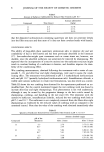
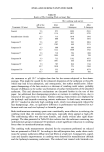
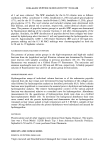
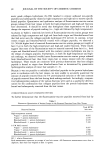
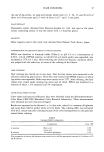
10 JOURNAL OF THE SOCIETY OF COSMETIC CHEMISTS Table IV Results of Wet Combing Work on Reduced Hair Wet combing work (g/cm) pH of the After After After Treatment (30 min) Treatment treatment 4 shampoos 8 shampoos Control 5.3 1515 3470 3846 10.7 1005 3625 4262 Stearalkonium chloride 5.3 1066 622 973 10.7 454 664 991 Compound 5 5.3 1521 794 1650 10.7 1044 642 1245 Compound 6 5.3 4036 1155 1538 10.7 4524 751 1474 Compound 7 5.3 2360 975 1645 10.7 1804 1587 1944 Compound 8 5.3 1354 555 1281 10.7 904 440 1210 Compound 9 5.3 3355 1165 2781 10.7 3911 2315 3176 Compound 10 5.3 264 523 616 10.7 278 904 1502 taining quats gave very high values of combing work, which were consequently de- creased after four shampooings. The greatest reduction in combing forces, durable through eight shampooings, was observed for the treatments with the diisothiuronium surfactant at pH 5.3. ABSORPTION AND SUBSTANTIVITY OF DYES The absorption of the control and isothiuronium-containing dyes was studied on both untreated and reduced hair. Substantivity of the dyeouts was evaluated by comparing the difference in Hunter b-values of the hair following dyeing and after six sham- pooings. Table V presents the results obtained for the treatments of blended gray hair performed utilizing various solvent systems at pH 5 (unhydrolyzed isothiuronium group) and 10 (partially or completely hydrolyzed isothiuronium group). The data indicate that 4 is considerably more washfast than 2 when applied from acidic solution, and only slightly more durable when applied from a solution at pH 10. Treatments with completely hydrolyzed 4, applied from a 60% EtOH-40% water solution at pH 10, were less substantive than the control dyeouts with 2. This seems to indicate that the expected disulfide exchange reaction between the hydrolyzed isothiuronium moiety of 4 and the keratin protein is not a significant factor in increasing substantivity of the dye. On the other hand, the cationic character of unhydrolyzed 4 may contribute to its observed higher substantivity to hair as compared to neutral 2. A relative increase in substantivity of the isothiuronium derivative was achieved by

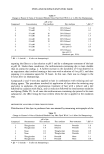
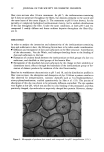
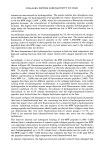
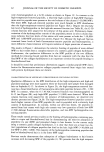
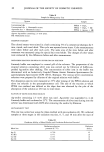
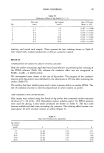
DYES AND SURFACTANTS FOR HAIR 11 Table V Change in Hunter b-Value of Untreated Blended Gray Hair Dyed With 2 or 4 After Six Shampooings pH of the Compound Concentration Dye medium Dye medium •Ab•* 2 55 mM 5 4 55 mM 5 2 55 mM 10 4 55 mM 10 2 24 mM 10 4 24 mM 10 2 55 mM 5 4 55 mM 5 4 55 mM 5 20% Ethanol 1.3 20% Ethanol 0. ! 20% Ethanol 2.3 20% Ethanol 1.5 60% Ethanol 0.9 60% Ethanol 1.5 20% Ethanol, 1.5 then pH 10 0.4 20% Ethanol, 0.0 then pH 10 (Ammonia gas, 18 h). * Ab -- b (initial) - b (after six shampooings). exposing the fibers to a dye solution at pH 5 and by a subsequent treatment of the hair at pH 10. Under these conditions, the isothiuronium-containing dye is more durable than its unreactive analog, 2. A further increase in the durability of 4 was observed in an experiment that involved treating a hair tress with a solution of 4 at pH 5, and then exposing it to ammonia vapors for 18 hours. In this case, there was no change in the b-value after six shampooings. Compounds 2 and 4 were also applied to hair in combination with reducing and oxi- dizing agents. The procedures involved (a) application of dyes after the reducing step and prior to oxidation, (b) simultaneous treatment of hair with a reducer and a dye followed by oxidation with H202, and (c) reduction followed by simultaneous oxidation and dyeing (Table VI). In all cases the isothiuronium-containing dye proved to be more substantive, the effect being the least evident when the dye is applied in the oxidation step. MICROSCOPIC ANALYSIS OF FIBER CROSS SECTIONS Distribution of the dyes in piedmont hair was assessed by examining micrographs of the Table VI Change in Hunter b-Value of Reduced Blended Gray Hair Dyed With 2 or 4 After Six Shampooings pH of the Compound Pretreatment Dye medium Dye medium Post-treatment •Ab•* 2 Thioglycolate 5.0 Solution Peroxide 1.9 4 Thioglycolate 5.0 Solution Peroxide 0.2 2 None 9.2 Thioglycolate Peroxide 0.9 4 None 9.2 Thioglycolate Peroxide 0.2 2 Thioglycolate 3.4 Peroxide None 1. ! 4 Thioglycolate 3.4 Peroxide None 0.8 * Ab = b (initial) - b (after six shampooings).
Purchased for the exclusive use of nofirst nolast (unknown)
From: SCC Media Library & Resource Center (library.scconline.org)