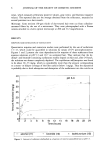
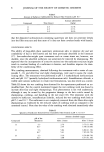
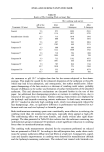
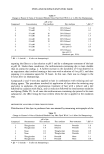
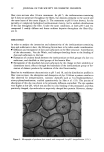
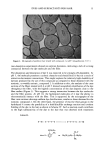
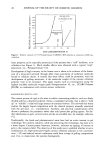
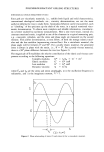
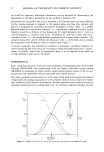
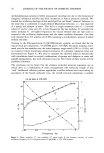
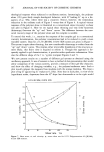
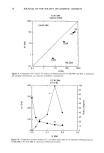
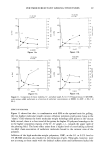
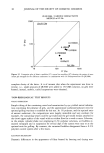
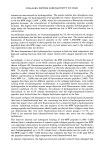
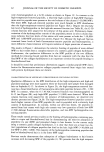
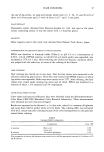
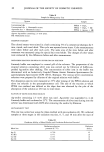
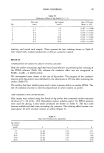
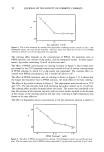
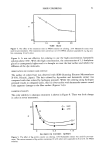
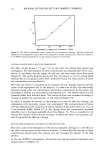
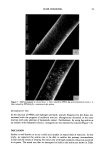
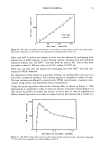
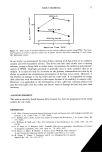
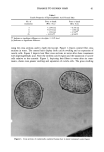
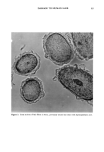
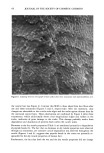
12 JOURNAL OF THE SOCIETY OF COSMETIC CHEMISTS fiber cross sections after 30-min treatments. At pH 5, the isothiuronium-containing dye 4 does not penetrate throughout the fibers, but deposits primarily in the cuticle and the outer layers of the cortex (Figure 3). The treatments at pH 10 (not shown), for the partially or completely hydrolyzed isothiuronium moiety, led to uniform distributions of the dye throughout the fiber. Under the same conditions, at both pH 5 and 10, compound 2 readily diffuses and forms uniform deposits throughout the fiber (Fig- ure 4). DISCUSSION In order to analyze the interaction and substantivity of the isothiuronium-containing dyes and surfactants to hair, the following factors have to be taken under consideration: © Diffusion and entrapment of dyes and surfactants in the fiber structure. Contribution of the electrostatic, Van der Waals, and hydrogen-bonding forces to the binding of dyes and surfactants to the hair. © Formation of covalent bonds between the isothiuronium or thiol groups of a dye or a surfactant, and disulfide or thiol groups of the keratin fiber. © Entrapment of the absorbed dyes and surfactants by the change in their solubility or dimensions (steric effects) through the hydrolysis of the isothiuronium group or for- mation of dimeric products by oxidation of the thiol functionality. Based on its washfastness characteristics at pH 5 and 10, and the distribution profiles in fiber cross sections, the absorption and desorption of dye 2 follows a pattern similar to that observed for semipermanent, nonionic dyestuffs such as N-(2-hydroxyethyl)-2- nitro-p-phenylenediamine, studied quantitatively by Han et al. (19). The process of absorption of this dye was shown to be primarily diffusion-controlled. The dye uptakes were higher at low pH, which was ascribed to ionic binding of the protonated, and thus positively charged, dye molecules to negatively charged hair protein. However, absorp- Figure 3. Micrographs of piedmont hair treated with compound 4 at pH 5 (magnification 312 X ).

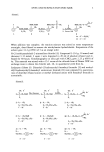
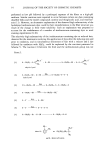
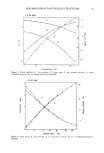
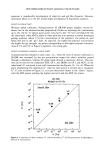
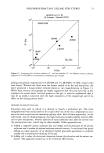
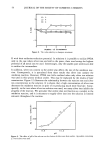
DYES AND SURFACTANTS FOR HAIR 13 Figure 4. Micrographs of piedmont hair treated with compound 2 at pH 5 (magnification 312 x ). tion-desorption experiments showed no sorption hysteresis, indicating a lack of a strong interaction between the dye molecules and the fiber. The absorption and desorption of dye 4 was expected to be strongly pH-dependent. At pH 5, the molecule possesses a cationic character and should bind to hair as a result of attractive electrostatic interactions. This might explain the relatively high durability of dyeouts produced by the use of this compound as compared to those obtained with the nonionic, or weakly cationic, compound 2. In addition to this, the analysis of the cross sections of the fibers treated with 4 at pH 5 showed nonuniform distribution of the dye throughout the fiber, with the highest concentration of the dye deposits close to the fiber surface (Figure 3). This suggests a strong interaction between the dye molecules and the fiber protein. At pH 10, the hydrolyzed molecules of 4 lose the ability to electrostatically interact with the fiber. This is supported by the micrographs of the fiber cross sections showing uniform dye distributions, similar to those obtained for the nonionic compound 2. On the other hand, the presence of reactive thiol groups in the hydrolyzed 4 creates the possibility of a thiol/disulfide exchange reaction and covalent binding of the dye to the hair as shown in Scheme IV. Such a reaction could contribute to the high substantivity of the dye to the hair that was observed with treatments Scheme IV. R--$H + K--S--S--K , R--$--$--K + HNCH2 CH2- uhere R = or CH.•(CH2) •4CH2•N--CH2CH2-
Purchased for the exclusive use of nofirst nolast (unknown)
From: SCC Media Library & Resource Center (library.scconline.org)