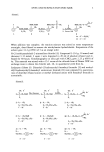
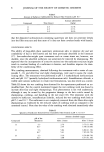
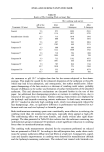
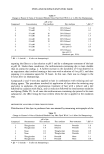
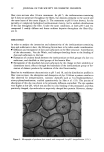
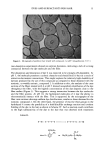
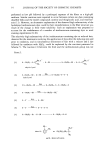
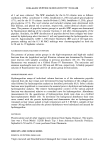
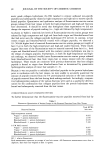
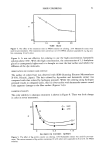
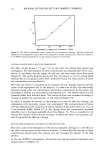
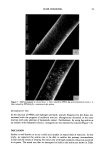
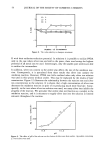
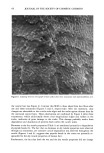
16 JOURNAL OF THE SOCIETY OF COSMETIC CHEMISTS untreated hair. On the other hand, the interaction between the unhydrolyzed isothi- uronium surfactant and reduced hair, followed by oxidation with H202, might involve the reactions presented in Scheme V (reactions 1-3). It should be noted, however, that the surfactant thioIs or dimers are water-soluble and cationic, due to the presence of quaternary ammonium groups. Thus, electrostatic binding, rather than insolubiliza- tion, in addition to covalent binding, could be responsible for the observed increased durability of these materials. Finally, it should be pointed out that the bromide-containing surfactants can also react with the thiol groups of reduced hair by forming sulfides (Scheme V, reaction 7). The data in Tables III and IV, however, indicate very high combing work after the treat- ment, with subsequent reduction in combing forces as a result of shampooings. Al- though this effect is observed for all surfactants at pH 10.7, it is much more dramatic in the case of the bromide-containing surfactant applied to reduced hair. Also, the combing work after eight shampooings was high and comparable to the untreated con- trol. All these data seem to suggest either a complete lack of interaction of bromide quats with reduced hair or, conversely, very efficient absorption and binding of the quats in the bulk of the fiber, with little modification of the fiber surface. This last point is strengthened by the results of hair treatments with bromide-containing quats at higher concentrations (not reported in this paper) that demonstrate durable condi- tioning of reduced hair. CONCLUSIONS It has been shown that the substitution of either a semipermanent dye or a cationic surfactant with an isothiuronium group increases its substantivity to hair. Enhanced electrostatic interactions, entrapment as a result of dimerization or change in solubility, or covalent binding through the formation of disulfide bonds with the keratin could be possible mechanisms of this phenomenon. Since after long treatment times unreactive cationic surfactants also show high substantivity to hair, and are not readily removed by shampooing, the enhanced conditioning effects in the case of isothiuronium derivatives was ascribed to a specific distribution of the surfactant with its maximum concentration close to the fiber surface. REFERENCES (1) W. Patterson, W. Geiger, L. Mizell, and M. Harris, Role of cysteine in the structure of the fibrous protein, wool,.]. Res. Nat. Bur. Stand., 27, 839 (1941). (2) K. Hall and L. Wolfram, Application of the theory of hydrophobic bonds to hair treatments,.]. Soc. Cosmet. Chem., 28, 231 (1977). (3) D. E. Deem and M. M. Rieger, Mechanical hysteresis of chemically modified hair, .]. Soc. Cosmet. Chem., 19, 395 (1968). (4) JP 62/205-014-A, assigned to Kao Corp. (5) A. Shansky, Hair straightening through silylation: A preliminary investigation, Cosmetic Technology, 32 (March 1982). (6) EP 0159628, assigned to Revlon Inc. (7) L. J. Wolfram, Wool modification by deposition of reactive polymers, Appl. Polym. Symp., 18, 523 (1971). (8) S. M. Murkinshaw and D. M. Lewis, "Reactive Dyes for Wool," in Proceedings of the International

DYES AND SURFACTANTS FOR HAIR 17 (9) (10) (11) (12) (13) (14) (15) (16) (17) (18) (19) (20) (21) Conference on the Chemistry and Application of Reactive Dyes, University of Leeds, September 18-19, 1989. G. B. Guise and I. W. Stapleton, New approaches to washfast dyes for wool. I. Isothiuronium salts as protected dye reactive groups. J.S.D.C., 91, 223 (1975). G. B. Guise and I. W. Stapleton, New approaches to washfast dyes for wool. II. Synthesis and dyeing properties of model isothiuronium dyes, J.S.D.C., 91, 259 (1975). R. S. Asquith and A. K. Puri, Disulphide exchange as a method of coloration of animal fibers, J.S.D.C., 87, 116 (1971). R. S. Asquith, P. Carthew, and T. T. Francis, The reactions of disulphide dyes for the covalent coloration of keratin, J.S.D.C., 89, 168 (1969). US 3,272,794, assigned to American Aniline Products Inc. US 3,803,323, assigned to l'Oreal. R. L. Shriner, R. C. Fuson, D. Y. Curtin, and T. C. Morrill, The Systematic Identification of Organic Compounds, 6th ed. (John Wiley & Sons, New York, 1980), p. 332. J. March, Advanced Organic Chemistry, 3rd ed. (John Wiley & Sons, New York, 1985), p. 220. M. L. Garcia and J. Diaz, Combability measurements on human hair, J. Soc. Cosmet. Chem., 27, 379 (1976). J. A. Swift and A. C. Brown, The critical determination of fine changes in the surface architecture of human hair due to cosmetic treatment, J. Soc. Cosmet. Chem., 23, 695 (1972). S. K. Han, Y. K. Kamath, and H.-D. Weigman, Diffusion of semipermanent dyestuffs in human hair, J. Soc. Cosmet. Chem., 36, 1 (1985). P. Finkelstein and K. Laden, The mechanism of conditioning of hair with alkyl quaternary am- monium compounds, Appl. Polym. Symp., 18, 673 (1971). C. Robbins, C. Reich, and J. Clarke, Dyestaining and the removal of cationics from keratin: The structure and influence of the washing anion, J. Soc. Cosmet. Chem., 40, 205 (1989).
Purchased for the exclusive use of nofirst nolast (unknown)
From: SCC Media Library & Resource Center (library.scconline.org)