j. Soc. Cosmet. Chem., 42, 19-34 (January/February 1991) Novel gelling structures based on polymer/surfactant systems E. D. GODDARD, P. S. LEUNG, and K. P. A. PADMANABHAN, Union Carbide Chemical and Plastics Company, Inc., Specialty Chemicals Division, Tarrytown, NY 10591. Received A, ugust 15, 1990. Synopsis Our objective was to seek and characterize new gelling compositions based on suitably chosen polymer/sur- factant pairs. In earlier work we reported unusual increases in viscosity when an anionic surfactant, such as SDS, was added to a cationic cellulosic polymer (Polyquaternium-10, medium MW). We have now found even greater increases in apparent viscosity and, indeed, formation of gels of good strength and clarity when a high-molecular-weight version of PQ-10 is used in combination with SDS. Gels are viscoelastic materials, i.e., possess both liquid and solid characteristics and are most appropriately characterized by oscillatory rheology measurements that yield such parameters as storage modulus (G'), loss modulus (G"), phase angle (8), and so on. Measurements, with data analysis, were carried out using the Bohlin VOR Rheometer. The results are interpreted in terms of the formation of "super" macromolecules through association of the alkyl groups of surfactant molecules bound to the ionic sites of different poly- meric molecules by strong electrostatic forces. It is shown that strong gels can be formed at quite low levels of polymer (--1%) and that there is an optimal level of SDS and other anionic surfactants to achieve maximum gel strength. Adjustment of the gel's properties, including liquefaction, can be achieved by suitable adjustment of the surfactant/polymer ratio or the addition of selected cationic materials. Preliminary information relevant to formulation is provided. INTRODUCTION In a series of papers we have drawn attention to the association tendency of water-sol- uble polymers and surfactants in aqueous solution. The various factors involved in the association reactions, and their analysis, have been the subject of recent reviews [see, for example, references (1) and (2)]. It is pointed out that the interaction tendency is strongest when the surfactant is charged and the polymer is a polyion bearing charges of opposite sign to that of the surfactant. For example, if one "titrates" a polycation with an anionic surfactant, one obtains indications of "cooperative" binding of the surfac- tant, with formation of surfactant clusters, at very low levels of added surfactant. Evi- dence of the latter comes from enhanced solubilization of oil-soluble dyes (3) and of various fiuorescing agents (4). Furthermore, evidence of structural changes accompa- nying formation of the "complexes" has been obtained from such measurements as self-diffusion (5), small angle neutron scattering (6), and viscosity (6). Changes in the 19

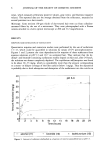
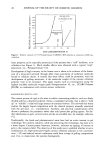
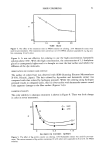
20 JOURNAL OF THE SOCIETY OF COSMETIC CHEMISTS • 125 0 100- • 75- •'• 252 el" o.oool I I I I I SDS SOLUTION 1 ER JR 400 , , ,If , O.OO1 O.O1 O.I 1 .O IO.O SDS CONCENTRATION % Figure 1. Relative viscosity of 1% Polyquaternium-10 (JR400), SDS mixtures as a function of SDS con- centration. latter property can be especially pronounced if the polymer has a "stiff" backbone, as in cellulosics (see Figure 1). Much smaller effects were obtained with a typical "vinyl" polycation, viz., Polyquaternium 5 (6). Development of high viscosity in the former case is taken to be evidence of the forma- tion of a structured network through alkyl chain association of surfactant molecules bound to cellulose chains. It seemed that these effects could be promoted, with the development of gelling structures, if the molecular weight of the cationic cellulosic polymer were to be increased. This paper reports such an investigation using the highest available molecular weight grade Polyquaternium 10, viz., UCARE Polymer JR30M, in combination with various anionic surfactants. BACKGROUND: WHAT IS A GEL? The current picture of a gel is of a state in which a structuring additive, such as a finely divided solid or a dissolved polymer, forms a crosslinked network, that is able to "hold up" or "solidify" a relatively large amount of entrained solvent. The network that forms endows the largely liquid composition with the classical property normally associated with the gel state, i.e., viscoelasticity. Aesthetic and practical considerations often dictate a preference for polymeric rather than solid particulate gelling agents. For fur- ther information on gels, several review articles are available [see, for example, reference (7)]. Traditionally, the foods and pharmaceutical areas have had an active interest in gel technology the cosmetic industry, while also practicing this technology, has done so to a lesser degree. Current patent literature, however, indicates an upsurge of interest in gels in the cosmetics field. The objective of this work was to establish whether or not a combination of a high-molecular-weight cationic cellulosic polymer at low concentra- tion (--1%) and selected anionic surfactants could form a range of gelling compositions and, if so, to characterize the systems rheologically.
Purchased for the exclusive use of nofirst nolast (unknown)
From: SCC Media Library & Resource Center (library.scconline.org)