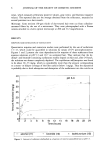
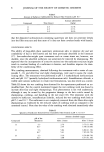
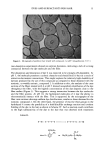
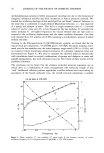
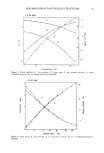
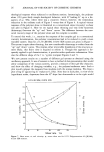
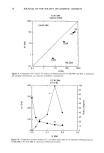
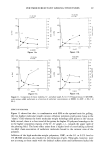
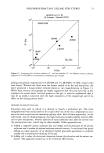
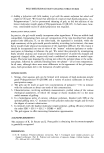
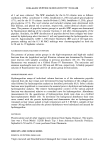
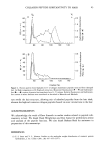
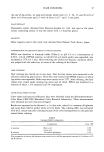
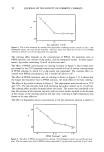
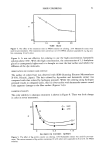
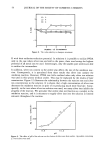
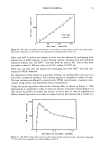
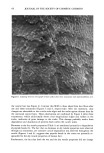
POLYMER/SURFACTANT GELLING STRUCTURES 29 1 To JR 30M at 0.2 Hz 400 300 --- ' t 200 o • • o.o o.1 0.2 % SDDBS Figure 1 la. lOO 9O 8O 70 6o ,:% 50 • ..o 40 '• 3O 2O 10 0 0.3 1% JR 30M at 0.2 Hz 400 300 2OO 100 C• I I 0.0 0.1 0.2 % AOT Figure 1 lb. lOO 8o 7o• 50 40 c• o 0.3 400 1% JR 30M at 0.2 Hz 300 200 100 0 • o.o o.1 0.2 % ES2 Figure 1 lc. 1 O0 400 I 8O 30O 70 5 - 60 • 50 • • 200 ..e b 40 • lOO 1% JR 30M at 0.2 Hz lOO lO o 0 0.3 0.0 0.1 0.2 %ES3 Figure 1 ld. 90 80 7O 60 • 50 • 4o • 50 2O 10 0 0.5 Figure 11. Comparison of elastic modulus, G', and phase angle, 8, for 1% Polyquaternium-10 (JR30M), with various added surfactants as a function of surfactant concentration: a) DDBS. b) AOT. c) ES-2. d) ES-3. EFFECT OF POLYMER Figure 13 shows first that, in combination with SDS at the optimal ratio for gelling, the two highest molecular weight cationic cellulosic polymers yield points lying in the "elastic" field whereas the lower molecular weight homologs yield points in the viscous field second, there is a clear trend of the points for higher CS polymer homologs to lie in the higher consistency regions of the G", G' graph, i.e., towards the upper right of the plotting field. The latter effect arises from a higher level of cross-linking achieved via alkyl chain association of surfactant molecules bound to the cationic sites of the polymer. Addition of the high-molecular-weight polyanion, CMC, at the 0.1 or 0.2% level to 1% JR30M solutions also resulted in the formation of gels. These gels, however, were not as strong as those made with the dodecyl sulfate anion and furthermore lacked the

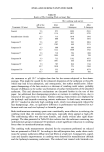
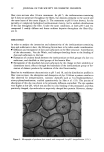
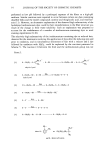
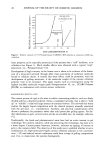
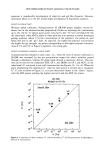
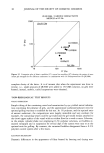
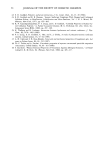
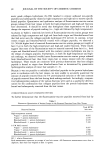
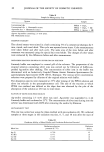
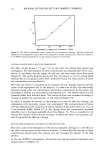
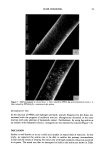
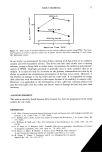
30 JOURNAL OF THE SOCIETY OF COSMETIC CHEMISTS 1% JR 30M / VARIOUS SURFACTANTS MODULI at 0.2 Hz 1 ooo ! U__quid Like • O.a%ES2 / O.i••DBS / 0.2•AOT Gel Like 10 10 100 1000 G' (Pa) Figure 12. Composite plot o[ citric modulus (G') versus loss modulus (G") showing the points o[ max- Jmum gc[ strength [or the •J•crcnt sur•ac•ants Jn combination with l• Po]yquatcrnJum-10 OR30M). complete clarity of the latter. It is of interest that when the experiment was done in reverse, i.e., small amounts of JR30M were added to 1% CMC solution, no gels were formed instead, mobile, turbid suspensions were obtained. "NON-RHEOLOGICAL" TEST RESULTS VISUAL INSPECTION Simple tilting of the containing vessel and examination by eye yielded initial informa- tion concerning the presence of gels, and the approximate surfactant/polymer ratio for optimal gelling was easy to establish by this test. At 1% polymer, and the optimal ratio of anionic surfactant, the compositions were largely immobile and very resilient for example, the containing vessel could be up-ended and the gel would remain attached to the (now) upper surface of the vessel with no evident flow for a week or more. Likewise, in the simple cylinder shake test employing 0.2% polymer solutions, air bubbles re- mained entrapped and in suspension for several days if the system were near or at the optimal ratio for gelling. By contrast, the entrained bubbles disappeared from a 0.2% polymer control system after a few hours. ELECTRON MICROSCOPY Dramatic differences in the appearance of films formed by freezing and drying non-
Purchased for the exclusive use of nofirst nolast (unknown)
From: SCC Media Library & Resource Center (library.scconline.org)