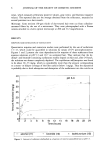
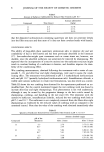
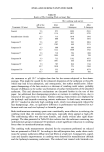
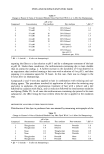
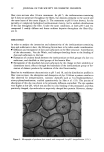
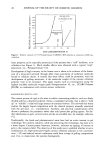
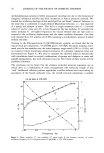
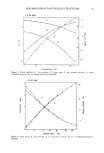
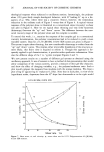
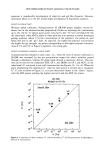
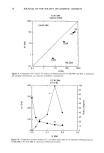
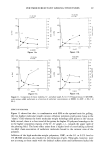
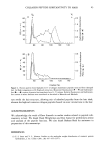
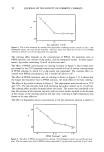
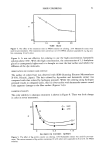
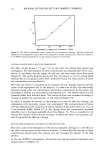
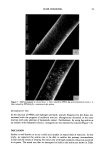
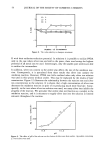
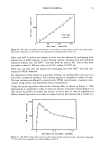
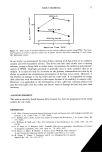
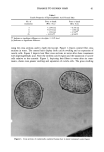
COLLAGEN PEPTIDE SUBSTANTIVITY TO HAIR 43 BO 50 10 V o Vi ,I, ,I, 2.0 o 1.5 • 0.5 • e• ß ß el e ß All ß ß ß ß 60 80 100 120 140 ß 60 B 5O 4O 3O 20 ß •0 %•' ß..• •...• ''- '' '. © A- A-- A-- A-- A-- A --• e A'•A--I'A-•- l e_ e _•_A e_ e.e Ae_ e 60 80 100 120 140 0.6 o 0.4 ,_ •_, 0.2 •øo Fraction No. Figure 2. Elution pattern from Sephadex G-15 of collagen hydrolysate peptides extracted from damaged hair. A) High-temperature or B) High-salt extraction. Monitored fluorescamine (© -- ©) and hydroxypro- line (A -- A) content of protein fractions placed on a G-15 column. Relative fluorescence and hydroxypro- line content in select fractions were monitored as described in Materials and Methods. ture swells the hair structure, allowing exit of adsorbed peptides from the hair shaft, whereas the high salt removes collagen peptides bound via ionic interactions to the hair. ACKNOWLEDGMENTS We acknowledge the work of Dave Simnick in earlier studies related to peptide sub- stantivity to hair. We thank Hank Weightman and Ron Caesar for preliminary amino acid analysis of the peptide fractions. We also thank Barbara Berk for assistance in preparation of this manuscript. REFERENCES (1) E. S. Stern and V. L. Johnsen, Studies on the molecular weight distribution of cosmetic protein hydrolysates, J. Soc. Cosmet. Chem., 28, 447-455 (1977).

44 JOURNAL OF THE SOCIETY OF COSMETIC CHEMISTS (2) E. S. Stern, Studies on the substantivity of collagen-derived polypeptides to human hair, Inolex Tech- nical Report 17 (1984). (3) E. S. Cooperman and V. L. Johnsen, Penetration of protein hyrolysates into human hair strands, Cosmetics and Perfumery, 88, 19-22 (1973). (4) R. T. Jones and C. A. Brown. The behavior of cationic cellulose derivatives containing fatty quat groups, Int. J. Cosmet. Science, 10, 219-229 (1988). (5) J. K. Herd and R. H. Marriott, The sorption of amino acids from shampoos onto hair, J. Soc. Cosmet. Chem., 10, 272-277 (1959). (6) V. L. Johnsen, Innovation in protein and technology, Cosmet. Toiletr. 92, 29-33 (1977). (7) S. A. Karjala, A. Karler, and J. E. Williamson, The effect ofpH on the sorption of collagen-derived peptides by hair, J. Soc. Cosmet. Chem., 18, 599-608 (1967). (8) S. A. Karjala, J. E. Williamson, and A. Karler, Studies on the substantivity of collagen-derived polypeptides to human hair, J. Soc. Cosmet. Chem., 17, 513-524 (1966). (9) G. Huszar, J. Maiocco, and F. Naftolin, Monitoring of collagen and collagen fragments in chroma- tography of protein mixtures, Anal. Blochem., 97, 424-429 (1980). (10) S. Udenfriend, S. Stein, P. Bohlen, W. Dairman, W. Leimgruber, and M. Weigele, Fluorescamine: A reagent for assay of amino acids, peptides, proteins and primary amines in the picamole range, Science, 178, 871-872 (1972). (11) N. Nakai, C. Y. Lai, and B. L. Horecker, Use of fluorescamine in the chromatographic analysis of peptides from proteins, Anal. Biochem., 58, 563-570 (1974). (12) M. Weigele, J. F. Blount, J.P. Pengi, R. C. Czaijkowki, and W. Leimgruber, The fluorogenic ninhydrin reaction. Structure of the fluorescent principle, J. Amer. Chem. Soc., 94, 4052-4054 (1972). (13) M. Weigele, S. I. DeBernardo, J.P. Pengi, and W. Leimgruber, A novel reagent for the fluoro- metric assay of primary amines,J. Amer. Chem. Soc., 94, 5927-5928 (1972). (14) P. Flesch, Chemical data on human epidermal keratinization and differentiation, J. Invest. Dermatol., 31, 63-73 (1958).
Purchased for the exclusive use of nofirst nolast (unknown)
From: SCC Media Library & Resource Center (library.scconline.org)