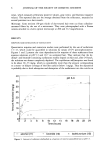
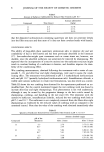
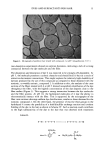
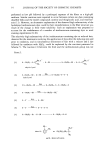
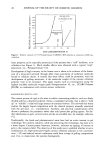
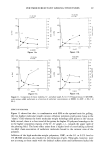
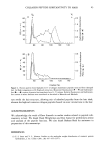
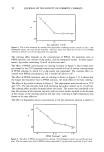
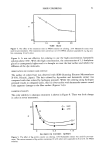
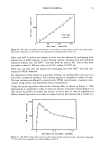
HAIR COLORING 57 lOO PPDA/H• O• Reaction Time (min) Figure 14. Time-course of mutation frequency on the various oxidation systems using PPDA. The muta- tion frequency of 2-AA as a positive control was 363/plate. Ag-zeo: Ag-zeolite containing 2.5 wt% silver. HE: Hamamelis extract. In our study, we investigated the basis of hair coloring with Ag-zeolite as an oxidative catalyst and with hamamelis extract. The silver ions that elute slowly into a coloring solution, owing to being held in zeolite pores, can promote the oxidation and polymer- ization of PPDA. Hydrogen peroxide is generally used in most oxidative dyes as an oxidant. It is used not only by its action on the primary intermediates but also by its ability to promote the simultaneous decoloration of the hair to be tinted. However, it has resulted in damage to the hair fiber and the scalp itself. It is impossible to change dark color hair with the method in this report because of its inability to remove color. However, it is applicable to the development of new, safer hair coloring products for gray hair and light color hair when one doesn't want to damage the hair any more than necessary. ACKNOWLEDGMENT The authors sincerely thank Sinanen-New Ceramic Co. Ltd. for preparation of the metal zeolites for our study. REFERENCES (1) H. Zahn, Chemical processes during bleaching of wool and human hair with hydrogen peroxide and peracids, J. Soc. Cosmet. Chem., 17, 687 (1966). (2) C. Robbins and C. Kelly, Amino acid analysis of cosmetically altered hair, J. Soc. Cosmet. Chem., 20, 555 (1969). (3) L. Wolfram, K. Hall, and I. Hui, The mechanism of hair bleaching,.]. Soc. Cosmet. Chem., 21, 875 (1970). (4) B. N. Ames, H. O. Kammen, and E. Yamasaki, Hair dyes are mutagenic: Identification of vaner,, of mutagenic ingredients, Proc. Natl. Acad. Sci., 72, 2423-2427. (5) K. Brown, A. Mayer, B. Murphy, T. Schultz, and L. Wolfram, Hair coloring A novel system for imparting durable yet reversible color effects, J. Soc. Cosmet. (6) M. Nagao, T. Yahagi, Y. Sugimura, and N. Ito, Mutagenicities of quinolit Mutation Res., 42, 335-342 (1977).

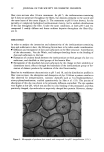
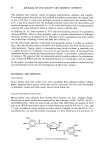
j. Soc. Cosmet. Chem., 42, 59-67 (January/February 1991) Cuticle damage and the tensile properties of human hair C. R. ROBBINS and R. J. CRAWFORD, Colgate Palmolive Technology Center, 909 River Road, Piscataway, NJ 08854. Received October 1990. Synopsis Oxidation of hair fibers with diperisophthalic acid can produce extensive damage throughout several cuticle layers that is readily observed microscopically. At the same time, no detectable changes in the tensile properties (wet or dry) are detectable. These results are consistent with the hypothesis that the tensile properties of human hair are due primarily to the cortex, with little or no cuticle involvement. INTRODUCTION Several methods have been published in the literature during the past several decades describing various ways to assess damage to human hair fibers. Evaluation of the tensile properties of hair fibers is one method that is frequently used to assess the strength of human hair. There is a long-standing hypothesis, that the cortex is primarily responsible for the tensile properties of human hair (1), although there is one publication with limited data suggesting the possibility of some cuticle involvement in the tensile properties of hair (2) and some evidence that wool fibers containing a medulla are weaker than non- medullated fibers (3). If the cortex is primarily responsible for the tensile properties of hair fibers, or even if there be only minor cuticle and/or medullary involvement in the tensile properties of hair, then the tensile properties are primarily an index of cortical damage. Therefore, if the tensile properties do not show change, without any further experimental evidence, such data does not stand as an indication of no hair damage. The lack of cuticle involvement in the tensile properties of hair or even minimal in- volvement might seem surprising, because, for a 70-micron hair fiber with a 4-micron- thick band of cuticular material (2), the cuticle represents approximately 22% of the total fiber cross-sectional area. Thus, it would be somewhat surprising if the cuticle were not involved at all in the tensile properties of human hair. With respect to medullary involvement in the tensile properties of hair, such involve- ment has only been demonstrated for selected wool fibers where the medulla represented more than 70 percent of the cross section (3), and such heavy medullation is not common in human hair. A few years ago, we examined an oxidative treatment for hair based on diperisophthalic acid. We found that under certain conditions this reagent could produce extensive 59
Purchased for the exclusive use of nofirst nolast (unknown)
From: SCC Media Library & Resource Center (library.scconline.org)