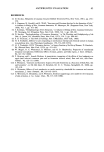
TRANSGLUTAMINASE 2 7 (43) (44) (45) (46) (47) (48) (49) (50) G. Paonessa, S. Metafora, G. Tajana, P. Abrescia, A. De Santis, V. Gentile, and R. Porta, Trans- glutaminase-mediated modifications of the rat sperm surface in vitro, Science, 226, 852-855 (1984). L. A. Goldsmith, Human epidermal transglutaminase, J. Invest. Dermatol., 80, 39s-41s (1983). R. J. Ward, H. A. Willis, G. A. George, G. B. Guise, R. J. Denning, D. J. Evans, and R. D. Short, Surface analysis of wool by x-ray photoelectron spectroscopy and static secondary ion mass spectrometry, Textile Res., J., 63, 362-368 (1993). A. P. Negri, H. J. Cornell, and D. E. Rivett, Effects of processing on the bound and free fatty acid levels in wool, Textile Res. J,, 62, 381-387 (1992). A. P. Negri, H. J. Cornell, and D. E. Rivett, A model for the surface of keratin fibers, Textile Res. J., 63, 109-115 (1993). Ajinomoto U.S.A., Inc., Teaneck, New Jersey. M. Motoki and N. Tambi (to Ajinomoto Co., Ltd.), Japan Patent Application 60-12311 (1985). M. Nonaka, H. Tanaka, A. Okiyama, M. Motoki, H. Ando, K. Umeda, and A. Matsuura, Poly- merization of several proteins by Ca 2 +-independent transglutaminase derived from microorganisms, Agric. Biol. Chem., 53, 2619-2623 (1989). APPENDIX A Calculation for Comparison of Transglutaminase Activity With Rat Sperm Cells and Human Hair The rat sperm data used in this calculation were taken from reference 43. 1. Substrate surface area, where Cell head diameter 5 •m Ssphere = •D 2 No. of sperm cells 6.0E06 Exposed hair length 0. 125 m Scylinder = •rDL No. of hairs 10 Ref. 43: Hair: 6.0E06 sperm X •r (5.0E-06 m) 2 = 4.7E-04 = 4.7 cm 2 10 hairs X • (70E-06 m) (0. 125 m) = 2.7E-04 = 2.7 cm 2 The ratio of total surface area of hair and sperm in the respective incubations was roughly 1:2, using average values for hair and sperm cell diameters. If we assume that the number of active glutamine sites per unit area was comparable, then the total number of active sites available for reaction was 1:2. Therefore, rat sperm cell binding data will be used on a one-to-two basis to estimate binding expected with hair. 2. Amount of enzyme used, where Ref. 43: Hair: 10 •xg/0.5 ml = 20 •xg/ml 0.5 units/ml X 1 mg/1.9 units X 1E03 •xg/mg = 260 •xg/ml We used about ten times more enzyme than used in the incubation with rat sperm. Reference 43 showed that the asymptotic number of reactive glutamine sites was not reached after a one-hour incubation of sperm cells with [•4C]-spermidine. It will be assumed that our increased enzyme concentration allowed all hair glutamine sites to react during the one-hour incubation. Discounting effects of enzyme activity loss, an estimate of the asymptotic number of disintegrations per minute (dpm) that would have been observed for complete reaction with rat sperm is 7,500 dpm (from Figure 1A in reference 43). 3. Isotope activity difference, where Ref. 43: 0.5 ml of 2 IxM [•4C]-spermidine yielded 2E5 dpm A) 2E5 dpm x 0.67 (our counter efficiency) = 1.34E5 cpm B) 2E-06 mol/L X 0.5E-03L/1.34E5 cpm = 7.46E-15 = 7.5 fmol/cpm Hair: 50 IxCi @ 1 mmol/115 mCi activity in 2 ml a 10-lxl aliquot of [•4C]-putrescine solution yielded 3.74E5 cpm.

28 JOURNAL OF THE SOCIETY OF COSMETIC CHEMISTS A) 50E-06 Ci x 1E-03 mol/l15E-03 Ci = 4.3E-07 mol [•4C] B) 4.3E-07 mol/2E-03L = 2.1E-04 M stock [14C] (diluted 1:10 for incubations) C) 2.1E-05 mol/L X 10E-061/3.74E05 cpm = 5.7E-16 = 0.6 fmol/cpm 4. Estimation of isotope binding (cpm) expected on hair, where the following assumptions were made: a) counting efficiency was the same, i.e., ref. 43 cpm = 0.67 dpm b) putrescine and spermidine have the same relative affinity c) the glutamine active site/unit area was the same on hair, but a 1:2 ratio of surface areas was actually used in incubations d) our greater concentration of enzyme allowed complete reaction with hair during incubation and e) 7500 dpm would have been observed from a complete reaction with the sperm surface. A) 7500 dpm x 0.67 x V2 x 7.5 fmol/cm = 19,000 fmol [•4C]-spermidine bound to sperm B) 19,000 fmol X cpm/0.6 fmol = 32,000 cpm for same amount of [•4C]-putrescine bound to hair Thus, based on the assumptions listed above, approximately 32,000 counts per minute were expected for complete reaction of all available glutamine sites on the hair surface.
Purchased for the exclusive use of nofirst nolast (unknown)
From: SCC Media Library & Resource Center (library.scconline.org)