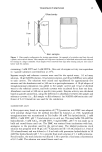
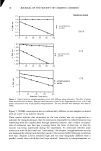
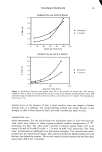
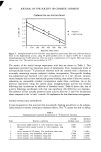
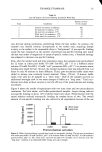
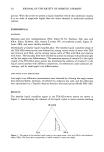
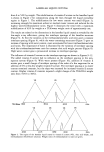
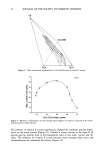
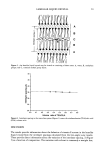
56 JOURNAL OF THE SOCIETY OF COSMETIC CHEMISTS Therefore, based on the general utility of the Semmes-Weinstein esthesiometer for tactile sensitivity under various conditions, this device was taken as the starting point to develop an itch esthesiometer. ENHANCEMENT OF THE ITCH STIMULUS Recently we have improved upon the Semmes-Weinstein esthesiometer. The monofil- aments of the Semmes-Weinstein are right cylinders, and may press a sharp edge into the skin upon application. Thus, dragging the filaments across the skin would not only induce itch but would also relieve itch by a scratching action that could also alter the physical condition of the skin. A new esthesiometer (trade name: Weinstein Enhanced Sensory Test TM , also WESTTM), has the following characteristics that differentiate it from the original Semmes- Weinstein esthesiometer: 1) the end of each filament is round in order to minimize the possibilities of scratching the skin, 2) the tip has texture that alternately grips and releases the skin in order to produce a stronger itch response, 3) multiple filaments mounted on the same handle enable more rapid testing, and 4) each filament is indi- vidually calibrated for grams of force applied. The resulting itch esthesiometer, WEST- itch TM , is used to induce itch sensation. STUDY OBJECTIVES In order to evaluate the efficacy of the itch esthesiometer in a procedure to measure low-to-moderate (i.e., OTC-level) antipruritic efficacy, two double-blind studies were conducted. The preliminary study (Study I) was conducted to establish methodologies and perform a general validation. Study II evolved from the results of Study I, further establishing the methodology that is applicable to testing OTC antipruritics. The methods to elicit itch were modified in Study II to enhance expedience and to increase the reliability of itch induction. Part of the procedural change included tape stripping the skin to mimic the irritation elicited by consumers' scratching, an action that usually precedes the use of OTC antipruritics. STUDY I (PRELIMINARY STUDY) The objectives of Study I, conducted on intact skin, were to determine whether the proposed method could differentiate: 1. Itch levels treated (oil-in-water vehicle) versus untreated skin 2. Itch levels between a potentially active ingredient (benzocaine) in the vehicle versus the vehicle alone The first hypothesis was that an oil-in-water vehicle, acting as a lubricant, emollient, and moisturizer would reduce itching. The immediate antipruritic effect of the oil-in- water vehicle is most probably caused by a combination of 1) lubrication, a reduction of friction at the skin surface, 2) hydration, an increase in skin moisture, 3) tactile sensation from evaporative cooling of the skin, and 4) emollient, a softening of the skin. The softening of the skin surface that accompanies the application of moisturizers may contribute to itch reduction by minimizing the skin's "hard-plate leverage" effect on

ANTIPRURITIC EVALUATION 57 receptors. That is, dry and hard skin better transmits forces into the skin to receptors implicated in itch than does soft skin. The second hypothesis was that benzocaine, a recognized topical anesthetic, would reduce itch beyond the level produced by an oil-in-water vehicle alone. The action of the benzocaine on itch is probably through the stabilization of neuronal membranes, thus inhibiting the ionic fluxes necessary to initiate and conduct impulses. STUDY II In order to mimic common OTC antipruritic usage conditions, Study II was conducted on mildly irritated skin. Two OTC antipruritics (one containing benzocaine and one containing hydrocortisone) were examined and compared. The objectives of Study II were to investigate: 1. The ability of the new itch esthesiometer and methods to elicit itch in a consistent, quantified manner 2. Whether the anticipated antipruritic effects of lotions (which includes the inherent vehicle effects) could be reliably measured 3. Whether the method could differentiate, either in the short or longer term, between potential antipruritic products (in this case, two products that contained either benzocaine or hydrocortisone). METHODS PRODUCTS In Study I an OTC antipruritic product (oil-in-water vehicle containing 6% benzocaine) was compared to its vehicle. In Study II, the OTC benzocaine product was compared to an OTC hydrocortisone (1%) antipruritic that did not contain any known topical anesthetics. GENERAL SUBJECT CHARACTERISTICS Subjects were recruited by newspaper advertisements to participate in this or prior studies. All subjects were screened over the telephone for study inclusion before coming to PACE for potential participation. Subjects entering the study were women who reported: 1. Being at least 18 years old 2. Having no health problems, including neurological or dermatological, that might interfere with testing 3. Having no known allergies to itch-relief products 4. Having not taken any drugs for the past 48 hours 5. Being a likely consumer of antipruritic products. Potential subjects were considered likely consumers of antipruritic products if they reported at least one of the following three conditions: 1) suffering from dry-skin itch, 2) suffering from winter itch, or 3) being a consumer of an anti-itch product for relief of itching due to skin irritation or other causes of itching. Subjects also reported whether
Purchased for the exclusive use of nofirst nolast (unknown)
From: SCC Media Library & Resource Center (library.scconline.org)