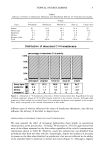
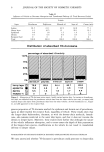
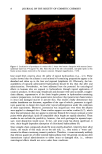
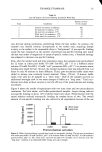
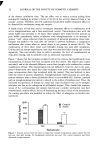
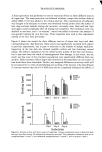
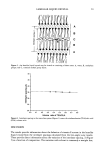
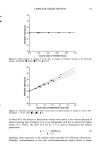
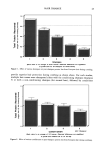
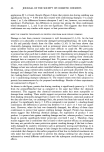
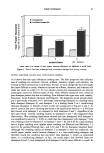
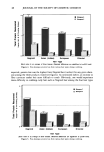
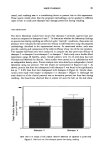
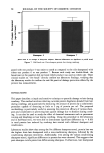
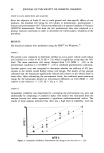
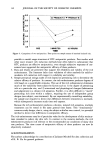
50 JOURNAL OF THE SOCIETY OF COSMETIC CHEMISTS o 'o ! • '• 500 0 Shampoo 5 Shampoo 7 (Each value Is an avaraga of thirty-nine subjects. Observed differences are significant at p=O.05 level). Figure 7. Half-head test: Post-shampoo protein loss during combing. pooed with test product 5 was easier to comb as compared to the side shampooed with either test product 6 or test product 7. Because each study was double-blind, the beautician (or the panelist) did not know which product was used on which side. These clinical studies on "live heads" directly confirm our laboratory findings, verifying that the laboratory results do confirm the real-life practical damage protection offered by the protein loss measurements. CONCLUSIONS This paper describes a simple and sensitive technique to quantify damage to hair during combing. This method involves collecting cuticular protein fragments abraded from hair during combing, and quantitatively measuring the amount of protein by a colorimetric procedure capable of detecting as little as 5 Ixg of protein per mi. The proposed methodology is particularly useful in assessing the protection efficacy of various sham- poos and conditioners in protecting hair against damage due to abrasion during comb- ing. It can also be used to study the effect of chemical treatments such as permanent waving and bleaching on hair during combing. Using this procedure in the laboratory and in half-head tests, we were able to demonstrate significant differences (p = 0.05) in total protein loss induced by combing hair treated with different shampoos and conditioners. Laboratory studies show that among the five different shampoos tested, protein loss was the highest from hair shampooed with a non-conditioning shampoo, followed by the conditioning shampoo treatments. Additionally, even among the various conditioning shampoos tested, significant differences in protein loss were observed. This suggests that post-shampoo cuticle protection differs among shampoos. Furthermore, hair shampooed

HAIR DAMAGE 51 with one of the conditioning shampoos (shampoo 5) showed significantly less protein loss during combing relative too all three leading-brand "stand-alone" conditioners tested. However, no significant differences in protein loss were observed in the condi- tioner-treated hair, suggesting that these conditioners are very similar with respect to hair protection during combing. Additional studies using three different shampoos on four different hair types, namely, Caucasian, Asian, Oriental, and Negroid hair, show that the methodology can be applied to assess post-shampoo hair damage during comb- ing regardless of the hair type. Finally, studies also show a significant increase in protein loss from hair during combing following chemical treatments, namely, permanent waving and bleaching. This suggests that chemically damaged hair is more susceptible to further damage from combing. Furthermore, the data indicate that chemical damage to hair not only makes hair more susceptible to combing damage but presumably also changes its substantivity towards different conditioners. Half-head studies, which provide a side-by-side comparison of the relative efficacy of two of the test products under real-life conditions, also showed significant differences in protein loss during combing from hair shampooed with the different shampoos. These clinical studies directly confirm our laboratory findings, suggesting that laboratory results from protein loss measurements can reflect "real-life" damage to hair during combing. ACKNOWLEDGMENTS We sincerely thank Mr. Nailesh Bhatt, Ms. Sharon E. Benashski, and Ms. Shuchi N. Kiri, intern students from Rutgers University, New Brunswick, N J, for their technical assistance during the course of these studies. REFERENCES (1) J. A. Swift and A. C. Brown, The critical determination of fine changes in the surface architecture of human hair due to cosmetic treatments, J. Soc. Cosmet. Chem., 23, 695-702 (1972). (2) M. L. Garcia, J. A. Epps, and R. S. Yare, Normal cuticle-wear patterns in human hair, J. Soc. Cosmet. Chem., 29, 155-175 (1978). (3) I. J. Kaplan, A. Schwan, and H. Zahn, Effects of cosmetic treatments on the ultrastructure of hair, Cosmet. Toiletr., 97, 22-26 (1982). (4) S. Kelly and V. N. E. Robinson, The effect of grooming on the hair cuticle, J. Soc. Cosmet. Chem. 33, 203-215 (1982). (5) T. Kambe, Synopsis of papers from the 6th International Hair Science Symposium of the German Wool Research Institute, Luneberg, Germany (1988). (6) M. M. Breuer, G. X. Gikas, and I. T. Smith, Physical chemistry of hair conditioning, Cosmet. Toiletr., 94, 29-34 (1979). (7) M. L. Garcia and J. Diaz, Combability measurements on human hair, J. Soc. Cosmet. Chem., 27, 379-398 (1976). (8) A. M. Schwartz and D. C. Knowles, Frictional effects in human hair, J. Soc. Cosmet. Chem., 14, 455-463 (1963). (9) R. Beyak, F. Meyer, and G. Kass, Elasticity and tensile properties of human hair. I. Single fiber test method, J. Soc. Cosmet. Chem., 20, 615-626 (1969). (10) C. Robbins and J. Crawford, Cuticle damage and the tensile properties of human hair, J. Soc. Cosmet. Chem., 42, 59-67 (1991). (11) W. Waggoner and G. V. Scott, Instrumental method for the determination of hair raspiness, J. Soc. Cosmet. Chem., 17, 171-179 (1966).
Purchased for the exclusive use of nofirst nolast (unknown)
From: SCC Media Library & Resource Center (library.scconline.org)