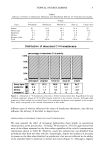
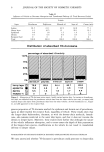
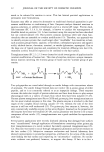
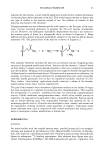
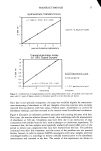
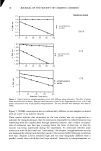
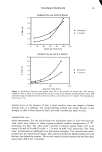
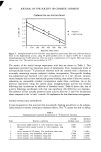
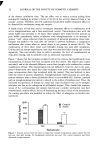
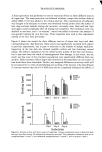
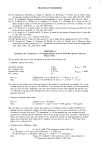
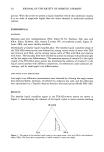
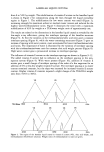
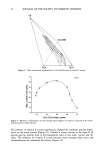
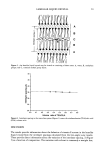
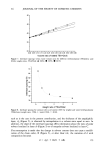
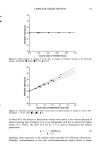
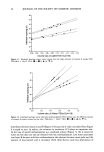
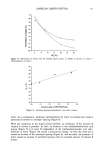
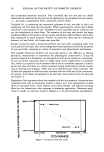
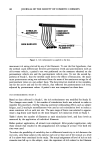
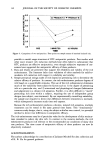
38 JOURNAL OF THE SOCIETY OF COSMETIC CHEMISTS For low values of vitamin E acetate there is no change in the d o value (Figure 10), but the presence of the vitamin causes a reduction of the water penetration. A higher triethanolamine/oleic acid ratio (Figure 11) allows increased vitamin content and in- creased d o value for the levels of vitamin in excess of those in Figure 10, with the penetration having reached low values. The later trend is even more pronounced if triethanolamine plus water is considered as the solvent. Now addition of vitamin E acetate caused a drastic reduction of penetration (Figure 13). The results actually allow calculation of the penetration of vitamin E acetate into the oleic acid layer in the liquid crystal. The slope in Figure 14 gives an ot value of 0.8, demonstrating that the vitamin E acetate is preferentially located in zone B (Figure 5). REFERENCES (1) J. Fuchs, R. Mehlhom, and L. Packer, Free radical reduction mechanisms in mouse epidermis skin homogenates, J. Invest. Dermatol., 93, 633 (1989). (2) H. S. Black, W. A. Lenger, J. Gerguis, and J. I. Thornby, Relation of antioxidants and level of dietary lipid to epidermal lipid peroxidation and ultraviolet carcinogenesis, Cancer Res., 45, 6254 (1985). (3) V. E. Kagan, E. H. Witt, R. Goldman, G. Seita, and L. Packer, Ultraviolet light induced generation of vitamin E radicals and their recycling. A possible photosensitizing effect of vitamin E in skin, Free RadicalRes. Commu., 16, 51 (1992). (4) S. E. Friberg, P. Liang, F. Lockwood, and M. Tadros, Single compound forming a lyotropic liquid crystal at room temperature, J. Phys. Chem., 88, 1045 (1984). (5) S. E. Friberg, C. Solans, and L. Gan-Zuo, Solubilization in non-aqueous lyotropic liquid crystals, Mol. Cryst. Liq. Cryst., 109, 159 (1984).

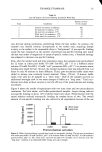
j. Soc. Cosmet. Chem., 46, 39-52 (January/February 1995) A simple and sensitive method using protein loss measurements to evaluate damage to human hair during combing SUKHVINDER S. SANDHU, RAM RAMACHANDRAN, and CLARENCE R. ROBBINS, Technology Center, Colgate Palmolive Company, Piscataway, NJ 08854-1340. Received June 1 O, 1994. Presented at the Annual Meeting of the Society of Cosmetic Chemists, New York, December 8-9, 1994. Synopsis A simple method to quantify hair damage during combing or brushing has been developed. The method involves collecting hair fragments that are chipped from hair during combing and quantitatively measuring the amount of protein using a colorimetric procedure capable of detecting as little as 5 Ixg of protein per mi. Using this procedure on hair tresses in the laboratory and on live heads (half-head tests), we were able to demonstrate significant differences in protein loss during post-shampoo combing of undamaged and chemically damaged hair previously treated with various shampoos/conditioners. The method is applicable to different types of hair tested, namely, Caucasian, Asian, Oriental and Negroid. INTRODUCTION The cuticle forms a protective barrier for each hair fiber. The cuticle governs the frictional properties of hair fibers and is also largely responsible for maintaining the structural integrity of hair. Many investigators have shown that the cuticle is gradually chipped, fragmented, and worn away by the abrasive action of combing, brushing, shampooing, and teasing of human hair (1-4). It is also known that gradual loss of cuticle layers can eventually lead to complete fibrillation of the fiber (4,5). Various investigators have used a number of techniques such as scanning electron microscopy [SEM (1,3,4)], combing measurements using an Instron Tensile Tester (4,6,7), fric- tional measurements (8), tensile measurements (9, 10) and measurement of the sound or raspiness caused when combing (11) to evaluate hair damage due to combing and/or the conditioning effects of various products. Some of these techniques require expensive instrumentation (e.g., SEM), some are qualitative (11), and others lack sensitivity [tensile measurements (10)], simplicity (SEM), and/or the precision desired in an ana- lytical technical for routine use to study surface damage. Previously we published a simple technique to assess surface damage to hair caused by oxidative/reductive treatments such as bleaching and permanent waving (12). Since hair 39
Purchased for the exclusive use of nofirst nolast (unknown)
From: SCC Media Library & Resource Center (library.scconline.org)