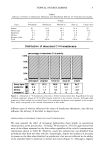
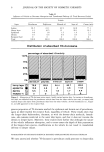
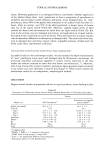
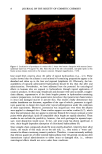
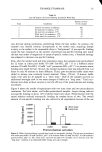
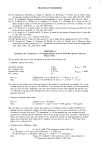
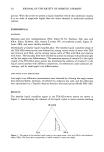
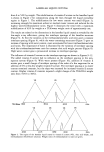
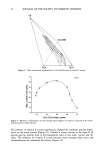
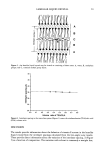
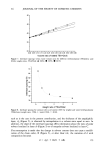
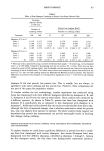
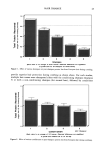
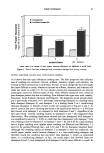
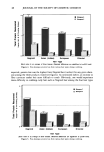
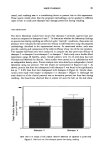
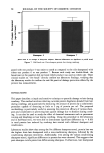
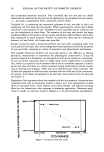
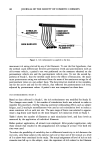
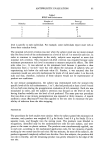
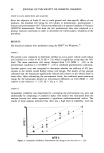
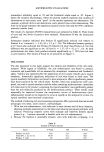
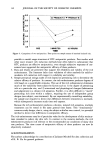
TOPICAL HYDROCARBONS 7 layers, following application to an abrogated barrier, and further, whether application of the labeled alkane from "neat" petrolatum or from a suspension of petrolatum in propylene glycol:ethanol would influence absorption across damaged skin. In "neat" petrolatum, about 90% of the applied label remained on the surface of the skin after 2 •/2 hours, while in contrast, over 50% of the label penetrated to deeper layers of murine skin out of the liquid vehicle (Table III). Moreover, slightly higher levels of label reached the dermis and subcutaneous fat layers from the liquid vehicle (Table III). But even in the extreme case of a damaged skin barrier, and application in a liquid vehicle, detectable levels of label did not reach the blood. These data show that docosane displays vehicle-dependent differences in absorption in damaged skin. The results also show that, even in damaged skin and from a liquid vehicle, negligible amounts of label reach the blood under these experimental conditions. VISUALIZATION OF PETROLATUM ACROSS INTACT AND DAMAGED SKIN In parallel studies to the radioisotope studies, we next assessed the depth of penetration of "neat" petrolatum across intact and damaged skin by fluorescence microscopy. As previously described, petrolatum appeared to remain strictly restricted to the skin surface and stratum corneum in intact skin (not shown see references 6, 7). Moreover, both 2 and 4 hours after acetone treatment, petrolatum again appeared largely restricted to the surface and outer epidermis of murine skin (Figure 4). These results confirm the radioisotope studies by an independent, morphological method. DISCUSSION Despite several decades of apparently safe use in topical products, recent feeding studies Table III Penetration of 3H-Docosane Across Acetone-Treated Hairless Mouse Skin (% Total Recovered Label) Vehicle Petrolatum in propylene Sample site 100% Petrolatum a-e glycol:ethanoP -e Surface (cottonball) 90.6 +-- 2.2 46.1 +-- 1.5 Total SC 7.82 45.1 Tape 1 5.97 +-- 1.2 (63) 36.09 + 1.5 (67) Tape2 0.79 + 0.1 (8) 5.96 --- 1.1 (11) Tape 3 1.06 +-- 0.6 (11) 3.04 +-- 0.2 (6) Epidermis 1.38 +-- 0.04 (2) 1.20 -+ 0.7 (2) Dermis 0.19 +-- 0.04 (2) 1.20 +-- 0.7 (2) Fat 0.08 -+ 0.04 (1) 0.39 --- 0.1 (1) Blood Trace Trace Total 100.05 94.01 % Applied label. MEAN +-- SEM n = 4 animals in each group. TEWL levels in both groups 2 mg/cm2/hr. Trace = not significantly different from background. Parentheses indicate % total absorbed label.

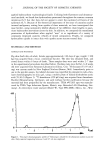
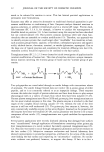
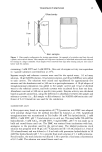
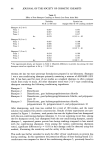
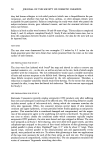
8 JOURNAL OF THE SOCIETY OF COSMETIC CHEMISTS Figure 4. Localization of petrolatum in murine skin 2 hours after barrier disruption with acetone [trans- epidermal water loss •4 mg/cm2/hr, (8)]. Note that all of the nile red-stainable, non-polar lipids in this frozen section remain restricted to the stratum corneum. Original magnification, x250. have raised fresh concerns about the safety of topical hydrocarbons (e.g., 4,5). These studies showed that the alkanes in oral mineral oil-containing preparations appear to be absorbed and taken up in the liver and regional lymphatics (4). Obviously, the bio- availability of topically administered hydrocarbons should be less than that after oral administration. Nevertheless, we have addressed here the potential for toxicological effects in humans who are exposed to hydrocarbons through topical application of cosmetic products. In this study, hexadecane and docosane were used as model, straight- chain alkanes, representative of the chain lengths present in hydrocarbon-containing cosmetic preparations, to obtain quantitative data about their penetration characteristics in intact and damaged murine or porcine skin. Our studies clearly demonstrate that neither hexadecane nor docosane, regardless of the type of vehicle, penetrate in signif- icant quantities to deeper skin layers after topical administration under the conditions of these experiments. Moreover, penetration was insignificant even when the alkanes were applied to damaged skin. These studies support our earlier studies (6,7), which show that petrolatum does not appear to penetrate beneath the stratum corneum at time points when physiologic lipids of comparable chain length are rapidly absorbed. These studies do not exclude the possibility, however, that with prolonged or repeated expo- sure, more absorption would occur. In fact, one prior study has shown significant in vitro, chain-length dependent absorption of chlorinated hydrocarbons (9). Since straight-chain compounds should be more-readily-absorbed, relatively short alkyl chains, the results of this study are on the safe side i.e., they mimic a "worst case" scenario for alkane-containing cosmetic products. Therefore, it seems extremely unlikely that relevant quantities of white mineral hydrocarbons enter the general circulation after intermittent topical administration to either intact or damaged skin i.e., relevant toxicological effects should not occur under these conditions.
Purchased for the exclusive use of nofirst nolast (unknown)
From: SCC Media Library & Resource Center (library.scconline.org)