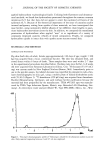
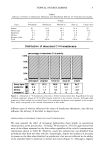
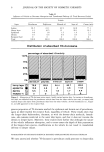
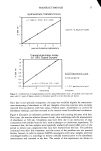
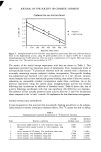
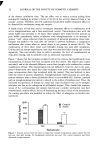
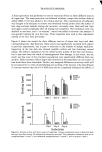
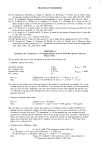
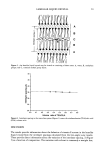
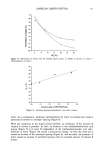
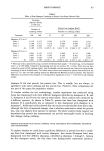
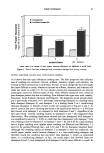
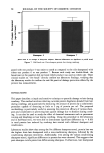
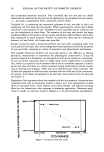
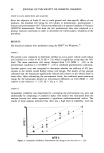
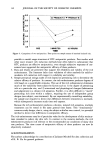
46 JOURNAL OF THE SOCIETY OF COSMETIC CHEMISTS application @ 1 cc/tress). Results (Figure 2) show that protein loss during combing was significantly less (p = 0.05) from hair treated with conditioning shampoo 5 vs condi- tioner 1 or 2 the differences between shampoos 5 and 3 are, however, not statistically significant. Furthermore, the differences in protein loss among the three conditioners tested (shampoos 1, 2, and 3) are also not significant. This suggests that these three conditioners are very similar with respect to hair protection efficacy. EFFECT OF COSMETIC TREATMENTS ON PROTEIN LOSS FROM HAIR DURING COMBING Damage to hair from cosmetic treatments is well documented (1,3,16). As the hair weathers or is physically or chemically damaged (perming/bleaching), the scales begin to lift and partially detach from the fiber surface (3, 16). It has been shown that chemically damaging treatments such as permanent waves and bleach treatments in- crease interfiber friction and make hair more difficult to comb (8). We previously reported that the permed/bleached hair surface is more susceptible than undamaged hair to protein loss when such hair is shaken in water (12). Experiments were designed to test whether we could demonstrate greater protein loss due to combing from chemically damaged hair as compared to undamaged hair. To pursue our goal, two separate ex- periments were performed in which European hair tresses, prepared from a single bundle of hair, were tested for protein loss due to combing before and after chemical treatment. Damage to hair was induced under controlled laboratory conditions by perming followed by bleaching, using commercially available products as previously described (12). Un- damaged and damaged hair were conditioned in the manner described above by using two leading-brand conditioners (identified as conditioners 1 and 3, Figure 2) and a 2-in-1 conditioning shampoo (shampoo 5). The treated tresses were then subjected to protein loss measurements by the proposed methodology. Results of these experiments are summarized in Figure 3. As shown in the figure, protein loss during combing is significantly greater (p = 0.05) from the permed/bleached hair as compared to the same hair before the chemical treatments. This suggests that chemical treatments make hair more susceptible to damage from combing. These results support our previous observations on protein loss from shaking chemically damaged hair in water (12). Furthermore, statistical analysis of the data also show that, on undamaged hair, the protein loss from hair treated with test product 5 is significantly less (p - 0.05) as compared to test product 1, a leading-brand conditioner the differences in protein loss between 5 vs 3 and 1 vs 3 were not signif- icant. However, when the hair was chemically damaged, the efficacy of these three conditioners to protect hair against combing damage changed. Protein loss measure- ments suggest that following chemical damage, the superiority of product 5 over product 1 to protect hair against combing damage was lost, whereas product 3 was now found to provide significantly better protection over both 5 and 1. Therefore, these studies suggest that a conditioner that is found to show superior efficacy on undamaged hair may not provide the same protection against combing damage if the hair is chem- ically damaged by cosmetic treatments such as permanent waving and bleaching. It is well known that chemical damage to hair changes the surface properties. It is therefore conceivable that changes in the surface properties of hair due to chemical treatments not only make hair more susceptible to protein loss during combing but also change its substantivity toward different conditioners and the subsequent conditioning/protective effects.

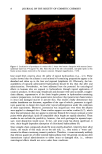
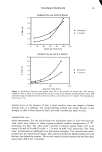
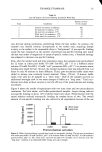
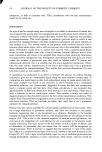
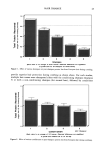
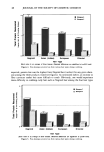
HAIR DAMAGE 47 0 c• o .E rr o D Undamaged Hair [] Perre/Bleach Damaged Hair I 3 5 CONDITIONER (21nl Shampoo) (Each value is an average of three tresses. Observed differences are significant at p=O.05 level). Figure 3. Protein loss from undamaged and perm/bleach-damaged hair during combing. PROTEIN LOSS FROM VARIOUS HAIR TYPES DURING COMBING It is known that hair type influences combing ease. The fiber properties that influence ease of combing are curvature, friction, stiffness, diameter, length, and cohesion. An increase in fiber curvature (as in curly hair), friction, or static charge (dry hair) will make hair more difficult to comb, whereas an increase an stiffness, diameter, and cohesion will make hair easier to comb (17). To test whether protein loss measurements can provide meaningful results for different types of hair, three different shampoos were tested for post-shampoo protein loss due to combing. Four different hair types were used, namely, Caucasian, Asian (Indian), Oriental, and Negroid. The shampoos tested include sham- poo 5 (previously evaluated 2-in-1 prototype conditioning shampoo) vs a leading brand baby shampoo (shampoo 6), and shampoo 5 vs a leading brand 2-in-1 conditioning shampoo (shampoo 7). Results of these studies are summarized in Figures 4 and 5. As shown, protein loss due to combing was found to be significantly lower (p: 0.05) from hair treated with shampoo 5 as compared to both shampoos 6 and 7, regardless of the hair type tested. Limited combing studies on shampoos 5 and 7 also supported these observations. Wet-combing experiments showed that hair shampooed with shampoo 5 was significantly easier (p = 0.05) to comb than hair shampooed with shampoo 7 [the wet-combing scores for shampoo 5 vs shampoo 7 were 7.85 and 6.64 for virgin Oriental hair (a higher combing score implies easier combing see Materials and Methods), 7.5 and 6.6 for permed Oriental hair, and 6.61 and 3.94 for European bleached hair]. Although wet-combing studies on shampoo 5 vs shampoo 6 were not conducted, one would expect similar results because shampoo 6 is a non-conditioning shampoo and therefore would not condition hair any better than shampoo 7, which, as mentioned above, is a conditioning shampoo. In fact, one would expect that between these two shampoos (6 and 7), hair shampooed with shampoo 6 will be more difficult to comb. As
Purchased for the exclusive use of nofirst nolast (unknown)
From: SCC Media Library & Resource Center (library.scconline.org)