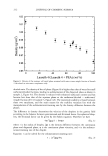
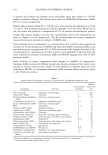
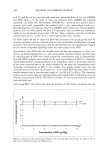
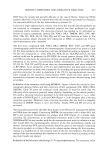
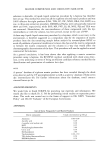
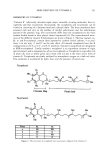
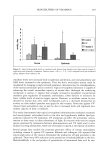
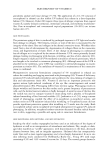
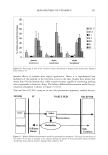
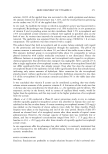
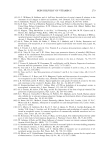
212 JOURNAL OF COSMETIC SCIENCE 1.02 1.01 1.00 0.99 0.98 0.97 0.96 I ' I ' I ' I ' I ' I 0.95 I • I I I I I • I 0 20 40 6o 80 lOO Laureth 4/(Laureth 4 + PEA) (wt %) Figure 6. Density of the isotropic oil liquid phase saturated with water versus weight fraction of laureth 4 calculated on non-water components only. alcohol ratio. The density of the oil phase (Figure 6) is higher than that of water for small surfactant/alcohol fractions, leading to sedimentation of the dispersed phase as shown in sample 2, Figure 4A. The density is reduced with enhanced surfactant content and has become less than that of the aqueous phase at the surfactant/(alcohol + surfactant)/ weight fraction of 0.32 (sample 3, Figure 4A). The maximum stability is found between these two emulsions, and the main reason for the stability variation lies with the manipulation of the sedimentation/creaming rate by the density difference between the phases. The difference in density determines the velocity of the droplets in the gravity field according to the balance between gravitational and frictional forces. For spherical drop- lets, the frictional factor can be given by the Stokes equation. Therefore we have 4q'rr3Apg/3 = 6q'rxlrv (Eq. 1) where r is the radius of droplet, Ap is the density difference between the continuous phase and dispersed phase, x I is the continuous phase viscosity, and v is the sedimen- tation/creaming rate of the droplet. Equation 1 can be solved for the sedimentation/creaming rate: v = 2r2Apg/9xl (Eq. 2)

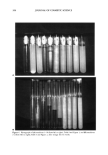
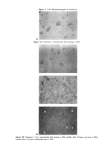
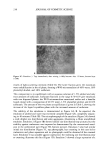
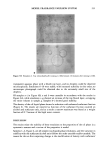
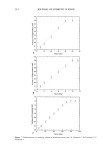
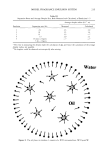
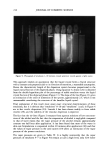
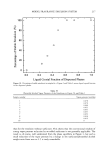
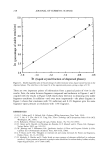
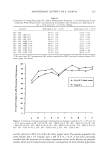
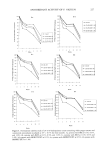
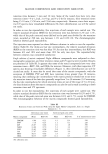
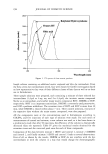
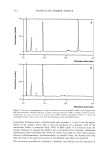
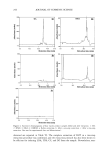
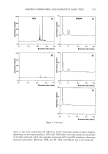
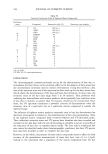
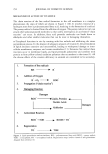
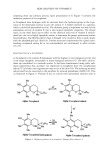
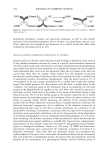
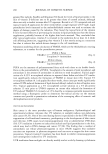
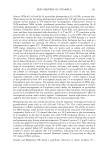
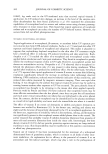
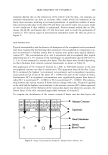
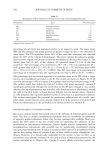
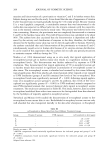
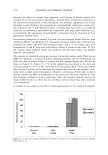
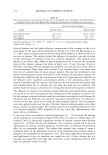
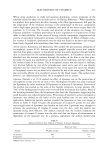
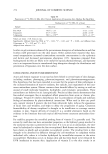
MODEL FRAGRANCE EMULSION SYSTEM 213 The volume of the sedimented part of the emulsion may be estimated from the height of the sediment because the fraction of oil remains constant with the location, as has been shown by Pinfield et al. (20). Hence, a plot of sedimented volume should be linear versus time, as shown in Figure 7A-C. Summarizing equation 2 V = 2•Apg/9qq (Eq. 3) -- the volume sediment is shown to be linear versus time and r 2 may be calculated. Table III shows a good agreement between these droplet sizes and those measured in the photos. The extremely low stability of sample 4 is understood against the colloidal structure of the oil phase (Table III). This emulsion is in fact a "double emulsion" it is a (water-in-oil microemulsion)-in-water system, (W/O l•em)/W (Figure 8). It contains maximum solu- bilized water, i.e., maximum concentration of inverse micelies (or W/O microemulsion droplets), and the exchange of surfactants between the microemulsion droplets and at the O/W (or more precisely W/O microemulsion/water [W/O l•em]/W) interface is facili- tated. Little stability against coalescence may be expected from such an emulsion. The stabilizing action on this emulsion by the liquid crystalline phase is significant, as demonstrated by Figure 4B. The presence of a liquid crystalline phase in samples 5-10 is obvious from the photographs in Figure 9, which was taken against a diffuse light source with the samples placed between crossed polarizers. The birefringence is con- spicous in sample 5 (a thin layer) and in samples 6-8, but weaker in the two last samples. Unfortunately, there is no information about these structures at present. The matter will be resolved in future investigations. Emulsion stabilization by a lameliar liquid crystal is well known (21), but the mecha- nism is not completely understood. It has been referred to as a liquid crystal network influencing the rheology of the continuous phase (22), a discontinuity in the dependence of the Van der Waals attraction forces in the flocculation process (23), the stabilization by vesicles (24,25), and the wedge effect (26). In the present case, the final explanation has to be deferred until information has been obtained about the colloidal structure of emulsions c-h in Figure 4. Figure 10 shows approximately 50% of the total dispersed mass to be liquid crystalline in order to avoid phase separation within a few weeks. It is of some interest that the volume of the creamed emulsion part in Figures 4B and 10 lends itself to a fractal approach. We assume that the emulsion is stable because the liquid crystal focuses on the interconnecting network, iramobilizing the structures. The aqueous space between the connecting liquid crystal particles is characterized as voids, also connecting. Furthermore, assuming that the voids are separated by liquid crystal pathways one has (27,28) Lvoi d oc M 1/dr (Eq. 4) or M o• (Lvoid) df (Eq. 5) in which M is the mass, L is a characteristic length, and df is the fractal dimension.
Purchased for the exclusive use of nofirst nolast (unknown)
From: SCC Media Library & Resource Center (library.scconline.org)