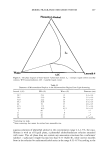
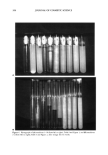
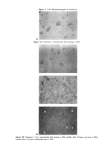
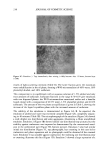
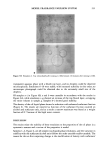
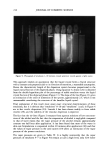
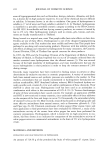
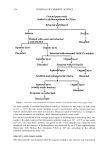
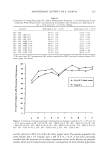
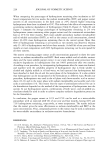
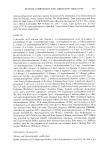
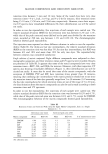
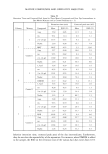
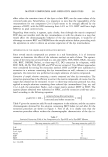
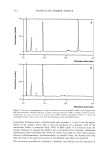
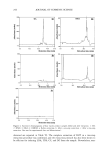
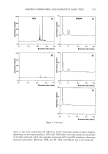
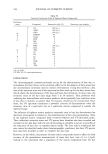
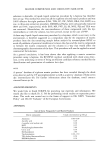
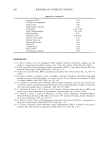
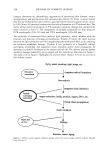
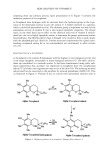
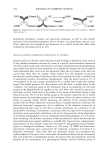
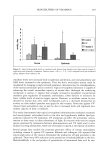
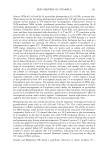
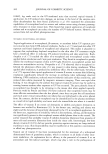
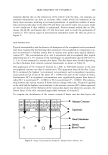
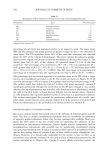
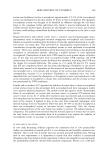
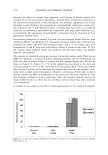
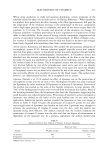
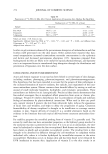
210 JOURNAL OF COSMETIC SCIENCE Figure 5C: Emulsion 3. Top: immediately after mixing (x100) bottom: after 12 hours, bottom layer (x200). results of light-scattering intensity (Table II). The latter fraction gives the maximum water solubilization in the oil phase, forming a W/O microemulsion of 46% water, 16% phenethyl alcohol, and 38% surfactant. This composition is in equilibrium with an aqueous solution of 1.5% alcohol and only trace amounts of surfactant. Surfactant fractions in the range 0.70-0.97 give emulsions with two dispersed phases: the W/O microemulsion mentioned earlier and a lameliar liquid crystal with a composition of 49.3% water, 1.5% phenethyl alcohol, and 49.2% surfactant. The amount of the two phases at equilibrium is given in Table I, showing the increase of the liquid crystalline phase with the increased amount of surfactant. The stability of the emulsions is demonstrated in Figure 4A, B. As expected, the emulsion of alcohol and water was extremely unstable (Figure 4A), completely separat- ing in 40 minutes (Table III). The microphotograph of the emulsion (Figure 5A) showed a wide droplet size distribution and some aggregates, illustrating a dilute unstabilized emulsion. Emulsion 2 (Figure 5B) showed similar size distribution (top picture), but the stability against coalescence was improved as demonstrated by the concentrated emul- sion in the sedimented part (Figure 5B, bottom picture). Emulsion 3 also had similar initial size distribution (Figure 5C, top photograph), but creaming in this case led to coalescence and phase separation and no photograph could be obtained of the creamed layer. Emulsion 4 was unstable against coalescence the widening size distribution prior to creaming illustrates this fact (Figure 5D). Emulsion 5 showed a large separation of a

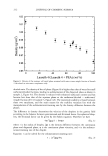
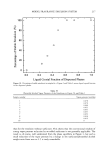
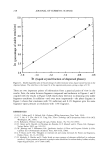
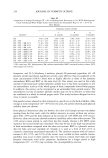
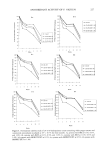
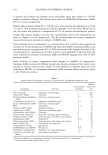
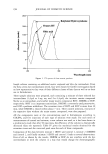
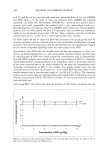
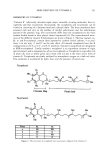
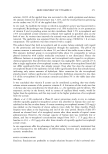
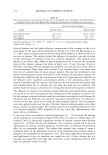
MODEL FRAGRANCE EMULSION SYSTEM 211 D Figure 5D: Emulsion 4. Top: immediately after mixing (x 100) bottom: 10 minutes after mixing (x 100). transparent aqueous phase with a bluish top layer, and no droplets could be observed microscopically. Emulsions 6-10 were stable, with increased turbidity in this order no microscopic photograph could be obtained due to the extremely small size of the droplets. Of samples a-j in Figure 4B, a and b were unstable in accordance with the results in Figure 4A, while emulsions c-g showed an increase of the top bluish layer, occupying the entire volume in sample g. Samples h-j showed good stability. The density of the oil liquid phase showed a reduction with enhanced surfactant fraction (Figure 6). The results are reported as function of the surfactant fraction counted on alcohol and surfactant only, and as a result a narrow maximum was found at a weight fraction of 0.7 because of the high water content. DISCUSSION The results relate the stability of these emulsions to the properties of the oil phase in a systematic manner and a review of the properties is useful. Samples 1-4, Figure 4, are all simple two-(liquid)-phase emulsions, and the variation in stability with the surfactant/alcohol ratio follows the order unstable-stable-unstable. The reason for this at-first surprising change is the modification of density with surfactant/
Purchased for the exclusive use of nofirst nolast (unknown)
From: SCC Media Library & Resource Center (library.scconline.org)