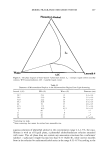
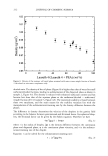
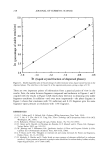
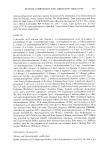
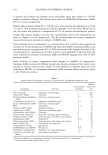
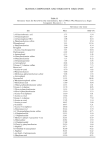
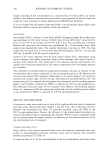
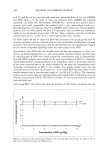
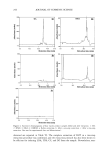
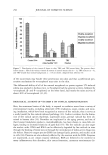
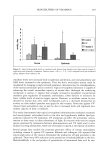
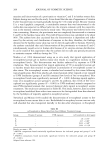
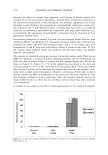
218 JOURNAL OF COSMETIC SCIENCE 5.0 4.0 3.,5 3.1:) 2.õ 2.0 ' I ' I ' ' I ' I ' -1.4 -1.2 -1.0 -0.8 In (liquid crystal fraction of dispersed phases) -0.6 Figure 11. Double-logarithm plot of the percentage of stable emulsion versus liquid crystal fraction in the dispersed phases. The solid line is the linear fit of the experimental points, giving a slope of 2.50. There are two important points of information from a practical point of view in the results. First, the ratios between fragrance compound and surfactant in Figures 1 and 2 coupled with the results in Figure 4A,B clearly show the limit to obtaining very stable fragrance emulsions. In addition--and even more importantly--the phase diagram in Figure 3 shows that emulsions with 5% surfactant and 0.1% fragrance give the same fragrance vapor pressure as emulsions with 1.5 % fragrance. REFERENCES (1) R. C. Colkin and J. S. Jellinek, Eds., Perfumery (Wiley-Interscience, New York, 1994). (2) C.T. Ho, S. T. Tan, and C. H. Tong, Eds., Flavor Technology (ACS Symposium Series 610) (ACS, Washington, DC, 1995). (3) K. Ballantyne, Perfume through the ages, Parfum. Kosmet., 76, 716-718 (1995). (4) H. Altner and J. Boeckh, in Physio/ogie des Menschen, R. F. Schmidt and G. Thews, Eds. (Springer- Verlag, Berlin, 1987), pp. 320-352. (5) W. Jennings and T. Shibamoto, Eds., Qualitative Analysis of Flavor and Fragrance Vo/atiles by G/ass Capillary Gas Chrimotography (Academic Press, New York, 1980). (6) J.P. Rozat and F. Nit, Thoughts on essential oils and aroma chemicals for flavors and fragrances, Perfum. Flavor., 21, 13-19 (1996). (7) R. Akaboski, S. Horike, and S. Noda, Study on vapor pressure of odorants solubilized in surfactant micelies. I. Vapor pressure ofgeraniol or geranyl acetate solubilized in sodium dodecyl sulfate micelies, Nippon Kagak• Kaishi, 1974-1980 (1984).

MODEL FRAGRANCE EMULSION SYSTEM 219 (8) (9) (10) (11) (12) (13) (14) (15) (16) (17) (18) (19) (20) (21) (22) (23) (24) (25) (26) (27) (28) (29) (30) R. Akaboski, S. Horike, and S. Noda, Study on vapor pressure of odorants solubilized in surfactant micelies. III. Vapor components of geraniol-geranyl acetate binary solution solubilized in sodium dodecyl sulfate micelies, Nippon Kagaku Kaishi, 943-948 (1985). H. Uchiyama, Sh. D. Christian, J. F. Scamehorn, M. Abe, and K. Ogino, Solubilization of 2 phenyl- ethanol by dodecyldimethylamine oxide in aqueous solution, Langvmir, 7, 95-100 (1991). M. Abe, K. Mizuguchi, Y. Kondo, K. Ogino, H. Uchiyama, J. F. Scamehorn, E. E. Tucker, and S. D. Christian, Solubilization of perfume compounds by pure mixtures of surfactants, J. Colloid. Interface Sci., 160, 16-23 (1993). S. E. Friberg, S. A. Vona, Jr., Fragrance microemulsions, triethylcitrate, water, sodium dodecylsulfate and pentanol, Soap, Cosmet., Chem. Spec., 32-40 (August 1994). H. Suhaimi, L. C. Rose, and F. B. H. Ahmad, A natural flavour in an amphiphilic association structure, PertainikaJ. Sci. Tech., 3, 141-149 (1995). M. Juszynski, R. Azoury, and R. Rafaeloff, Fragrance loaded lyophilized liposomes, S(SFW, 118, 811-815 (1992). Y. Tokuoka, H. Uchiyama, M. Abe, and Sh. D. Christian, Solubilization of some synthetic perfumes by anionic-nonionic mixed surfactant systems, Langmuir, 11,725-729 (1995). S. Horike and R. Akahoshi, Solubilization mechanism of cis-3-hexenol and menthyl acetate into sodium dodecyl sulfate micelies, and the vapor pressure of these odorants, Nippon Kagaku Kaishi, 12, 1033-1037 (1996). Y. Tokuoka, H. Uchiyama, and M. Abe, Solubilization of some synthetic perfumes by ionic and nonionic surfactants, Nihon Yukagakkaishi, 45, 13-19 (1996). J. Yang, G. Rong, S. E. Friberg, and P. A. Aikens, The phase behavior of polyoxethylene 10 stearyl ether/geraniol/olive oil/H20 system and preliminary evaluation of fragrance evaporation, Int. J. Cosmet. Sci., 18, 43-56 (1996). S. E. Friberg, Vapour pressure of some fragrance ingredients in emulsion and microemulsion formu- lations, Int. J. Cosmet. Sci., 19, 75-86 (1997). S. E. Friberg, T. Huang, L. Fei, S. A. Vona, Jr., and P. A. Aikens, Vapor pressure of phenethyl alcohol in the system with water, and polyoxyethylene, 4, laury! ether (Brij©30), Progr. Colloid. Polym. Sci., 101, 18-22 (1996). V. J. Pinfield, E. Dickinson, and M. J. W. Povey, Modeling of concentration profiles and ultrasound velocity profiles in a creaming emulsion: Importance of scattering effect,J. Colloid. interface Sci., 166, 363-374 (1994). T. Ebisama and Y. Teshima, Low-alcohol perfume compositions containing lower glycols and/or lower alcohols, Eur. Pat. AppL EP 687,460 (December 20, 1995). B. W. Barry, Rheology of emulsion stabilized by sodium dodecyl sulfate/long-chain alcohols,J. Colloid. interface Sci., 32, 551-560 (1970). S. E. Friberg, I. Kayall, A. J. I. Ward, T. Suhery, F. A. Sireion, and L. D. Rhein, Interaction of retinoic acid with a model of stratum corneum lipids, JDCES, 2, 7-18 (1991). K. Westesen and T. Wehler, Physicochemical characterization of a model intravenous oil-in-water emulsion, J. Pharm. Sci., 81,777-786 (1992). J. T. Simmonet, Lipid vesicles: Technology and advances, Cosmet. Toiletr., 109, 45-52 (1994). A. Kabalnov and H. WennerstriSm, Macroemulsion stability: The oriented wedge theory revisited, Langmuir, 12, 276-292 (1996). A. Bunde and S. Havlin, Eds., Fractals and Disordered Systems (Springer-Verlag, New York, Berlin, Heidelberg, 1991). B. H. Kaye, Ed., A Random Walk Through Fractal Dimensions (VCH Publishers, New York, 1989). S. Campbell, H. Yang, R. Patel, S. E. Friberg, and P. A. Aikens, Kinetics of vesicle formation, Colloids Polymer Sci., 275, 303-306 (1997). T. Huang, MicroemMsions, Emulsions and Liquid Crystals--implication in Cosmetics and Fragrances, PhD dissertation, Clarkson University, Potsdam, NY, 1995.
Purchased for the exclusive use of nofirst nolast (unknown)
From: SCC Media Library & Resource Center (library.scconline.org)